
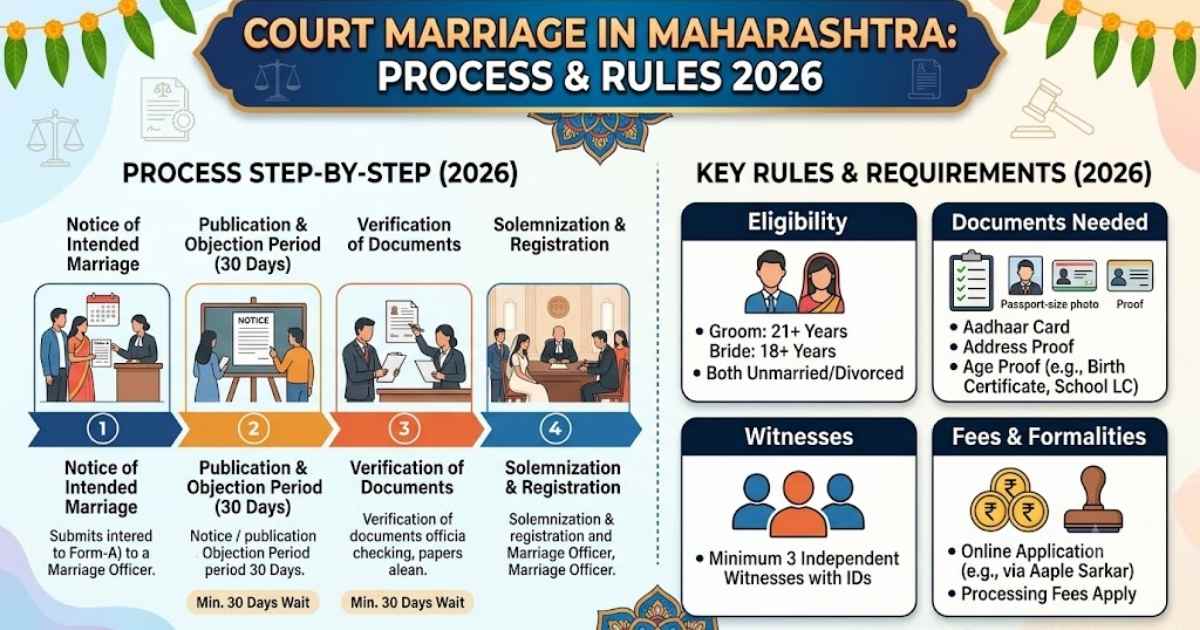

Getting married through the court system used to feel like wading through paperwork with no end in sight. That’s changed. In 2026, court marriage in Maharashtra runs through a digital-first system that’s faster, clearer, and a lot less stressful than it used to be. This guide walks you through every step, so you know exactly what to expect before you even open the portal.
Marriage Compliance Dashboard
| Metric | Detail |
| 📅 Notice Period | 30 Days |
| 👥 Witnesses Required | 3 |
| 💻 Digital Portal | IGR Maharashtra |
| 💰 Govt Fee (Avg) | ₹1,000 |
What is Court Marriage? The 1954 Legacy
Court marriage in India draws its authority from the Special Marriage Act, 1954, and it works differently from a typical religious wedding. Instead of pheras, a nikah, or a church ceremony, a Marriage Officer usually the Sub-Registrar solemnizes the union directly. There’s no need for either party to convert their faith or follow the other’s customs, which is exactly why so many couples choose this route.
This matters most for interfaith marriage in Maharashtra and inter-caste couples who want a legally sound wedding without navigating two different religious frameworks. It’s also popular with couples who simply prefer a secular ceremony over a traditional one. Once solemnized under this Act, the marriage carries the same legal weight as any religious marriage, and it’s recognized across India without any additional formality. This is precisely why court marriage in Maharashtra has grown so popular among couples who want a paperwork-light path to a legally binding union.
RElated POST: 34 IPC in BNS: Section 3(5) Mapping, Common Intention & Liability
Eligibility: Age, Status & Residence Rules
Before you start the process, you need to check four basic conditions. First, the groom must be at least 21 years old and the bride at least 18, with self-attested age proof required at filing. Second, at least one partner needs to have lived in the jurisdiction of the Sub-Registrar Office (SRO) for a minimum of 30 days before the notice is filed. Third, both parties must have the mental capacity to give informed, voluntary consent.
There’s a fourth condition that trips people up more than you’d think: neither party can have a living spouse at the time of marriage. Bigamy isn’t just frowned upon here it’s a criminal offence under Indian law, and the Marriage Officer will check for this during verification. If you meet all four conditions, you’re clear to begin the notice process, and honestly, most couples applying for court marriage in Maharashtra do meet them without any trouble.
The 30-Day Notice: The Statutory Waiting Period
Section 5 of the Special Marriage Act requires every couple to file a Notice of Intended Marriage before anything else happens. Once you submit it, the Marriage Officer displays the notice publicly at the SRO. This isn’t a formality for its own sake it gives anyone with a legal objection, say, evidence of an existing marriage or a prohibited relationship, a chance to raise it under Section 7.
You can’t skip or shorten this 30-day notice for court marriage, no matter how urgent your situation feels. If no objection comes in during that window, you’re free to solemnize the marriage any time within the next 90 days. Plan around this timeline early, because rushing the process rarely works out and honestly, most couples find the wait manageable once they understand why it exists.
Online Registration: The IGR Maharashtra Guide
The IGR Maharashtra Portal has genuinely simplified what used to be a paperwork-heavy ordeal for anyone pursuing court marriage in Maharashtra. You start on igrmaharashtra.gov.in, choose the marriage option under Public Data Entry, and enter both partners’ details. From there, you select the SRO where one of you resides, since that determines jurisdiction for the entire process.
Next comes document upload Aadhaar Card, passport or birth certificate, and recent photographs. You’ll pay a notice fee, usually around ₹100, through the Government Receipt Accounting System (GRAS), which is fully integrated into the portal. The final step is a short biometric visit to the SRO, where you provide thumbprints and digital photos. That visit is what officially starts your 30-day notice for court marriage clock, so don’t delay it once your online submission is confirmed.
Online memorandum of marriage submission in Maharashtra
Completing court marriage in Maharashtra doesn’t end at solemnization; if you’re registering under the Maharashtra Regulation of Marriage Bureaus and Registration of Marriages Act, 1998, or through the Special Marriage Act, the Memorandum of Marriage is your key document. It’s essentially the official application for your marriage certificate, and it’s filed digitally through the same IGR Maharashtra portal you used for the notice. Under Public Data Entry, you’ll select Marriage Registration and fill in personal particulars names, dates of birth, religion, occupation, and residential address for both parties.
You’ll also need to upload age proof, like a birth certificate or school leaving certificate, along with address proof such as an Aadhaar card, electricity bill, or passport. Once the details for all three witnesses are entered, the system calculates applicable fees and stamp duty, payable through GRAS. After payment, you get a unique application number and a downloadable Memorandum of Marriage, known as Form D, complete with a barcode for tracking. Print this and bring it, along with your originals, to the SRO for biometric authentication.
The Witness Matrix: Roles & Requirements
You’ll need three adult witnesses present when you sign the marriage register, and here’s something that surprises a lot of couples: they don’t have to be family. Anyone above 18, holding a valid Aadhaar card, and personally known to you qualifies. Friends, colleagues, even a trusted neighbor all of them work just as well as relatives.
What matters is that your witnesses can genuinely attest that they know you and that your marriage is happening with full, mutual consent. Because of this, it’s worth choosing people who are comfortable attending an official interview and signing legal paperwork. Witness requirements for court marriage in Maharashtra exist to protect both partners, not to create red tape, so treat this step as a safeguard rather than a hurdle.
Witness eligibility and Sub-Registrar interview requirements
Section 11 of the Special Marriage Act makes the physical presence of three adult witnesses mandatory at the time of marriage. Each witness must be at least 18, of sound mind, and carry valid ID with address proof Aadhaar is the preferred document here. Contrary to a common misconception, witnesses don’t need any family relationship with the couple at all.
At the SRO, both the couple and their witnesses go through a formal interview with the Sub-Registrar. This isn’t an interrogation into your personal choices; it’s a statutory check to confirm identity, consent, and eligibility, backed by biometric verification through thumbprint and facial photo capture. The Sub-Registrar confirms the marriage is voluntary, free of coercion, and doesn’t fall within a prohibited degree of relationship. If anything seems off, the officer can pause registration and investigate further, so it genuinely pays to have your witnesses well-prepared and their documents in order.
The ‘Objection’ Phase: Handling Section 7 Caveats
Once your notice is public, anyone can raise an objection during the 30-day window, and the Marriage Officer has 30 days from that objection to investigate it. Not every objection carries weight, though. If someone objects on personal or social grounds disapproval of caste or community, for instance the officer dismisses it and lets the marriage proceed.
Legally valid objections are a different story. If there’s evidence of an existing marriage or a prohibited relationship, the process stops until it’s resolved. Courts overseeing court marriage in Maharashtra in 2026 have been clear on one point: Marriage Officers aren’t gatekeepers for personal disapproval. They can only halt a marriage when a specific legal bar under the Act actually applies, which protects couples from arbitrary delays.
Tatkal Marriage: Clarifying the Urgent Myths
A lot of couples ask about a “24-hour marriage,” assuming there’s some emergency court option that skips the notice period entirely. There isn’t at least not under the Special Marriage Act. The so-called Tatkal marriage is a religious ceremony option, arranged privately through a temple, mosque, or similar venue, and it has nothing to do with civil marriage registration.
If you need your union to be legally recognized quickly, the fastest path is still filing your notice the moment you’re eligible and completing your biometric visit without delay. Trying to shortcut court marriage in Maharashtra through informal channels can leave you with a ceremony that isn’t legally valid, which defeats the entire purpose of choosing this process. When in doubt, always confirm timelines directly with your SRO rather than relying on rumors.
Evidence Checklist: Your Marriage Dossier
Before you head to the SRO, it helps to have every document organized in one folder rather than scrambling at the counter. You’ll need age proof (birth certificate, passport, or school leaving certificate), address proof (Aadhaar card, utility bill, or passport), passport-sized photographs, and identity documents for all three witnesses. If either partner was previously married, a divorce decree or death certificate of the former spouse is also required.
Missing documents are the single biggest reason applications get delayed, so double-check everything against the SRO’s published list before your appointment. It’s worth keeping both physical copies and scanned digital copies handy, since the portal and the in-person visit both need them. A little preparation here saves you an extra trip and keeps your 30-day clock running smoothly.
The Maharashtra Marriage Roadmap
Portal PDE
Everything begins with Public Data Entry on the IGR Maharashtra portal, where you enter both partners’ personal details, choose your SRO, and upload your initial documents.
Verification Visit
Next comes your biometric appointment at the SRO, where thumbprints and photographs are captured to officially trigger your notice period.
Notice Period
The mandatory 30-day window runs next, during which your notice is publicly displayed and open to objection under Section 7.
Solemnization
Once the notice period closes without a valid objection, you and your witnesses return to the SRO to sign the register and complete the marriage within the following 90 days.
Global Validity: Passports, Visas & Beyond
One reason so many couples specifically choose court marriage in Maharashtra is international recognition. A marriage certificate issued under the Special Marriage Act is accepted for spousal visa applications, name changes on passports, and joint bank accounts abroad, without the added step of getting a religious certificate attested. Embassies and consulates generally treat it as a straightforward civil document.
This becomes especially useful for couples completing court marriage in Maharashtra when one partner is planning to move abroad for work or study soon after the wedding. Because the certificate is digitally archived in Maharashtra’s central registry, duplicate copies and verification requests are quick to process even years later. If international travel or immigration is part of your plans, keep a few certified copies of your certificate on hand, since different authorities may ask for originals at different times.
हिन्दी में स्पष्टीकरण: महाराष्ट्र में कोर्ट मैरिज (विशेष विवाह अधिनियम) की प्रक्रिया
महाराष्ट्र में कोर्ट मैरिज विशेष विवाह अधिनियम, 1954 के तहत होती है, और यह किसी भी धार्मिक रीति-रिवाज से अलग एक कानूनी प्रक्रिया है। जोड़े को सबसे पहले IGR महाराष्ट्र पोर्टल पर विवाह की सूचना (नोटिस) दाखिल करनी होती है, जिसके बाद 30 दिनों की अनिवार्य प्रतीक्षा अवधि शुरू होती है। इस दौरान कोई भी व्यक्ति वैध आपत्ति दर्ज करा सकता है, लेकिन बिना ठोस कानूनी आधार के आपत्ति खारिज कर दी जाती है।
नोटिस अवधि पूरी होने के बाद, जोड़े को तीन गवाहों के साथ सब-रजिस्ट्रार कार्यालय जाना होता है, जहाँ बायोमेट्रिक सत्यापन और दस्तावेज़ों की जांच होती है। सभी औपचारिकताएँ पूरी होने पर विवाह प्रमाणपत्र जारी किया जाता है, जो पूरे भारत में और अंतरराष्ट्रीय स्तर पर भी मान्य होता है। यह प्रक्रिया अंतरजातीय और अंतरधार्मिक जोड़ों के लिए विशेष रूप से उपयोगी मानी जाती है।
Conclusion
Court marriage in Maharashtra has come a long way from paper files and long queues, and the 2026 process reflects that shift clearly. Between the IGR portal, digital biometric verification, and a clear 30-day notice structure, the entire process is now predictable enough that couples can plan around it with confidence. Whether you’re dealing with an interfaith union, an inter-caste marriage, or simply prefer a civil ceremony, the Special Marriage Act framework gives you a legally solid foundation.
The key to a smooth experience really comes down to preparation: get your documents in order, line up your three witnesses early, and respect the statutory timelines rather than trying to rush them. Do that, and you’ll find the 2026 process is about as painless as government paperwork gets.
