
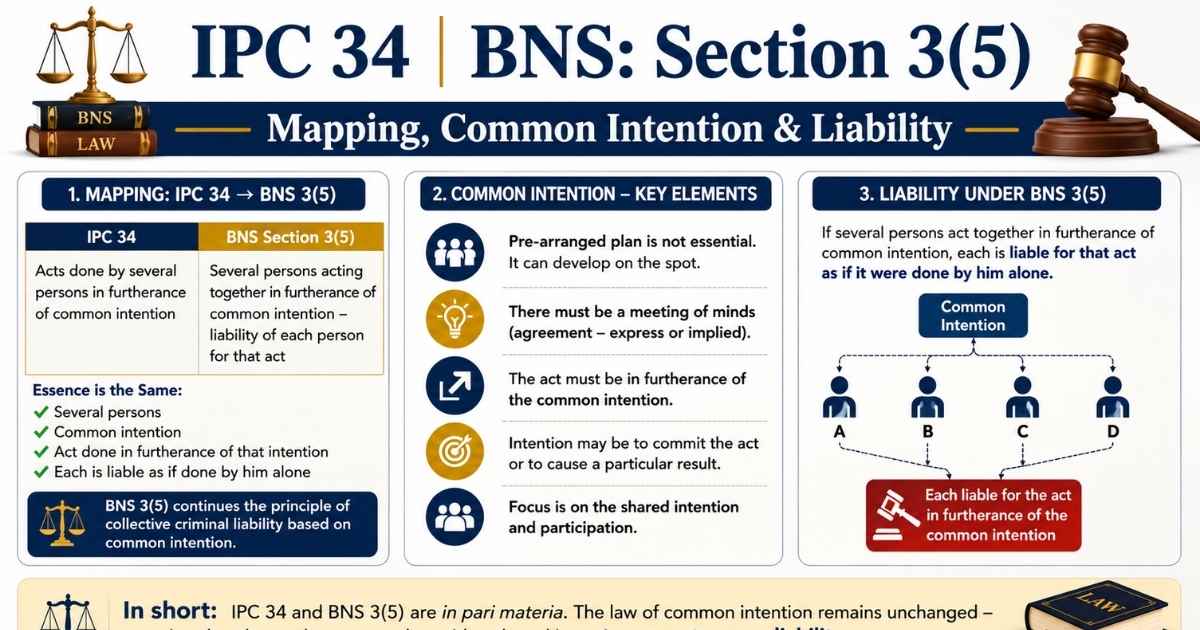

34 IPC in BNS is one of the most searched legal terms in India today. Many advocates and law students want to know the exact match for 34 IPC in BNS. The old Indian Penal Code has been replaced. So every section needs a new number. 34 IPC in BNS now falls under Section 3(5). This section deals with common intention. It holds every person in a group equally liable. The law treats them as if each person did the act alone.
Understanding 34 IPC in BNS is important for every practicing lawyer. It helps in bail arguments. It helps in framing of charges. It also helps during trial. This guide explains 34 IPC in BNS in simple terms. It covers common intention, joint liability, and courtroom strategy. Every point is written for real practice in 2026.
Legal Excellence
Section 34 IPC was one of the most frequently invoked and most frequently misused provisions in Indian criminal law. It didn’t create a new offence; it created a rule of evidence that let courts treat every participant in a group crime as equally liable, “as if” each had committed the entire act alone. That principle has survived the 2023 recodification intact. Under the BNS, it now lives as Section 3(5), tucked inside Section 3’s “General Explanations” rather than standing alone a structural change that matters more than it first appears.
Related post: 354 IPC in BNS: Section 74 Mapping, Modesty Offences & Bail
Section 3(5) BNS: Common Intention Standard
Section 3(5) of the BNS states that when a criminal act is done by several persons in furtherance of the common intention of all, each of them is liable for that act in the same manner as if it were done by him alone. It is, word for word, the same operative text as old Section 34 no substantive change, only a new address.
Three ingredients have to be established before Section 3(5) can be invoked:
- A criminal act committed by two or more persons the act itself must exist and be attributable to a group, not one individual acting alone.
- A shared common intention a meeting of minds, whether formed well in advance or moments before the act.
- Participation in furtherance of that intention each accused must have played some active role connected to the shared plan, not merely stood by.
| Element | IPC Section 34 | BNS Section 3(5) | Practitioner Note |
| Nature | Rule of joint liability | Rule of joint liability | Not a standalone offence |
| Scope | Two or more persons | Two or more persons | Applies across all chapters |
| Core test | Common intention | Common intention | Requires prior meeting of minds or its rapid formation |
| Sentence | Same as substantive offence | Same as substantive offence | No separate punishment prescribed |
| Statutory home | Standalone section | Sub-section within Section 3 | Reflects consolidation of general provisions |
A key point courts have repeatedly made: Section 3(5) is always read with a substantive offence Section 103 for murder, Section 109 for attempt, Section 318 for cheating, and so on. Drop the common-intention link, and the accused falls back on liability for only their own individual act, which may amount to a lesser offence such as simple hurt under Section 115 BNS.
Key Changes from IPC 34
The wording hasn’t changed. What has changed is where the provision sits, how it’s argued, and how “common intention” gets proved in 2026’s evidence environment.
Three Major Practitioner Shifts:
- Structural repositioning. IPC Section 34 stood as its own section. BNS Section 3(5) is now a sub-clause of Section 3, the chapter of general definitions. This reframes it as a universal liability principle applicable across the entire code make sure charge sheets and pleadings cite it correctly as “Section 3(5) BNS,” not the old numbering.
- Digital evidence standard. Establishing a “meeting of minds” increasingly relies on WhatsApp or Telegram logs, GPS co-location data, and call records. Under Section 63 of the Bharatiya Sakshya Adhiniyam (BSA), any electronic record used to prove such planning requires a proper certification without it, the material risks being treated as unreliable coincidence rather than proof of conspiracy.
- Mandatory videography of seizure. Where the prosecution’s theory involves a physical meeting accused persons gathering to plan an offence Section 105 of the BNSS makes videographed seizure and search procedure the norm, giving the defense a concrete procedural checkpoint to test.
None of this changes the underlying jurisprudence. Every landmark judgment built under Section 34 IPC, from Barendra Kumar Ghosh to Pandurang v. State of Hyderabad, continues to apply with full force under Section 3(5) BNS.
Procedure and Joint Liability
A Section 3(5) case typically moves through five stages, each with its own tactical opportunities.
FIR & Role Assignment
The FIR names multiple accused, and under Section 173 BNSS, the informant is expected to at least broadly indicate the common intention or shared object alleged. Vague or boilerplate references to “common intention” without any factual basis are an early red flag worth flagging in bail submissions.
Digital Fingerprint Seizure
Investigators seize phones and devices to look for prior communication establishing the plan. This seizure must follow the videography requirements under Section 105 BNSS any lapse here can be raised later to question the chain of custody.
Arrest & Joint Police Custody
Police often seek police custody (PC) for all co-accused together, aiming to establish the “inter-relationship” between them. This is one of the most commonly overreached steps in group-crime investigations.
Bail Application
Counsel typically files bail under Sections 480/483 BNSS, arguing that the common intention is unproven and that the client’s role, if any, was incidental or entirely separate from the alleged plan.
Framing of Charges
The court frames charges with the Section 3(5) BNS prefix attached to the substantive offence. This is the critical stage to argue for discharge if no credible “bridge evidence” connects a particular accused to the act.
Breaking the ‘Prior Meeting of Minds’ Link
The entire contest in a Section 3(5) trial usually comes down to one question: was there a pre-arranged plan, or did people simply act together in the heat of the moment?
- The “sudden quarrel” defense. Courts have consistently held that common intention can form even seconds before the act but where a fight erupts spontaneously and several people strike out independently, Section 3(5) may not apply at all. Each person then answers only for the specific injury they caused.
- Common intention vs. common object. Section 3(5) demands a shared plan among the accused; Section 190 BNS (the old Section 149, unlawful assembly) only requires membership in a group sharing a common object, which is a lower threshold. Distinguishing between the two can significantly reduce liability in group-scuffle cases.
- Digital alibi evidence. Location history and cellular data, admissible under Section 61 of the BSA, can help demonstrate that a client was nowhere near the location where the alleged planning took place.
- Mere presence is not enough. Supreme Court precedent, including Girish Akbarasab Sanavale v. State of Karnataka, has repeatedly held that passive presence at a crime scene, without active participation in furtherance of the plan, does not by itself attract Section 3(5) liability.
Critical Pitfalls for Practitioners
Common errors that weaken a Section 3(5) case on either side of the table:
- Citing “Section 34 IPC” in 2026 pleadings. Always use Section 3(5) BNS for offences registered after the transition; mixing old and new numbering can cause procedural confusion and delay.
- Ignoring the pre-planning requirement. If the prosecution cannot show how and when the common intention was formed, the section should be dropped at the charge-framing stage.
- Seeking custody for every co-accused. Section 3(5) does not automatically justify police custody for every named person Section 187 BNSS can be used to resist unnecessary detention of peripheral accused.
- Failing to challenge digital evidence. Chat logs or call data lacking the mandatory Section 63 BSA certificate are inadmissible and should be objected to at the earliest opportunity.
- Using outdated trial templates. Ensure document supply follows Section 230 BNSS and trial commencement follows Section 248 BNSS, rather than the older Cr.P.C. framework.
Trial and Evidence Strategy
- Motion for discharge. At the charge-framing stage, move for discharge under Section 250 BNSS where the chain connecting a specific accused to the common intention is missing or weak.
- Cross-examine on motive. If the motive appears individual a personal dispute or separate grievance it becomes harder for the prosecution to establish a genuinely shared intention.
- Anticipatory bail as a priority. Since Section 3(5) is frequently used to implicate entire families or friend groups, anticipatory bail applications should be filed promptly once any co-accused is arrested.
- Compromise and quashing. In bailable, low-gravity offences involving common intention (such as simple hurt cases), Section 528 BNSS allows for High Court quashing once parties reach a genuine settlement.
FAQ’s
What is 34 IPC called in BNS?
Section 34 of the IPC now corresponds to Section 3(5) of the Bharatiya Nyaya Sanhita, 2023, with identical wording.
Is Section 3(5) BNS a separate offence?
No. It is a rule of joint liability that must always be read with a substantive offence section, such as murder or cheating.
Can common intention form suddenly, without prior planning?
Yes. Courts have held that common intention can develop moments before an act; it does not always require advance planning.
What is the difference between common intention and common object?
Common intention (Section 3(5)) requires a shared plan among the accused, while common object (Section 190 BNS) applies to members of an unlawful assembly and requires a lower threshold of proof.
Does mere presence at the scene attract liability under Section 3(5)?
No. Courts require active participation in furtherance of the common intention; passive presence alone is not sufficient.
Conclusion
34 IPC in BNS is now clear for every practicing lawyer. 34 IPC in BNS means Section 3(5) of the new code. The wording has not changed. Only the number has changed. This makes 34 IPC in BNS easy to learn once you know the mapping.
34 IPC in BNS still needs common intention. It still needs joint action. It still needs a shared plan. Lawyers must use 34 IPC in BNS correctly in every case. Bail, charges, and trial all depend on this section. Learning 34 IPC in BNS well helps every advocate win real cases.
