

If you filed a cheating complaint before July 2024 and you’re revisiting it now, the numbers on your paperwork probably don’t match what the courts expect anymore. The IPC 420 in BNS section shift moved this offence to Section 318(4) of the Bharatiya Nyaya Sanhita, and while the punishment stayed largely the same, the surrounding procedure didn’t.
For advocates, clients, and anyone drafting a fresh FIR, understanding this conversion isn’t optional anymore it’s the difference between a complaint that gets registered smoothly and one that bounces back for correction. This guide breaks down exactly what changed and what didn’t.
Legal Excellence
If you’re still citing Section 420 IPC in a fresh complaint, you might be setting your client up for a delay you didn’t see coming. The IPC 420 in BNS section shift isn’t just a renumbering exercise it changes how you draft, how you argue bail, and how a magistrate reads your papers. This guide walks you through the mapping, the punishment comparison, the bailability question, the related sections advocates keep asking about, and the exact steps for filing a fresh complaint under the new code.
420 IPC New Section: What is the BNS Equivalent?
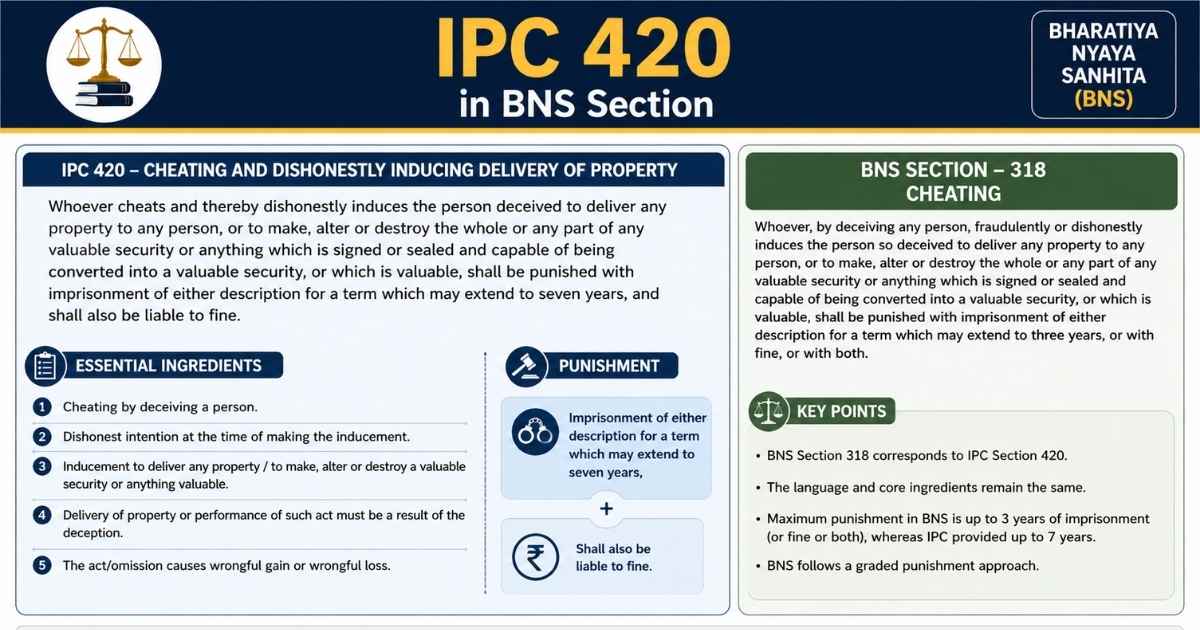
Every practicing advocate has run into this question at least once since July 2024: what is the section 420 IPC replaced by which section in the new code? The answer is Section 318(4) of the Bharatiya Nyaya Sanhita, and it covers the same ground cheating and dishonestly inducing delivery of property. The IPC 420 to BNS conversion keeps the core wording nearly identical, so the case law you’ve relied on for years still applies without much friction.
That said, don’t assume the IPC 420 in BNS section move is a simple copy-paste job. The Bharatiya Nyaya Sanhita 2023 groups cheating differently within its chapter on property offences, and Section 318 itself has multiple sub-clauses. Sub-section (4) is the one that mirrors old Section 420, but sub-sections (1) through (3) deal with lesser forms of cheating carrying shorter sentences. Get the sub-section wrong in your complaint, and you’ll either undercharge a serious fraud or overcharge a minor dispute both cost you credibility in front of the bench.
Related Post: Section 115 2 BNS Hurt Bailable Or Not: 2026 Guide
318(4) BNS in IPC – Complete Section Mapping
Lawyers often ask for a BNS equivalent of IPC 420 cheat sheet they can pin above their desk, and honestly, that’s not a bad idea. Section 318(4) BNS retains the exact punishment ceiling, the same cognizable and non-bailable classification, and the identical compounding rules that governed old Section 420. What’s changed is largely structural where the section sits in the code and which allied provisions it now references.
Getting a clear picture of the IPC 420 in BNS section mapping matters most here, since a mismatched sub-section can undermine an otherwise solid complaint. The forgery sections that used to ride alongside Section 420 old Sections 467, 468, and 471 now map to Sections 336, 338, and 340 of the BNS. If you’re drafting a complaint involving forged documents used to induce a fraudulent transaction, you’ll need to cite these together. Missing the allied sections is one of the most common oversights advocates make when they convert an old draft template into a BNS-compliant one, and it can weaken an otherwise solid cheating offence under BNS filing.
Section 420 IPC Punishment vs Section 318(4) BNS Punishment
Here’s the good news for anyone tracking the IPC 420 in BNS section changes and worried the recodification softened penalties: it didn’t. Section 318(4) BNS punishment carries the same maximum of seven years’ imprisonment along with a fine, exactly matching what Section 420 IPC prescribed. This continuity matters because it keeps jurisdiction with the Magistrate of the First Class, so you’re not scrambling to figure out which court has authority over your matter.
What’s worth noting is the emphasis shift in prosecutorial strategy rather than the punishment itself. Because the quantum stayed the same, judges and prosecutors are leaning harder on proving fraudulent intention from inception the idea that the accused meant to deceive from day one, not that a legitimate deal simply soured later. For defense counsel, this is actually your strongest lever. If you can show the dispute is a criminal breach of trust vs cheating question rather than clear-cut deception at the outset, you have real room to argue for quashing or bail.
Is Section 318(4) BNS Bailable or Not?
Straight answer, and one of the most searched questions around the IPC 420 in BNS section topic: no, it isn’t bailable in the ordinary sense. Section 318(4) BNS remains a cognizable and non-bailable offence, just like its predecessor. That means police can arrest without a warrant, and you can’t walk into a police station expecting bail as a matter of right you’ll need to approach the court.
That doesn’t mean your client is stuck, though. Anticipatory bail under BNSS is very much alive and well, and it’s often the first move for anyone anticipating arrest under this section. A well-drafted application, backed by an argument that the Investigating Officer skipped the mandatory notice requirement under Section 35 BNSS (the old Section 41A CrPC), tends to get a sympathetic hearing, especially when the underlying dispute looks more commercial than criminal. Sessions Courts in several states have shown a willingness to grant interim protection quickly once this argument is raised properly.
Related IPC Sections in BNS
Cheating cases rarely travel alone they usually show up with a cluster of related charges, and clients (and junior associates) constantly ask how each one fits into the broader IPC 420 in BNS section picture. Below is a quick reference for the sections that most often accompany a cheating charge, so you’re not hunting through the bare act mid-hearing.
406 IPC in BNS – Equivalent Section Explained
Old Section 406, criminal breach of trust, now sits at Section 316 of the BNS. It’s frequently confused with cheating, but the distinction matters a lot for your defense strategy breach of trust involves property entrusted to someone who then misappropriates it, while cheating requires deception from the very start of the transaction. Getting this distinction right early can determine whether your client faces one charge or two.
467 IPC in BNS – Equivalent Section Explained
Forgery of a valuable security, will, or authority to adopt, previously under Section 467 IPC, now falls under Section 338 of the BNS. This section frequently accompanies cheating charges when forged documents were used to induce delivery of property, so expect to see it charged alongside Section 318(4) in most fraud matters involving fabricated paperwork.
465 IPC in BNS – Equivalent Section Explained
Basic forgery, once Section 465 IPC, now corresponds to Section 336 of the BNS. It’s the baseline forgery provision and typically gets cited when a document has been fabricated but doesn’t rise to the level of a valuable security or will, which keeps it distinct from the more serious Section 338.
120B IPC in BNS – Equivalent Section Explained
Criminal conspiracy, formerly Section 120B IPC, is now covered under Section 61 of the BNS. Prosecutors reach for this section whenever more than one accused is involved in orchestrating a fraud, and it’s worth checking carefully whether the evidence actually shows a meeting of minds, since conspiracy charges are sometimes added loosely to strengthen a weak standalone cheating case.
How to File a Complaint Under Section 318(4) BNS
Filing a fresh complaint under the IPC 420 in BNS section today looks different from filing one in 2023, mainly because of the procedural layer added by the BNSS. FIR under Section 318 BNS filings now go through a structured pathway that gives both complainants and the police clearer timelines to follow, which is a genuine improvement if you know how to use it. The steps below reflect what actually works in practice, not just what’s written in the bare act.
Following this sequence carefully protects your client whether you’re pushing for registration of an FIR or preparing to contest one. Each stage has its own documentation requirements, and skipping ahead say, jumping straight to a magistrate’s application without exhausting the SP escalation can get your petition thrown out on a technicality.
Drafting the Initial Complaint
Address your complaint to the Station House Officer and lay out, in plain terms under the IPC 420 in BNS section framework, how the deceptive intent existed right from the transaction’s start. This is the single most important paragraph in your draft, since it’s what separates a criminal complaint from a civil recovery suit dressed up as one. Cite Section 318(4) BNS directly rather than the old IPC number if the transaction occurred after 1 July 2024.
Filing Online via E-FIR (Where Applicable)
The BNSS actively encourages electronic registration under Section 173, so use it. Upload bank statements, agreements, and any digital communication you have, along with a preliminary certificate under Section 63 BSA for electronic evidence under Section 63 BSA to hold up later at trial. Always secure the digital acknowledgment receipt before you consider the filing complete.
Preliminary Enquiry (Section 173(3) BNSS)
For economic offences carrying a punishment between three and seven years, police may conduct a preliminary enquiry lasting up to 14 days before they register the FIR. If you’re on the defense side, this window is your chance to submit counter-documents and representations that might close the matter before an FIR ever gets registered.
Escalation to SP/DCP
If the SHO won’t register your complaint, escalate in writing to the Superintendent of Police under Section 173(4) BNSS. Send it by registered post or through the appropriate electronic channel, and keep proof of delivery, since you’ll likely need it for the next step.
Filing a Complaint Case / Application before Magistrate
When police action still hasn’t followed, approach the Judicial Magistrate under Section 175(3) BNSS, seeking a direction to register the FIR. Attach an affidavit confirming you’ve exhausted the earlier steps courts following the Priyanka Srivastava guidelines expect this, and skipping it is one of the fastest ways to get your application dismissed on a preliminary objection.
Get Verified Cheating & Fraud Client Leads Free
Handling more economic offences under BNS means you need a steady pipeline of clients who actually need this expertise. JuriGram connects advocates with verified leads in cheating and fraud matters, in your city, at no cost to sign up.
Speak to a Lawyer
If you’re a client trying to make sense of an FIR filed against you, or one you want registered, don’t navigate the advocate guide to BNS Section 318 alone. Reach out to a practicing advocate who handles economic offences regularly the procedural window in these matters closes fast, and early advice often makes the biggest difference.
Conclusion
The move from Section 420 IPC to Section 318(4) BNS didn’t rewrite the substance of cheating law the punishment, the compoundability, and the non-bailable classification all carried over largely intact. What changed is the procedural architecture around it, from the BNSS timelines governing FIR registration to the BSA’s stricter approach to electronic evidence. For advocates handling a charge sheet after 1 July 2024, the real skill isn’t memorizing a new number it’s knowing how the BNSS and BSA now interact with the substantive offence at every stage, from the first complaint to the final argument at trial.
Whether you’re drafting a fresh FIR, defending a client at the bail stage, or negotiating a compromise for quashing, treating the IPC 420 in BNS section transition as purely cosmetic is a mistake. Build your templates around the new procedure, keep your evidentiary objections ready from day one, and the IPC 420 in BNS section shift becomes a tool in your favor rather than a hurdle you’re constantly working around.
