
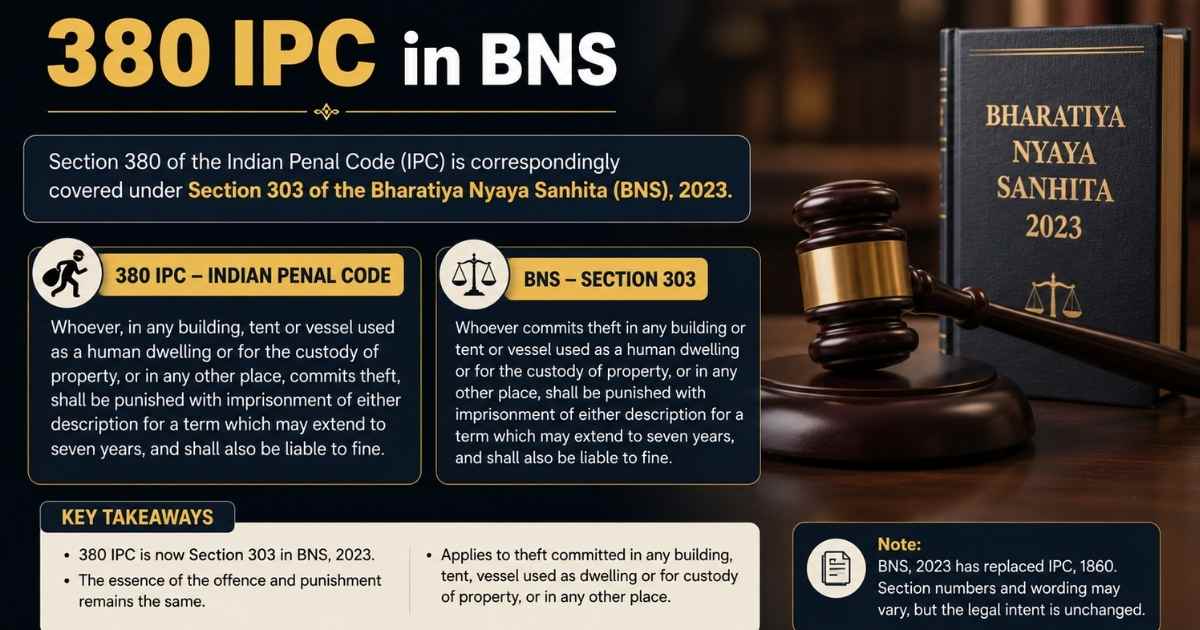

380 IPC in BNS is a change every lawyer needs to know. The old law is gone. It now lives as Section 305. This is not just a number change. The rules around bail and punishment shifted too. If you handle theft cases, you must understand this shift clearly. It affects how you argue in court. It affects how you advise your client. Small details now matter more than before.
This guide breaks down the mapping in plain terms. We cover the new punishment. We cover the bail process. We cover what changed in evidence rules. You will learn how the law works in real cases today. No confusing legal jargon here. Just clear, useful information you can use in practice.
Legal Excellence
If you’re a practicing advocate in 2026, you already know that criminal law in India has shifted under your feet. 380 IPC in BNS is now Section 305, and that single renumbering carries real consequences for how you build a defence or argue for bail. It’s not just a cosmetic change. The ingredients, the punishment structure, and even the evidentiary standards have moved with it. You need to know this cold, whether you’re drafting a bail application at 11 PM or cross-examining an investigating officer in open court.
This guide walks you through the mapping, the practical differences, and the trial strategy you’ll actually use in a courtroom. No fluff, no theory for theory’s sake just what you need to argue the case well.
Section 305 BNS: Aggravated Theft
Section 305 targets theft committed inside a building, tent, or vessel that’s used as a human dwelling, or used to store property. Think of it as Section 303 (simple theft) with a sharper edge. The location of the theft is what elevates it steal a phone off a park bench and you’re looking at simple theft. Steal that same phone from inside someone’s house, and the charge changes entirely.
This distinction matters more than most lawyers give it credit for. The prosecution has to prove not just that a theft happened, but that it happened at a specific kind of location one connected to human habitation or safekeeping of property. That’s your opening. If the site doesn’t clearly meet that bar, you have room to argue the charge down. For example, an open courtyard or an unfinished structure without a roof may not qualify as a “dwelling” in the strict sense, and that single argument can change your client’s bail prospects overnight.
Related post: Court Marriage in Maharashtra: Process & Rules 2026
Key Changes from IPC 380
The core language hasn’t changed dramatically, but three shifts affect how you’ll actually run a case. First, punishment structure: under IPC 380, the fine was discretionary. Under BNS 305, it’s mandatory. That’s a small wording change with a big practical effect you can no longer negotiate a fine-free sentence in plea discussions.
Second, evidentiary procedure has tightened considerably. The BNSS and BSA together demand a level of documentation that simply didn’t exist before. Forensic visits, videography, and digital certification aren’t optional anymore they’re baked into the process. If the investigating agency skips a step, you have a genuine, technical ground to challenge the prosecution’s case rather than relying purely on witness credibility.
Three Major Practitioner Shifts:
Here’s what actually changes your day-to-day practice. One, the mandatory fine means sentencing arguments now revolve around quantum, not existence, of the fine. Two, Section 176 BNSS makes a forensic expert’s crime-scene visit compulsory for any offence carrying up to seven years, which includes BNS 305. Skip that step, and you’ve got a solid ground for acquittal. Three, Section 63 BSA requires a proper digital certificate for CCTV or security footage. Most residential theft cases now lean heavily on home security systems, so if the prosecution can’t produce that certificate, the footage becomes inadmissible. Challenge it early, and challenge it hard.
Arrest and Bail Procedure
Since BNS 305 stays non-bailable and cognizable, the police can arrest without a warrant, and your client won’t get bail as a matter of right. That doesn’t mean bail is impossible it just means you need a stronger argument than “he’s entitled to it.” Judges will weigh flight risk, recovery of stolen property, and the strength of the prosecution’s evidence before granting relief. Your job is to poke holes in each of those factors, one by one.
The procedural roadmap under BNSS also gives you more checkpoints to intervene than the old CrPC did. Each stage from the FIR to the framing of charges offers a chance to test the prosecution’s case and push for your client’s release. Let’s break down what happens at each step.
FIR & Scene Videography
The moment an FIR gets registered under BNS 305, the police must arrange for crime-scene videography, given the offence carries up to seven years. If this step gets skipped or done poorly, note it immediately in your case diary it becomes a strong technical objection later at trial.
Arrest & PC Remand
Police can arrest without a warrant since the offence is cognizable. However, they still need to justify custodial interrogation when seeking police custody (PC) remand. Push the magistrate to ask why custodial questioning is necessary if the stolen property has already been recovered.
Bail Application
Because BNS 305 is non-bailable, you’ll typically move for bail before the Sessions Court or High Court. Focus your argument on recovery status, the accused’s roots in the community, and any procedural lapses in the investigation these carry real weight with judges.
Framing of Charges
At this stage, argue hard if the facts only support simple theft under Section 303 rather than aggravated theft under Section 305. Getting the charge reduced here can change your client’s entire bail and sentencing trajectory.
Property Restoration
Courts often allow interim custody of recovered property to the rightful owner during trial. Use this stage to negotiate terms that also work in your client’s favor, especially where restitution might influence sentencing later.
Evidence and Trial Strategy
Winning or at least defending well in a BNS 305 case usually comes down to the crime scene and the paper trail around it. You’ll want to scrutinize the site inspection report first. Was the location genuinely a dwelling, or could you argue it was something looser, like an open verandah or a storage shed under construction? That single question often decides whether the charge sticks as aggravated theft or gets pulled back to simple theft.
Digital evidence deserves equal attention. Most residential theft cases today rely on CCTV footage, and that footage is only as strong as its certification. If the prosecution hasn’t filed a proper certificate under Section 63 BSA, don’t let that slide object at the earliest opportunity, because once the evidence gets marked as an exhibit, it’s much harder to exclude later. Between site classification and evidence certification, you’ll usually find your strongest levers for defence, whether you’re aiming for acquittal or a reduced charge.
Conclusion
Understanding 380 IPC in BNS isn’t just an academic exercise it directly shapes how you approach bail, evidence, and trial strategy in 2026. The renumbering to Section 305 brought real procedural changes, from mandatory forensic visits to stricter digital evidence rules, and each one gives a sharp advocate new ground to work with. Master the dwelling-house definition, stay alert to procedural lapses, and you’ll be well-positioned to defend these cases effectively under the new framework.
