
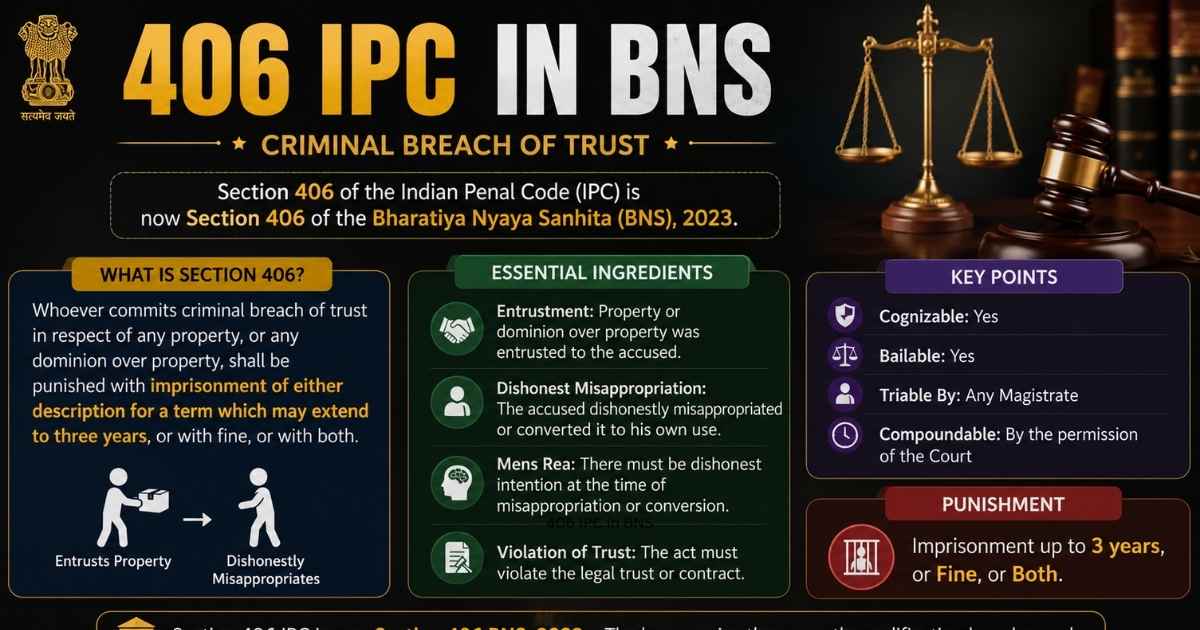

If you’ve been searching for 406 IPC in BNS, you’ve probably noticed that the old numbering system doesn’t work anymore. The Bharatiya Nyaya Sanhita (BNS) has replaced the Indian Penal Code, and Section 406 the provision that dealt with Criminal Breach of Trust (CBT) now lives under a new number. For lawyers, students, and even people caught up in a dispute themselves, getting this mapping right isn’t just a formality. It changes how you file, how you argue bail, and how you build a defense in 2026.
This guide walks you through the full picture: what 406 IPC in BNS actually maps to, how the punishment and bail rules have shifted, and what practical traps to avoid if you’re handling one of these cases today.
Section 316 BNS: The Complete Criminal Breach of Trust (CBT) Framework
Section 316 of the BNS now covers everything that used to sit across Sections 405 to 409 of the IPC. Instead of scattering CBT across several sections, the new code groups them under one umbrella with different sub-clauses for different categories of accused. A general breach falls under 316(2), while breaches by carriers, clerks, servants, or public servants get their own sub-sections within the same provision.
If you started your search looking for 406 IPC in BNS specifically, Section 316(2) is the exact provision you want. This consolidation actually makes life easier once you get used to it. You don’t need to hunt through five separate sections anymore you just need to identify which sub-clause of 316 fits your client’s role. For example, an employee who misuses company funds falls under a different sub-clause than a random business partner who does the same thing. Below is a quick reference table so you can see the old-to-new mapping at a glance.
| Capacity of Accused | Old IPC Section | New BNS Section | Bail Status |
| General Person | 406 | 316(2) | Non-Bailable |
| Carrier/Warehouse Keeper | 407 | 316(3) | Non-Bailable |
| Clerk/Servant | 408 | 316(4) | Non-Bailable |
| Public Servant/Agent | 409 | 316(5) | Non-Bailable |
Key Changes from IPC Section 406 to BNS Section 316
The shift from IPC 406 to BNS 316 isn’t just a renumbering exercise. Lawmakers used this transition to tighten a few practical gaps, especially around evidence and restitution. If you’re still citing the old section in a 2026 filing, you’re inviting an easy procedural objection from opposing counsel, so it pays to get the details right from the start.
Anyone tracking 406 IPC in BNS closely will notice this pattern across the whole code, not just CBT. One of the biggest shifts is how evidence gets treated. Under the Bharatiya Sakshya Adhiniyam (BSA), digital records like bank transfer logs and UPI transaction IDs now carry much more weight than they used to. That means the “he told me verbally” style of proving entrustment is a lot harder to rely on. Courts expect a paper trail, or more accurately, a digital one.
Related Post: Section 504 IPC / 352 BNS — Intentional Insult Charge: Bail & Punishment India
Three Major Practitioner Shifts Every Lawyer Should Know
There are three changes you’ll notice immediately in practice. First, courts and prosecutors now lean toward imposing fines alongside jail time, partly to push for direct restitution to the victim rather than leaving it to a separate civil suit. Second, charging has become more consolidated. If your client is an employee accused of a breach, you charge them straight under 316(4) instead of hunting for old Section 408 language. Third, digital entrustment proof has become the default expectation, which means you’ll want to get ahead of this by collecting bank statements and email trails early, not after the police already have.
Arrest and Bail Procedure Under Section 316 BNS
The Bharatiya Nagarik Suraksha Sanhita (BNSS) has reshaped the procedural roadmap for CBT cases, and the changes matter most in commercial disputes. Police are now expected to exercise more caution before making an arrest, especially in cases that look more like a business disagreement than a genuine crime. This doesn’t mean arrests won’t happen, but it does give defense counsel more room to argue for restraint early on.
This is the part of 406 IPC in BNS practice that trips up even experienced lawyers, since the old CrPC habits don’t map cleanly onto the new BNSS timelines. Getting the sequence right from FIR to trial helps you spot where to push back. Each stage below gives you a chance to protect your client, whether that’s demanding a preliminary inquiry, challenging how evidence was seized, or moving for bail at the earliest possible point.
FIR Registration & Preliminary Inquiry
When a complaint comes in, the FIR gets registered as usual, but for commercial or business-related CBT allegations, police guidelines now call for a preliminary inquiry first. This step exists specifically to weed out disputes that are really just civil disagreements dressed up as criminal complaints, so it’s worth raising immediately if your client’s case fits that mold.
Digital Seizure of Evidence
Police can seize phones, laptops, and account records under Section 105 BNSS, but this seizure has to be videographed and properly synchronized with the case record. If that procedure wasn’t followed, you have solid ground to challenge the admissibility of whatever was recovered.
Bail Application Under BNSS
Bail applications now go under Section 481 BNSS. The strongest argument you can make, in most general CBT matters, is that the dispute is fundamentally civil in nature and doesn’t call for custodial interrogation. Judges tend to respond well to this framing, especially when the case revolves around accounting disagreements rather than outright theft.
Compounding Under Section 528 BNSS
Here’s something that surprises a lot of first-time practitioners: CBT is compoundable. If the accused returns the money or property in question, the case can be settled or quashed with the court’s permission under Section 528 BNSS. This is often the fastest and cheapest resolution for both sides, and it’s worth raising early in settlement talks.
Magistrate Trial Process
CBT cases follow the warrant procedure and are tried before a Magistrate. The prosecution carries the burden of proving dishonest intention, and it’s worth repeating to every client and judge: simply being unable to repay money isn’t the same as committing a criminal breach of trust.
406 IPC in BNS: Is Section 316 BNS Bailable or Non-Bailable?
This is probably the single most common question clients ask, and the answer is straightforward: 406 IPC in BNS, now Section 316(2), remains non-bailable. That said, “non-bailable” doesn’t mean “no bail.” It simply means bail isn’t a matter of right, and the accused has to apply for it before a Magistrate or Sessions Court.
In practice, bail is granted fairly often in general CBT matters once the court sees that the dispute involves documents and accounting rather than violence or flight risk. Judges also look at whether the accused has cooperated with the investigation. If your client hasn’t tampered with evidence and has a fixed address and job, that’s usually enough to secure bail within a reasonable timeframe.
IPC 406 and 420 in BNS Act: Updated Legal Mapping
People often confuse Section 406 with Section 420 because both involve financial wrongdoing, but they’re legally distinct. Section 406 IPC dealt with Criminal Breach of Trust, where property was lawfully entrusted and then dishonestly misused. Section 420 IPC, on the other hand, dealt with cheating and dishonestly inducing delivery of property meaning the wrongdoing started right at the point of obtaining the property through deception.
Under the BNS, Section 406 maps to Section 316, while Section 420 maps to Section 318. Knowing which one applies matters a lot, since prosecutors sometimes charge both together when the facts are murky. A sharp defense lawyer will push to strike whichever charge doesn’t fit the actual sequence of events, since conflating entrustment with deception weakens the prosecution’s own case.
420 IPC in BNS: Corresponding Section and Legal Changes
Section 420 IPC now corresponds to Section 318(4) of the BNS, which deals with cheating and dishonest inducement of property delivery. The core definition hasn’t changed dramatically, but the BNS has reorganized cheating-related offences into a single section with multiple sub-clauses, similar to what happened with CBT under Section 316.
If your case involves allegations of both cheating and breach of trust, you’ll want to separate the timeline carefully. Ask when the property changed hands and under what representation. If the deception happened before the property was handed over, you’re looking at Section 318. If the property was legitimately entrusted and misused later, that’s Section 316 territory instead.
Section 406 IPC Punishment Under the New BNS Framework
Under the old IPC 406, punishment for criminal breach of trust extended up to three years imprisonment, a fine, or both. The BNS keeps this same punishment structure under Section 316(2), so nothing dramatic has changed on paper. What has shifted is how courts apply the fine component in practice.
Magistrates now lean more heavily toward imposing meaningful fines, particularly where the victim hasn’t recovered their money or property through any other means. This gives defense counsel a useful bargaining chip: offering restitution upfront, even before trial, often results in a lighter sentence or a faster compounding of the case altogether.
406 IPC Example: Understanding Criminal Breach of Trust
Looking at a real-world scenario is often the fastest way to understand how 406 IPC in BNS applies day to day. A simple example makes this easier to grasp. Say a business partner hands over ₹5 lakh to a colleague to invest in raw materials for their shared venture. Instead of buying the materials, the colleague spends the money on personal expenses. That’s a textbook breach of trust the money was entrusted for one purpose, and it was dishonestly used for another.
Compare that to a scenario where someone borrows ₹5 lakh as a personal loan, promising repayment with interest, and later fails to pay it back. That’s a civil debt dispute, not a criminal breach of trust, even though the amount and the disappointment feel similar. The distinction lies entirely in whether the money was entrusted for a specific purpose or simply lent.
IPC 406 and 420: Bailable or Non-Bailable Explained
Both Section 406 (now 316 BNS) and Section 420 (now 318 BNS) are non-bailable offences, and both are triable by a Magistrate. Where they differ is in how courts perceive the severity of the underlying conduct. Cheating cases involving large-scale fraud sometimes draw a tougher stance from courts than a straightforward business-partner dispute over misused funds.
That said, non-bailable status in both cases still allows for regular or anticipatory bail, provided the accused can show they’re not a flight risk and haven’t tampered with evidence. Courts routinely grant bail in both categories once the initial investigation stage is complete.
506 IPC in BNS: New Section Mapping and Punishment
Section 506 IPC, which dealt with criminal intimidation, now maps to Section 351 of the BNS. It’s worth mentioning here because CBT complaints sometimes come bundled with intimidation allegations, especially in messy business or family disputes where one party accuses the other of threats during a confrontation over money.
If your client is facing both a Section 316 and a Section 351 charge, treat them as separate legal questions with separate evidentiary standards. Threats made during a heated argument about repayment don’t automatically prove criminal intimidation, and conflating the two charges can actually weaken the prosecution’s overall case if you point out the distinction clearly.
409 IPC in BNS: Criminal Breach of Trust by Public Servants
Old Section 409 IPC, which dealt with breach of trust by a public servant, banker, or agent, now sits under Section 316(5) BNS. This category carries a higher degree of scrutiny because the accused typically held a position of significant trust, whether through public office or a fiduciary role in banking or agency work.
Defending a 316(5) case requires showing that the accused’s role didn’t actually involve exclusive custody or control over the property in question. If the job description or official duties didn’t grant that kind of authority, the higher sub-clause simply shouldn’t apply, and the case should fall back to the general provision instead.
Proving ‘Entrustment’ vs ‘Debt’ in Criminal Breach of Trust Cases
The entire outcome of a Section 316 BNS case usually rests on one question: was this entrustment, or was it just debt? Entrustment means property was handed over for a specific purpose, and the accused was expected to use it that way or return it. Debt, on the other hand, is a straightforward loan where repayment terms exist, but there’s no obligation to use the money in a particular manner.
Bank statements can help you make this case. If interest was being paid on the amount in question, that’s a strong indicator of a civil loan rather than an entrustment arrangement. In matrimonial disputes involving stree-dhan, video evidence of jewelry or valuables being returned something commonly recorded in front of family elders can serve as powerful defense material. In business partnership disputes, arguing that both parties had joint ownership over the funds can also defeat the claim of exclusive entrustment.
For employer-employee cases, always check the employment contract or job description first. If it didn’t formally grant the accused custody over company property or funds, Section 316(4) simply doesn’t apply, no matter what the employer alleges after the fact.
Critical Pitfalls for Practitioners Handling Section 316 BNS Cases
Even lawyers well-versed in 406 IPC in BNS matters slip up on procedure now and then. A handful of avoidable mistakes tend to sink otherwise strong defense arguments in CBT cases. Missing a procedural detail, or citing outdated law by habit, can cost your client real time and money, so it’s worth double-checking these before every filing.
Citing old CrPC Section 167(2) for remand is a common slip. The correct reference now is Section 187 BNSS, and the custodial remand timelines have shifted slightly under the new framework. Similarly, if police made an arrest in a business dispute without conducting the required preliminary inquiry, that’s a solid ground to move the High Court for quashing the FIR altogether.
Digital evidence deserves extra scrutiny too. If the bank logs or transaction records submitted by the complainant don’t carry the proper certification under Section 63 BSA, they’re inadmissible, and you should challenge this during the admission-denial phase under Section 230 BNSS. Also, always check the updated compounding rules under BNSS rather than relying on the old compoundable offences list, since the property value thresholds for compounding without High Court involvement have changed.
Trial and Defense Strategy for Section 316 BNS Cases
By the time a 406 IPC in BNS matter reaches trial, most of the groundwork should already be in place. Strong defense strategy in a CBT trial often comes down to timing and precision rather than dramatic courtroom moments. Filing the right motion at the right stage matters more than most people realize.
If the property in question was destroyed by accident, fire, or theft beyond the accused’s control, that undermines the mental intent required for a conviction. Insurance claims or fire department reports can support this defense effectively. At the charge-framing stage, move for discharge under Section 250 BNSS if the FIR fails to specify the date and manner of entrustment, since these are considered fatal omissions in a CBT complaint. And because CBT remains non-bailable, police sometimes use the threat of arrest as leverage to pressure repayment, so filing for anticipatory bail under Section 482 BNSS early can head off that kind of coercion before it starts.
One more thing worth watching for: if multiple CBT allegations get filed against the same person, prosecutors sometimes try to invoke Section 111 BNS, which deals with organized crime. Resist this aggressively where it applies, since treating separate, unrelated business disputes as an organized pattern is a significant overreach that courts are often willing to reject when the distinction is laid out clearly.
Conclusion
The move from 406 IPC in BNS 316 isn’t just a numbering change, it reflects a broader shift toward digital evidence, consolidated charging, and a sharper procedural framework under the BNSS and BSA. For anyone facing a criminal breach of trust allegation in 2026, understanding this mapping is the first step toward building a solid defense.
Whether you’re a lawyer preparing a bail application, a business owner caught in a partnership dispute, or someone trying to make sense of a family property disagreement, the key question always comes back to entrustment versus debt. Get that distinction right, gather your digital evidence early, and you’ll be in a much stronger position no matter which side of the case you’re on.
