
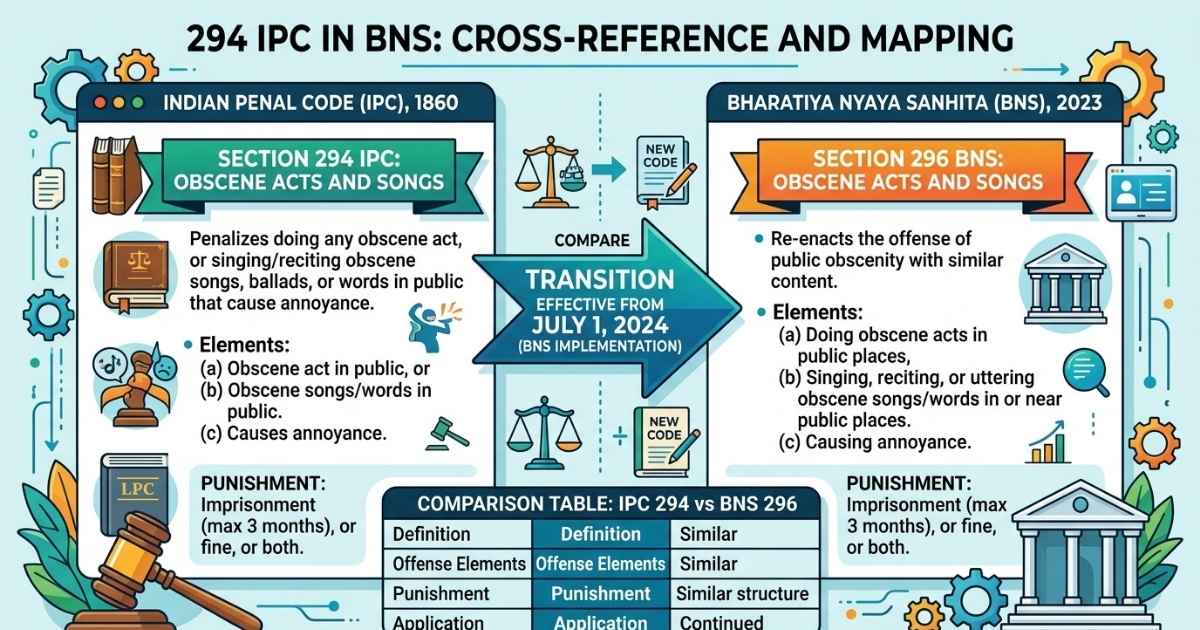

294 IPC in BNS is now a key topic for every legal practitioner in India. The old law under 294 IPC has changed. It is now called Section 296 BNS. This shift is part of the new criminal law system. Many advocates search for 294 IPC in BNS to understand the new rules. The change affects obscene acts and obscene songs in public places. It also affects how police handle arrests and bail.
Understanding 294 IPC in BNS helps lawyers build strong defense strategies. It also helps common citizens know their rights. The punishment under 294 IPC in BNS stays almost the same. But the fine amount is now fixed. Digital evidence also plays a bigger role today. This guide explains 294 IPC in BNS in simple words. It covers key changes, court process, and defense tips.
Legal Excellence
A clear grasp of Section 296 BNS is no longer optional for criminal law practitioners. With moral policing incidents, public disputes, and viral social media clips increasingly triggering FIRs under this section, lawyers need both doctrinal clarity and courtroom-ready strategy to serve their clients effectively.
Section 296 BNS: Obscene Acts in Public
Section 296 of the BNS criminalizes two distinct forms of conduct: doing an obscene act in a public place, or singing, reciting, or uttering an obscene song, ballad, or words in or near a public place provided either causes annoyance to others. The offence carries imprisonment of up to three months, a fine of up to one thousand rupees, or both.
This provision is the direct successor to Section 294 of the old Indian Penal Code, and courts continue to rely on decades of precedent interpreting “obscenity” and “annoyance” while applying the renumbered section.
Related Post: Section 420 IPC / 318(4) BNS Cheating Charge: Bail, Punishment & Defence
Critical Ingredients:
For a conviction to hold, the prosecution must establish each of the following elements:
- Public Place – The conduct must occur somewhere accessible to the public, such as a street, park, market, or public transport. Private clubs, ticketed venues, or fenced residential spaces are generally excluded.
- Obscenity – The act, song, or words must be judged obscene by prevailing community standards, not merely by the personal sensitivities of the complainant.
- Annoyance – There must be credible evidence that a real person not just the arresting officer was actually annoyed or offended by the conduct.
If any one of these ingredients is missing, the charge under Section 296 BNS cannot be sustained.
Key Changes from IPC 294
While the substance of the offence remains largely unchanged, the BNS introduces a few notable refinements, particularly around fine amounts and evidentiary standards.
| Aspect | IPC 294 (Old Law) | BNS 296 (New Law) | Remarks |
| Imprisonment | Up to 3 months | Up to 3 months | No change in duration |
| Fine | Unlimited, at magistrate’s discretion | Capped at ₹1,000 | BNS introduces a defined ceiling |
| Classification | Cognizable, Bailable | Cognizable, Bailable | Arrest without warrant remains possible |
| Evidentiary Focus | Witness testimony, community standards | Witness testimony plus digital/CCTV authentication | Reflects the rise of video-based FIRs |
In short, the legal test for obscenity hasn’t shifted dramatically but the way evidence is gathered, recorded, and proven in court has changed considerably.
Digital Obscenity and BSA Rules
A large share of present-day Section 296 BNS complaints originate from mobile phone recordings, CCTV footage, or viral social media reels rather than direct police observation. This shift makes digital evidence handling central to both prosecution and defense.
- Authentication Requirement: Any video or audio recording relied upon by the prosecution must be certified under Section 63 of the Bharatiya Sakshya Adhiniyam (BSA) to be admissible in court.
- CCTV Continuity: Defense counsel should scrutinize whether footage is unbroken or shows signs of editing. Any gap or cut typically requires a forensic examination report.
- Loudspeaker or Recording Equipment: Where the alleged obscene words were amplified or recorded, the equipment itself may need to be seized and videographed as part of the investigation.
Failure to comply with digital authentication requirements is one of the most common grounds on which Section 296 BNS prosecutions collapse at trial.
Police Action and Bail Procedure
The procedural journey of a Section 296 BNS case is designed to move quickly, given its bailable and relatively minor nature.
FIR Filing
An FIR is registered once a complaint is made, and because the offence is cognizable, police may arrest the accused on the spot if the act is ongoing or freshly reported.
Station Bail
Since Section 296 BNS is bailable, the investigating officer is obligated to release the accused on a personal bond directly at the police station, without requiring a court appearance.
Section 63 BSA Check
The investigating officer must collect any video or digital evidence and secure the mandatory certification within the standard charge-sheet filing window.
Summary Trial
Given the minor punishment involved, magistrates typically try Section 296 BNS matters through a summary trial procedure, which is designed to conclude faster than a regular trial.
Order of Release/Fine
Most convictions result in a modest fine rather than imprisonment. The judgment must specifically record how the “annoyance” of an identified witness was established.
Challenging ‘Obscenity’ and ‘Annoyance’
Because both “obscenity” and “annoyance” are inherently subjective terms, this is exactly where a well-prepared defense can succeed.
- Testing the Standard: Defense lawyers can argue that the act in question served an artistic, protest-related, or performative purpose and therefore does not meet the threshold of appealing to prurient interest.
- Absence of Independent Witness: If no ordinary member of the public as opposed to the police themselves testifies to being annoyed, the prosecution’s case is significantly weakened.
- The Public Place Challenge: Conduct occurring inside a private balcony, gated society, or members-only club may not satisfy the “public place” requirement at all.
- Digital Alibi: Any mismatch between the date or time stamp on video evidence and the FIR timeline can undermine the entire prosecution narrative.
Critical Pitfalls for Practitioners
Even experienced advocates can stumble on avoidable procedural errors in Section 296 BNS matters:
- Citing the Old Section: Continuing to reference “294 IPC” instead of “Section 296 BNS” in pleadings can lead to documents being returned by the registry.
- Advising a Quick Guilty Plea: A conviction, even for a small fine, can surface in background checks for government jobs or affect future visa applications so the merits of the case should always be weighed first.
- Overlooking BSA Certification: Video evidence that hasn’t been properly authenticated under Section 63 BSA should be challenged rather than accepted at face value.
- Missing Compounding Opportunities: Where the complainant is a neighbor or acquaintance, using the compounding provisions under the BNSS can resolve the dispute amicably and preserve relationships.
Trial and Evidence Strategy
A methodical approach to cross-examination and case management often determines the outcome in these matters.
- Cross-Examine the Complainant: Questions such as “How exactly did the act cause you annoyance?” or “Why did you continue watching before objecting?” can expose inconsistencies in the annoyance claim.
- Consider Plea Bargaining: For minor, non-contentious cases, plea bargaining provisions can help resolve matters at the very first hearing with a nominal fine.
- Verify Location Status: Checking whether the location holds a public license or operates as a private establishment can determine whether the “public place” element is even satisfied.
- Document Review: Always cross-check FIR timestamps against any digital recording to identify discrepancies early in the proceedings.
FAQ’s
Is Section 296 BNS bailable?
Yes, Section 296 BNS is both cognizable and bailable, meaning the accused can typically secure release at the police station itself.
What is the maximum punishment under Section 296 BNS?
The offence carries imprisonment of up to three months, a fine of up to one thousand rupees, or both.
Does IPC 294 still apply to old cases?
Cases registered before July 1, 2024 generally continue under IPC 294, while new complaints are filed under Section 296 BNS.
Can police officers be the sole witnesses of annoyance?
No, courts typically require testimony from an independent member of the public to prove that annoyance actually occurred.
What role does Section 63 BSA play in these cases?
It mandates a digital certificate authenticating any video or audio evidence before it can be admitted in court.
Conclusion
The shift from 294 IPC in BNS reflects a broader theme running through India’s new criminal codes: continuity in substance, but modernization in procedure. The core legal test an obscene act or utterance in a public place causing real annoyance remains unchanged, but the growing reliance on CCTV footage, smartphone recordings, and social media clips has made digital evidence authentication under the BSA central to how these cases are now investigated and tried.
For practitioners, the real value lies in the details: verifying whether the location truly qualifies as a public place, testing whether an independent witness genuinely experienced annoyance, and ensuring that video evidence meets the certification bar before it is accepted by the court. Handled well, a Section 296 BNS matter can often be resolved swiftly through summary trial, compounding, or plea bargaining protecting the client’s record while upholding the letter of the law.
