
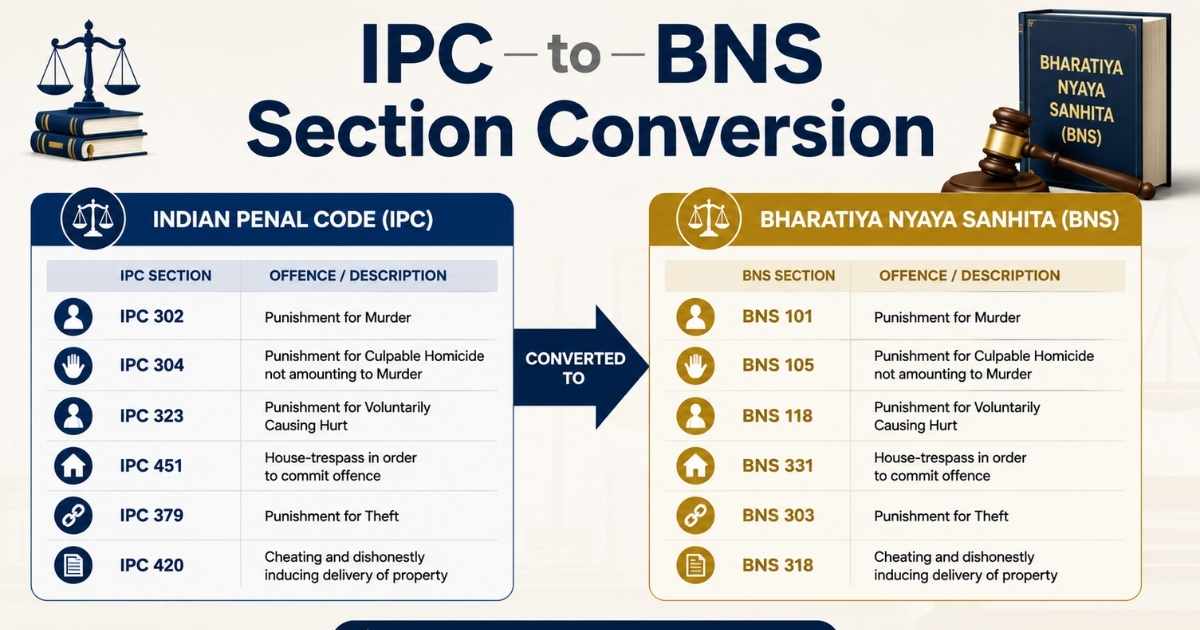

For over 160 years, the Indian Penal Code shaped how crimes were defined and punished across the country. That changed on 1 July 2024, when the Bharatiya Nyaya Sanhita took over as the new backbone of criminal law in India. If you’ve been searching for a reliable IPC to BNS Section Conversion resource, you’re not alone lawyers, students, and citizens alike are still adjusting to the new numbers.
This guide breaks down the IPC to BNS Section Conversion in plain language, mapping familiar old sections to their updated equivalents. Whether you’re prepping for exams, filing a case, or simply curious, you’ll find clear answers here.
Overview and Legislative Philosophy
The BNS isn’t a simple renumbering exercise. The IPC’s 511 sections have been consolidated into 358 sections in the BNS, with several offences merged, a handful dropped, and new categories organised crime, terrorism, mob lynching, and “snatching” as a distinct offence from theft added for the first time. Sedition under Section 124A IPC is gone; in its place, Section 152 BNS penalises acts that threaten the sovereignty, unity, and integrity of India, with a narrower and more specific scope.
The drafting philosophy behind the BNS emphasises victim-centric justice, faster trials, and recognition of technology digital records and electronic evidence are now treated as primary evidence rather than an afterthought. Community service appears as a sentencing option for the first time in Indian criminal law. None of this changes the core of most offences murder is still murder, theft is still theft but the framework around them has shifted meaningfully.
Related post: IPC 506 in BNS Section Conversion Complete Advocate’s Guide
Bail Bond Amount Calculator
Bail practice under the new framework hinges on getting the section number right before anything else. Since bail amounts and eligibility (bailable vs. non-bailable, and default bail timelines) are tied to the specific BNS section and its prescribed punishment, always cross-check the charge sheet’s cited section against the punishment schedule before estimating a bond figure. A mismatch between an old IPC citation and the applicable BNS punishment band is one of the most common reasons bail applications get sent back for correction.
Legal Excellence
This guide draws on the official BNS Schedule, Ministry of Home Affairs conversion tables, and post-2024 High Court rulings interpreting the transition not secondhand summaries. Where the law is settled, we say so plainly; where courts are still split (as with certain BNSS procedural questions), we flag the disagreement rather than paper over it. Always verify against the current bare act before filing.
The Master IPC to BNS Conversion Table
The table below covers the highest-frequency conversions practitioners look up daily.
| IPC Section | Offence | BNS Section |
| 302 | Murder | 103 |
| 304A | Death by negligence | 106 |
| 304B | Dowry death | 80 |
| 306 | Abetment of suicide | 108 |
| 307 | Attempt to murder | 109 |
| 323 | Voluntarily causing hurt | 115 |
| 325 | Voluntarily causing grievous hurt | 117 |
| 354 | Assault on woman with intent to outrage modesty | 74 |
| 375/376 | Rape | 63/64 |
| 379 | Theft | 303 |
| 384 | Extortion | 308 |
| 406 | Criminal breach of trust | 316 |
| 420 | Cheating | 318 |
| 498A | Cruelty by husband/relatives | 85 |
| 499/500 | Defamation | 356 |
| 506 | Criminal intimidation | 351 |
| 511 | Attempt to commit offences | 62 |
| 124A | Sedition | 152 (reframed) |
Note: This is a quick-reference selection, not the complete 358-section map. A single IPC section sometimes splits across more than one BNS sub-section, so always confirm against the full Schedule for anything going into a pleading.
Critical Substantive Changes for Practitioners
A handful of changes go beyond renumbering and actually affect strategy:
- Sedition replaced, not renamed. Section 152 BNS is narrower and offence-specific compared to the old 124A, which matters for quashing arguments.
- Hit-and-run carries a distinct, harsher track. Section 106(2) BNS creates a specific enhanced punishment up to ten years where a driver causing death by negligence flees the scene without reporting it.
- Organised crime and terrorism now sit inside general criminal law, not only in special statutes, giving prosecutors an additional charging option.
- Snatching is now its own offence, separated from theft, which changes how such FIRs should be drafted and contested.
- Digital and electronic records are treated as primary evidence, altering how documentary evidence is proved at trial.
Sentencing Enhancements and Community Service
Community Service (Section 4)
Section 4 of the BNS formally introduces community service as a sentencing option a first in Indian criminal law. It is currently applied mainly to minor and first-time offences: petty theft, public nuisance, and select cases under Section 106(1). Courts retain discretion over what “community service” means in practice, so expect variation between jurisdictions until the higher courts settle uniform guidelines.
Enhanced Fines Across the Board
Many offences that carried nominal or fixed fines under the IPC now carry significantly higher, and in some cases proportionate, fine structures under the BNS. Practitioners drafting plea or settlement strategies should recompute exposure rather than relying on IPC-era fine figures.
Mandatory Minimums for Women and Children
Offences against women and children including provisions carried over from Sections 354, 375, and 498A IPC generally retain or strengthen mandatory minimum sentencing, reflecting the victim-centric orientation of the new code. Anticipatory bail strategy in these matters should account for the minimum sentence exposure at the outset, not after framing of charges.
Transition and Filing Procedures (The 531 BNSS Gap)
The single most litigated transitional question isn’t really about the BNS at all it’s about Section 531 of the Bharatiya Nagarik Suraksha Sanhita (BNSS), the CrPC’s replacement. <cite index=”9-1,9-2″>Section 531 BNSS is a savings clause: any pending appeal, application, trial, inquiry, or investigation that was already underway before the BNSS came into force continues to be disposed of under the old CrPC.</cite> <cite index=”12-1,12-2″>In short, it governs how cases and proceedings pending at the time of transition should be handled, so that ongoing matters aren’t disrupted.</cite>
Courts have consistently drawn a substance-versus-procedure line: <cite index=”10-1″>new FIRs and investigations initiated after the changeover must be conducted under the BNSS</cite>, even where the underlying offence was committed under the IPC and continues to be prosecuted under IPC provisions. Put simply the offence definition looks backward to the date of the act, but the procedure looks forward to the date of filing. This “531 gap” is where most drafting errors originate, because lawyers often assume one code governs both substance and procedure uniformly. It doesn’t.
Court-Specific Implementations and Registry Objections
Registries across different courts have not applied the transition uniformly. Some High Court and district registries reject filings that cite IPC sections for post-July-2024 conduct outright; others return the filing for correction; a few accept it with a covering note. Before filing in an unfamiliar court, it’s worth a quick call to the registry or a review of recent local circulars the safest default is always to plead the BNS/BNSS section that matches the date of the offence and the date of filing, with the corresponding old-code citation added in a footnote for judicial reference where relevant precedent is being relied upon.
Fatal Drafting Mistakes to Avoid
- Citing an IPC section for an offence committed after 1 July 2024 (or vice versa for pre-2024 conduct).
- Relying on IPC-era precedent without expressly correlating it to the equivalent BNS provision and confirming the legal ingredients haven’t changed.
- Treating BNSS as retrospective for substantive offences it isn’t; only procedure moves forward under Section 531(2)(a).
- Quoting outdated fine or sentencing figures carried over from IPC-era templates.
- Assuming every IPC section maps one-to-one to a single BNS section several split across multiple sub-sections.
Strategic Chamber Tips for Trial Lawyers
- Audit your templates. Go through your most-used drafts bail applications, quashing petitions, protest petitions, legal notices and create dedicated BNS-era versions rather than editing on the fly during a hearing.
- Build a personal cross-walk cheat sheet of the 15–20 sections you use most, and keep it accessible during arguments and cross-examination.
- Plead both codes where precedent is central. When relying on IPC-era Supreme Court judgments, explicitly correlate the old section to its BNS equivalent in the pleading itself.
- Check the date twice the date of the offence for substantive law, and the date of filing for procedural law. They are not always the same code.
- Track your local registry’s practice, since implementation varies between courts even though the statute is uniform nationally.
Conclusion
Navigating the shift from the old code to the new one doesn’t have to be overwhelming. With a clear IPC to BNS Section Conversion reference by your side, you can move through FIRs, petitions, and courtroom arguments with confidence instead of confusion. The numbers may have changed, but the underlying principles of justice remain the same knowing where to look makes all the difference.
As India’s legal system continues settling into this new framework, bookmarking a dependable IPC to BNS Section Conversion guide will save you time and reduce costly errors. Stay updated, double-check every citation, and treat this transition as an opportunity to sharpen your legal fluency for the years ahead.
