
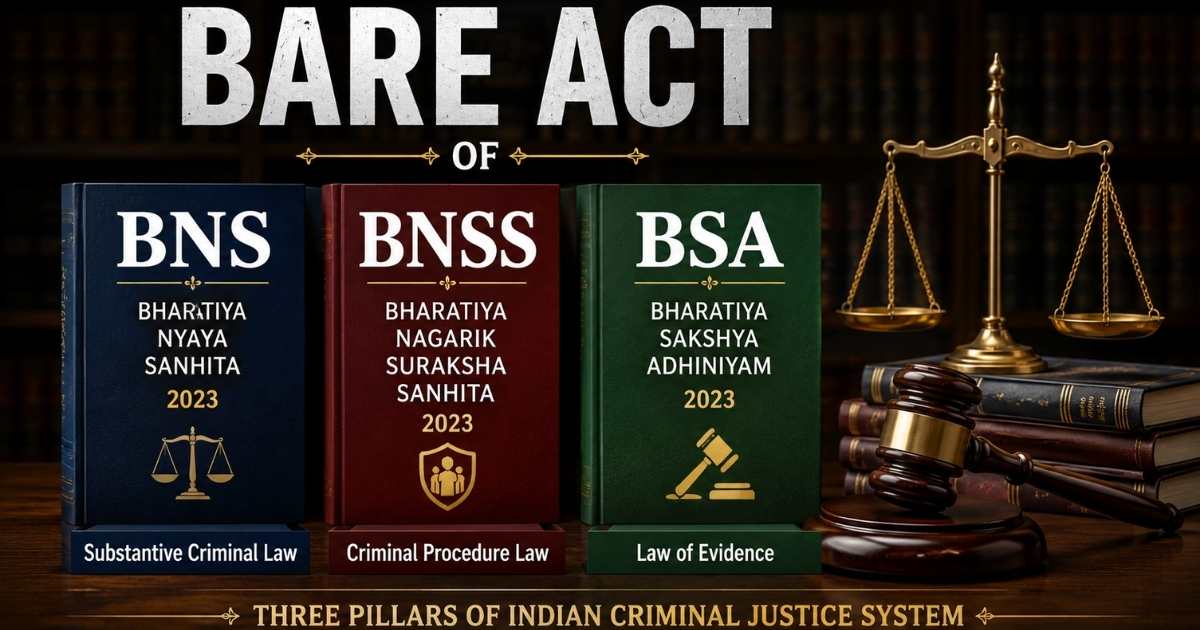

India’s criminal law landscape changed forever in 2024, and every advocate, student, and legal researcher now needs quick, reliable access to the Bare Act BNS BNSS BSA in 2026. With so many outdated drafts and unofficial copies circulating online, finding the correct, Gazette-verified version has become a genuine challenge for anyone working in litigation or legal education.
This guide simplifies that search. It walks you through authenticated sources for the Bare Act BNS BNSS BSA, explains key differences from the old IPC, CrPC, and Evidence Act, and shows how to organize these documents for real courtroom use.
Bail Bond Amount Calculator
Before diving into the documents themselves, it helps to understand how these laws affect real outcomes. Bail provisions under BNSS have shifted meaningfully from the old CrPC framework, particularly around custody timelines and first-time offenders. A rough bail-estimate tool factoring offense type, severity, and prior record can give litigants a starting reference point, though the final amount always rests on judicial discretion under the applicable BNSS sections.
The ‘Final Act’ Alert
A large number of PDFs still circulating online are labeled “BNS Bill” or “Draft Sanhita.” These are not usable references. Several sections were renumbered, reworded, or dropped entirely between the bill stage and the version that received Presidential Assent. Before you trust any download, check for the Act number printed at the top for example, “Act No. 45 of 2023” for the BNS. If that line is missing, treat the file as unreliable.
Legal Excellence
Working with the correct Bare Act isn’t just a formality it directly affects the quality of your legal drafting, your credibility in front of a judge, and your ability to advise clients accurately. An authenticated PDF is the foundation of good legal practice in the post-2024 era.
Related post: 147 IPC in BNS: Section 191(2) Mapping, Rioting Laws & Bail
Official Sources: Avoiding ‘Shadow’ PDFs
The single authoritative source for any central legislation in India is the Gazette of India, published by the Department of Publication under the Ministry of Law and Justice. Anything downloaded from unverified blogs, forwarded WhatsApp files, or random file-sharing sites falls into what practitioners informally call “shadow PDFs” copies that may look legitimate but carry typos, missing clauses, or stale bill-stage text.
Two sources consistently stand out as dependable in 2026:
India Code Portal
The Government of India’s official legislative repository hosts the current, updated text of BNS, BNSS, and BSA, cross-linked to amendments and notifications. It is the best starting point for research and everyday reference.
e-Gazette
For anything that might be contested in court, the e-Gazette notification is the gold standard. It carries the government seal and is treated as conclusive proof of the law’s exact wording.
| Source | Best For | Reliability |
| India Code Portal | Daily research, quick lookup | High official & updated |
| e-Gazette (egazette.gov.in) | Court citations, disputes over wording | Highest legally conclusive |
| High Court digital libraries | Court-ready formatted copies | High |
| Random blogs / WhatsApp forwards | Not recommended | Low risk of errors |
BNS 2023: The Core Criminal Code
The Bharatiya Nyaya Sanhita replaces the 160-plus-year-old Indian Penal Code. It compresses 511 IPC sections into 358 BNS sections, which means substantial renumbering murder, for instance, has moved from the familiar Section 302 to Section 103.
When downloading the BNS PDF, make sure it includes the Schedule, which lists offence classifications and prescribed punishments. Many law students and practitioners now prefer “hybrid” PDFs that show the corresponding old IPC section in brackets next to the new BNS number useful for anyone who still mentally references cases by their IPC numbers but needs to argue under the new code.
BNSS 2023: The Procedural Manual
The Bharatiya Nagarik Suraksha Sanhita takes over from the CrPC as the procedural rulebook of the criminal justice system, spanning 531 sections. It introduces notable changes around police custody limits, trial timelines, and provisions for trial in absentia.
Because procedural law is time-sensitive and frequently interpreted by courts, always look for the most recently updated PDF rather than a static 2024 copy. A version with clickable internal cross-references so a citation like “subject to Section 480” jumps directly to that section saves significant time during live arguments or quick lookups in chambers.
BSA 2023: The Evidence Framework
The Bharatiya Sakshya Adhiniyam, at 170 sections, is the smallest of the three acts but arguably the most technical, since it governs how evidence is presented and admitted. Its biggest shift is formally embedding electronic evidence WhatsApp chats, emails, server logs into the core framework rather than treating it as an exception.
If your practice involves cybercrime, financial fraud, or any digital-evidence-heavy matter, prioritize a PDF that includes the updated certification requirements for electronic records (the BSA’s equivalent of the old Section 65B), since improperly certified digital evidence is a common ground for objections in trial.
Comparative PDFs: IPC-BNS Mapping
Since decades of Indian case law are indexed by IPC and CrPC section numbers, lawyers still need to move fluidly between the old and new systems especially for appeals or revisions tied to offences committed before July 2024. This is where a Correlation Table becomes essential.
A good correlation table is typically structured in three columns:
- Old Section (IPC/CrPC/Evidence Act)
- New Section (BNS/BNSS/BSA)
- Nature of Change (renumbered, modified, or newly added)
| What You Need | Recommended Source | Why It Works |
| Clean BNS text for filings | Ministry of Law official PDF | Print-ready, no formatting errors |
| Quick old-to-new mapping | Bar Association hybrid charts | Fast reference during trial |
| Cross-referenced BNSS | Legal research portals | Easier navigation between sections |
| Electronic evidence rules | BSA Gazette notification | Correct certificate formats |
The Gazette Standard: Why It Matters
If a judge ever questions the exact wording of a provision, textbooks and commentary carry no weight only the Gazette does. It is treated as a public record whose contents are legally presumed correct. Before relying on any downloaded copy, check for the digital signature or the Government of India emblem on the first page; without it, the document should be treated as informal and unsuitable for citation.
Digital Annotation: Setting Up Your iPad
Carrying printed Bare Acts to every hearing is no longer practical. Most advocates now work from annotated PDFs on a tablet or laptop, using apps such as GoodNotes, Notability, or LiquidText to make the documents genuinely usable in real time.
The ‘Pre-Argument’ PDF Setup:
- OCR Scan If your PDF is a scanned image rather than searchable text, run OCR so you can search terms like “custody” or “bail” instantly.
- Color-coded highlighting For example, yellow for penalties, blue for definitions, green for exceptions.
- Split-screen reference Keep BNS open on one side and BNSS on the other during arguments that touch both substantive and procedural law.
- Cloud sync Ensure your annotated files sync across devices, since you may need to pull up a section on your phone outside your usual setup.
2026 Legal Tech: Dynamic PDF Features
Legal-tech platforms have started layering interactive features on top of static Bare Acts tapping a section number can now surface recent judgments interpreting that provision. These “smart” versions are often paid add-ons, but a verified, official PDF remains the essential baseline every practitioner should keep as a reliable fallback.
Always check the “last updated” date before relying on any downloaded copy. Courts continue to interpret, and in some cases read down, specific provisions, so a file that was accurate in 2024 may already be outdated in parts by 2026.
Frequently Asked Questions
Are Hindi versions of BNS, BNSS, and BSA available?
Yes, official Hindi translations are published alongside the English versions on the India Code portal and Gazette notifications.
Can I use the ‘Bill’ version if I can’t find the ‘Act’?
No several sections changed between the bill stage and final assent, so only the numbered Act (e.g., Act No. 45 of 2023) should be cited.
Where is the best place to find correlation tables?
Bar Association websites and High Court digital libraries typically publish the most reliable IPC-to-BNS mapping charts.
Are these downloads truly free?
Yes, the official versions from the India Code portal and e-Gazette are free; only certain annotated or “smart” commercial versions carry a cost.
Conclusion
The shift to Bare Act BNS BNSS BSA marks one of the most significant legal transitions in modern Indian history, and getting comfortable with these three acts starts with having the right document in hand. An official, Gazette-verified PDF isn’t just a convenience it’s the difference between a citation that holds up in court and one that invites unnecessary risk.
Once you have the authenticated text, the real value comes from how you use it: indexing it for quick navigation, annotating it with color-coded notes, and keeping a correlation table nearby for older cases still working through appeal. Small habits like these turn a dense legal document into a tool you can actually rely on under pressure, whether you’re preparing for a bail hearing, drafting a petition, or simply staying current in a fast-changing legal landscape.
