

If you’ve handled even a handful of criminal matters since July 1, 2024, you’ve run into the same confusion in courtroom after courtroom: an FIR reads “Section 351 BNS,” a client calls it “506,” and the police diary mixes both. That gap between old habit and new law is exactly where cases get lost or won.
This guide walks through the IPC 506 in BNS section conversion in plain, practice-ready terms what changed, what stayed the same, and how to use that knowledge at the bail stage, the charge-framing stage, and at trial.
IPC 506 in BNS: What is the Equivalent Section?
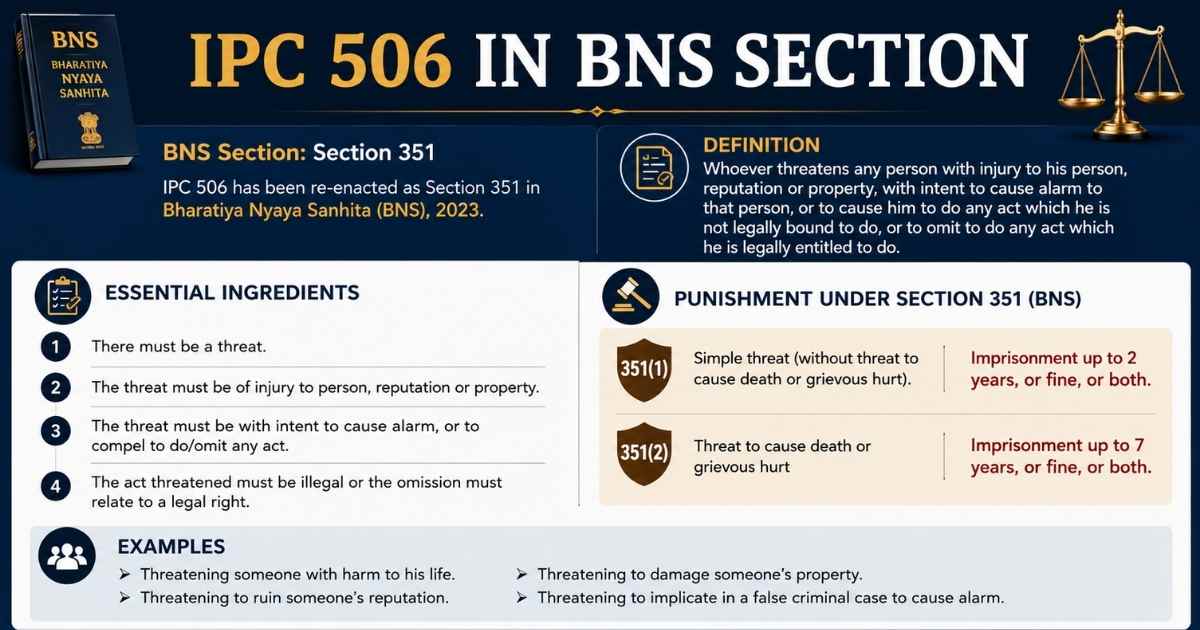
Section 506 of the Indian Penal Code, which punished criminal intimidation, has been re-enacted as Section 351 of the Bharatiya Nyaya Sanhita (BNS), 2023. The offence itself threatening a person with injury to body, reputation, or property in order to cause alarm or to compel them to act (or not act) against their will is untouched in substance.
What has changed is the drafting style. Section 351 BNS folds the definition and the punishment into one consolidated provision, split across sub-sections, rather than spreading them across separate clauses the way the old Code did. It also explicitly recognises threats made through electronic means, closing a gap that earlier courts had to bridge through interpretation rather than statutory text.
| Old Provision (IPC) | New Provision (BNS) | What It Covers |
| Section 506, Part I | Section 351(2) BNS | Basic criminal intimidation |
| Section 506, Part II | Section 351(3) BNS | Aggravated intimidation (threat of death/grievous hurt) |
| Section 504 IPC | Section 352 BNS | Intentional insult to provoke breach of peace |
| Section 509 IPC | Section 79 BNS | Word, gesture, or act insulting modesty of a woman |
| Section 34 IPC | Section 3(5) BNS | Common intention / joint liability |
Section 504 and 506 IPC in BNS
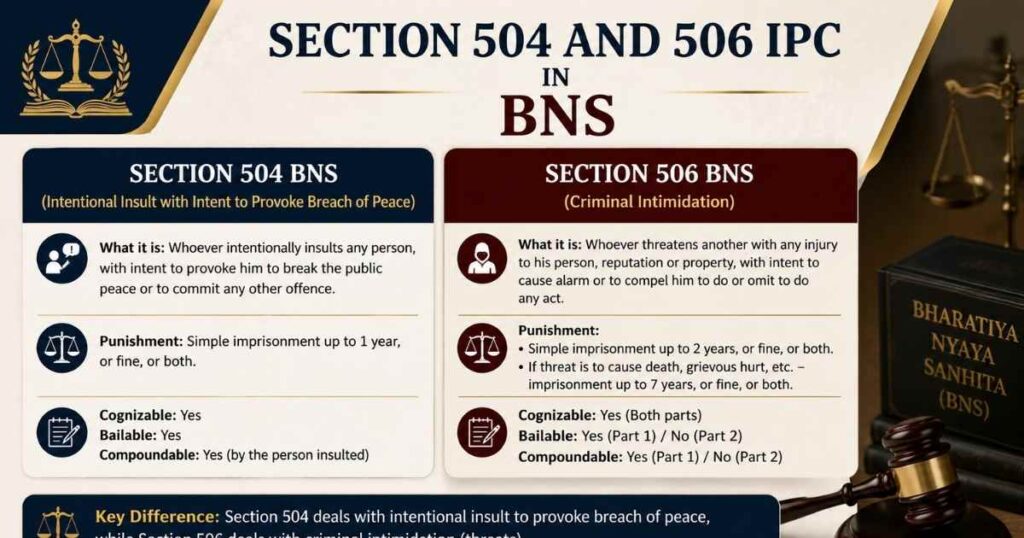
These two sections were almost always charged together in the old regime, and that pattern hasn’t disappeared it’s simply been relabelled. An FIR alleging abuse followed by a threat typically now reads Section 352 BNS (insult) read with Section 351 BNS (intimidation).
The practical point for defense counsel: police rarely distinguish the insult from the threat in the complainant’s statement. That blurring is a genuine opportunity you can argue the FIR fails to specify which words constituted the insult and which constituted the threat, weakening the foundation for both charges.
Section 506 IPC Explained
Under the old Code, Section 506 penalised anyone who threatened another with injury to their person, reputation, or property, provided the threat was made with intent to cause alarm, or to force the person into doing (or omitting) an act they were not legally bound to do. Two elements had to be proved:
- A definite threat, not vague or ambiguous language
- Intent to cause alarm or coerce not merely angry words spoken in the heat of an argument
This ingredient-based test has carried over unchanged into Section 351 BNS, and it remains the single biggest battleground in intimidation trials.
Related post: 392 IPC in BNS: Section 309(4) Mapping, Highway Robbery & Bail
506(2) IPC in BNS
Colloquially called “506(2),” this refers to the aggravated form of the offence threats involving death, grievous hurt, destruction of property by fire, or an offence punishable with death or life imprisonment. Under the new code, this is Section 351(3) BNS.
This sub-section is the one investigating officers reach for when they want to resist granting station bail, since it carries a far heavier maximum sentence than the basic offence.
Section 506 IPC Bailable or Non-Bailable
| Limb | Old IPC Status | BNS Equivalent | Punishment |
| Basic intimidation | Bailable, non-cognizable | Section 351(2) BNS | Up to 2 years, or fine, or both |
| Aggravated intimidation | Bailable, non-cognizable (centrally) | Section 351(3) BNS | Up to 7 years, and fine |
Centrally, both limbs remain bailable and non-cognizable meaning police ordinarily need a Magistrate’s permission under Section 174 BNSS before they can even investigate. In practice, however, this default is frequently overridden at the state level, so treating the “bailable” label as absolute is a mistake no advocate should make.
Is Section 351(2) BNS Bailable or Not?
Yes. Section 351(2) BNS the basic form of criminal intimidation is bailable and non-cognizable under the central scheme. An accused has a statutory right to bail, and police cannot arrest without a Magistrate’s order unless another cognizable offence is attached to the same FIR. Section 351(3), the aggravated limb, is a different question entirely and depends on state-specific notifications.
34 IPC in BNS
Section 34 of the IPC the doctrine of common intention, under which each person in a group is liable for an act done by any one of them in furtherance of a shared plan is now Section 3(5) of the BNS. It continues to be relied upon heavily alongside intimidation and insult charges whenever more than one accused is named in the FIR, so always check whether it has been invoked before assessing each co-accused’s individual exposure.
504 IPC in BNS
Section 504 IPC, dealing with intentional insult meant to provoke a breach of peace, is now Section 352 BNS. It remains bailable, non-cognizable, and compoundable, and is triable by any Magistrate. The offence still requires proof of three things: an intentional insult, actual provocation, and knowledge that the provocation was likely to cause a breach of peace or another offence.
509 IPC in BNS
Section 509 IPC word, gesture, or act intended to insult the modesty of a woman has been renumbered as Section 79 BNS. The ingredients are unchanged, but the new framework leans more heavily on electronic evidence, since a large share of modern complaints originate from messages, comments, or calls rather than in-person conduct.
Legal Excellence: A Defense Roadmap Under the BNS
Handling a criminal intimidation matter well under the new code means moving fast and methodically. Here is the sequence experienced advocates follow.
Analyze the FIR for Cognizability
Before anything else, check whether the FIR is registered solely under Section 351(2) BNS. If no other cognizable offence is attached and there is no order from a Magistrate under Section 174 BNSS, the investigation itself is procedurally defective. This is often the fastest route to quashing.
Anticipatory Bail Application (Section 482 BNSS)
Where the aggravated Section 351(3) BNS has been invoked and your state treats it as non-bailable, move for anticipatory bail immediately. Focus on the absence of any weapon, overt act, or corroborating evidence beyond the complainant’s own account.
Challenge the Section 35 BNSS Notice
Since the maximum punishment under the aggravated limb touches seven years, police are bound to issue a notice of appearance under Section 35 BNSS rather than making a routine arrest. Raise this at the remand stage, anchored in the Supreme Court’s guidance in Arnesh Kumar and Satender Kumar Antil.
Filing for Quashing on Compromise (Section 528 BNSS)
Criminal intimidation and insult offences are largely personal disputes matrimonial discord, property quarrels, neighbourhood friction. Where the parties have genuinely settled, a joint petition under Section 528 BNSS before the High Court is usually the cleanest way to close the matter.
Objecting to Electronic Evidence Without BSA Certificate
If the alleged threat came through WhatsApp, SMS, or a call recording, insist on strict compliance with the certification requirement under Section 63 of the Bharatiya Sakshya Adhiniyam before that evidence is allowed at charge-framing.
Conclusion
The shift from IPC 506 in BNS Section is, at its core, a renumbering exercise rather than a rewrite of the underlying law but for advocates, that renumbering carries real consequences. Bail strategy, jurisdiction, cognizability, and the standard of proof all continue to hinge on the same distinction that existed under the old Code: whether the threat in question falls under the basic or the aggravated limb. Add to this the layer of state-specific amendments and the new evidentiary demands under the BSA, and it becomes clear why treating this as a simple find-and-replace exercise is a costly error.
For practitioners, the discipline that pays off is the same one that has always mattered in criminal defense read the FIR closely, test whether the ingredients of intimidation are genuinely made out, and stay alert to the procedural safeguards the new codes have built in. Whether you’re seeking bail, arguing discharge, or negotiating a compromise, anchoring your strategy in the exact statutory language of Section 351 BNS, rather than old habits from Section 506 IPC, is what will hold up before the Magistrate.
