
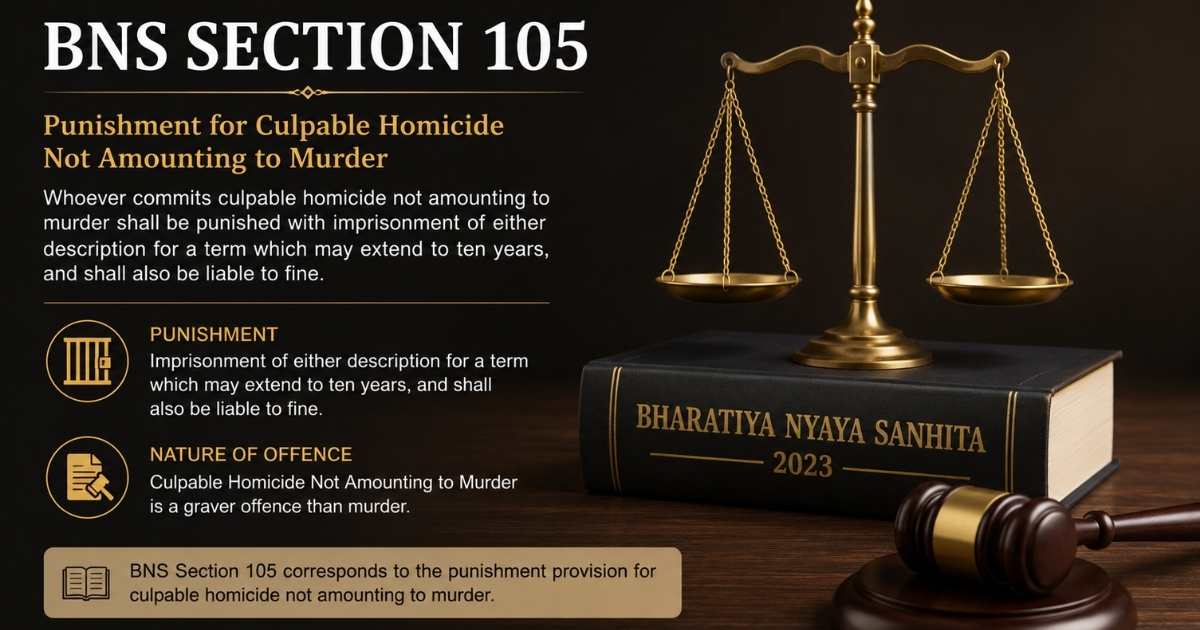

BNS Section 105 deals with culpable homicide not amounting to murder. It is part of India’s new criminal law, the Bharatiya Nyaya Sanhita, 2023. This law replaced the old IPC. Under BNS Section 105, a person can be punished for causing death without full murder intent. The law looks at intent and knowledge. Both matter a lot under BNS Section 105.
Many people search for BNS Section 105 to understand its meaning and punishment. This section is different from murder under Section 103 BNS. BNS Section 105 sets out two kinds of punishment. One is for intent. One is for knowledge alone. The offence is serious. It is non-bailable. Only a Sessions Court can grant bail. This guide explains BNS Section 105 in simple words. It covers punishment, bail, and legal defenses in detail.
Legal Definition of Section 100 & 105 BNS
Before you can understand the punishment, you need to understand the offence itself.
Section 100 BNS defines culpable homicide as causing death by an act done:
- With the intention of causing death, or
- With the intention of causing bodily injury likely to cause death, or
- With the knowledge that the act is likely to cause death
Section 105 BNS lays down the punishment for this offence. In essence, it states that whoever commits culpable homicide not amounting to murder shall face imprisonment for life, or a term that shall not be less than five years and may extend to ten years, along with a fine, if the act was done with intention. Where the act was done only with knowledge that death was likely without any intention to cause death or a fatal injury the punishment is imprisonment up to ten years, along with a fine.
In simple terms, Section 105 covers situations that fall short of murder but are far more serious than mere negligence think sudden fights, provoked attacks, or reckless acts like drunk or rash driving that end in death without a premeditated plan to kill.
Related POST: 302 IPC in BNS: Section 103(1) Mapping, Trial Procedure & Bail
Key Legal Elements of the Offense
For a conviction under Section 105 BNS, the prosecution has to establish each of the following:
- Death of a human being There must be conclusive proof that a person has died.
- Causal link to the accused’s act The death must be a direct consequence of the accused’s conduct.
- Requisite mental state The act must have been done either with intent (Part I) or with knowledge (Part II) that death was a likely outcome.
- Absence of murder-level intent The facts must not meet the higher threshold of premeditation or cruelty required to classify the act as murder under Section 103 BNS.
Courts typically look at the weapon used, the number of injuries, the part of the body targeted, and the surrounding circumstances to work out which of these mental states applies.
Section 299/304 IPC vs. Section 100/105 BNS
Practitioners familiar with the old code will recognize this provision instantly it’s a direct continuation of Sections 299 and 304 IPC, just renumbered and reorganized.
| Aspect | Old Law (IPC) | New Law (BNS) |
| Definition | Section 299 IPC | Section 100 BNS |
| Punishment | Section 304 IPC | Section 105 BNS |
| Part I punishment (intent) | Life imprisonment or up to 10 years, plus fine | Life imprisonment or 5–10 years, plus fine |
| Part II punishment (knowledge only) | Up to 10 years, or fine, or both | Up to 10 years, plus fine |
| Bail status | Non-bailable | Non-bailable |
| Trial court | Court of Session | Court of Session |
The most notable change is that BNS Section 105 introduces a mandatory minimum sentence of five years for the intent-based offence under Part I something the earlier IPC provision did not fix as strictly. This makes the new law slightly firmer in its deterrent effect while keeping the underlying legal philosophy the same.
Intent vs. Knowledge: Part I vs. Part II Punishment
The mental state of the accused legally called mens rea decides which part of Section 105 applies, and how harsh the sentence will be.
- Part I (Intention): Applies when the accused intended to cause death, or intended an injury that was likely to prove fatal. Punishment ranges from a minimum of five years’ imprisonment up to life imprisonment, along with a fine.
- Part II (Knowledge only): Applies when the accused had no intention to kill or injure fatally, but was aware their act could likely cause death. Punishment extends up to ten years’ imprisonment, along with a fine.
This distinction matters enormously at trial. For example, in a sudden street fight or a case of rash driving, defense lawyers often argue there was no deliberate intent to kill only an awareness of risk pushing the case toward the comparatively lighter Part II punishment.
Is BNS Section 105 Bailable or Non-Bailable?
Given the severity of the offence, bail under Section 105 is not straightforward.
- Non-bailable offence: Culpable homicide under Section 105 BNS is classified as non-bailable under the First Schedule of the Bharatiya Nagarik Suraksha Sanhita (BNSS), 2023. Bail is not a matter of right.
- Cognizable offence: Police can register an FIR and arrest the accused without needing a magistrate’s warrant first.
- Jurisdiction for bail: A magistrate’s court cannot grant regular bail in such cases. The application must go before the Court of Session or the High Court under Section 483 BNSS.
- Anticipatory bail: If a person fears arrest, they can apply for anticipatory bail under Section 482 BNSS before the Sessions Court or High Court.
How to Defend Against Culpable Homicide Charges
A charge under Section 105 carries serious consequences, so a well-built defense is critical. Common defense strategies include:
- Sudden fight (Exception 4, Section 101 BNS): Arguing the death occurred in a sudden quarrel, in the heat of passion, without the accused taking undue advantage or acting in a cruel manner.
- Private defense: Showing the accused acted to protect their own life or property, using force that was proportionate to the threat.
- Absence of intention or knowledge: Arguing the death was a genuine accident, which would fall instead under Section 106 BNS (death by negligence) a far less severe offence.
- Medical negligence or pre-existing condition: Demonstrating that the injury itself was not fatal, and that death actually resulted from a pre-existing illness or negligent medical treatment afterward.
Judicial Interpretation of Exception 4 (Sudden Fight) & Exception 1
Courts apply a strict four-part test before allowing an accused to claim the sudden-fight exception, which prevents the charge from escalating to murder under Section 103 BNS:
- Sudden quarrel: The fight must have started spontaneously, with no prior planning or premeditation.
- Heat of passion: The fatal act must have occurred while emotions were still running high from that sudden quarrel.
- No undue advantage: The accused must not have exploited a position of power for instance, using a lethal weapon against an unarmed victim.
- No cruel or unusual conduct: Repeated or brutal blows on a victim who was already defenseless will disqualify this defense entirely.
Closely related is Exception 1 (Grave and Sudden Provocation), which requires proof that the provocation was severe enough to make the accused temporarily lose self-control, and that the accused did not deliberately provoke the situation to create an excuse for violence.
FIR Registration & Medical Inquest
The process usually begins with an FIR under Section 105 BNS, since it is a cognizable offence. Police simultaneously initiate a medical inquest to determine the cause of death, and the body is sent for post-mortem examination.
Investigation and Seizure
Investigating officers collect the weapon or instrument used, forensic evidence, witness statements, and CCTV footage where available, and record the accused’s statement in accordance with procedure.
Committal to Sessions Court
Because Section 105 is triable exclusively by a Court of Session, the magistrate’s court commits the case after the chargesheet is filed, transferring the file for trial.
Sessions Trial
The Sessions Judge frames formal charges, records evidence from both prosecution and defense, hears final arguments, and delivers the judgment acquittal, conviction under Section 105, or in some cases a conviction under a related and lesser or graver section.
Legal Excellence
Handling a culpable homicide case demands more than textbook knowledge of the BNS it requires courtroom experience in cross-examining medical witnesses, challenging forensic reports, and building a credible narrative around intent versus knowledge. Engaging an advocate who has actually argued Sessions trials, rather than one working purely from theory, often makes the difference between a Part I and Part II outcome.
Official Statutory References & Databases
For verified legal text and updates, always cross-check with official government sources such as the India Code portal (indiacode.nic.in), the Ministry of Home Affairs notifications on the BNS and BNSS, and published Supreme Court and High Court judgments available through the National Judicial Data Grid. Relying on primary sources ensures you’re working with the current, authoritative version of the law rather than outdated commentary.
Conclusion
BNS Section 105 explains the law on culpable homicide not amounting to murder. It sets clear rules for intent and knowledge. This helps courts decide fair punishment. BNS Section 105 is a serious, non-bailable offence.
Understanding BNS Section 105 is useful for law students and the public. It also helps anyone facing a real case. The law under BNS Section 105 is strict but fair. It looks at facts, not just outcomes. If you need help with a case, talk to a criminal lawyer. They can guide you through BNS Section 105 and protect your rights.
