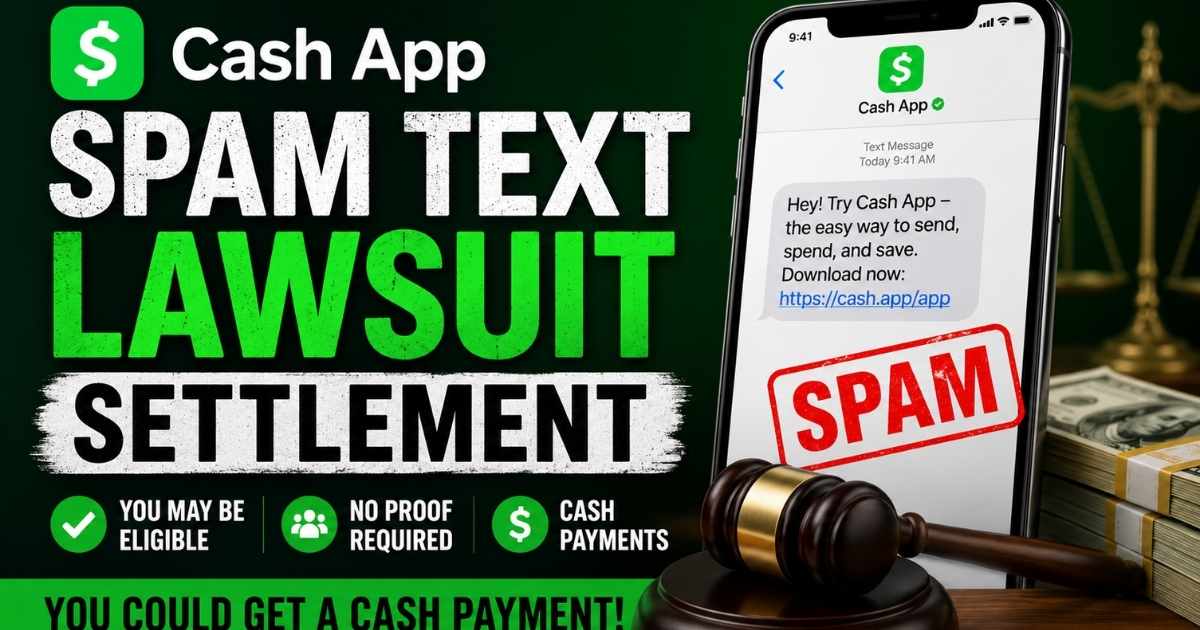

If you’re a Washington state resident who received an unexpected referral text from Cash App, you may have been part of one of the most talked-about consumer privacy cases in recent years. The Cash App spam text lawsuit settlement officially known as Bottoms v. Block, Inc. resulted in a $12.5 million class action settlement, with eligible claimants receiving $394.36 per accepted claim. This guide breaks down everything you need to know: who qualified, how the money was distributed, and where things stand today in 2026.
What Is the Cash App Spam Text Lawsuit Settlement?
The Cash App spam text lawsuit settlement is a $12.5 million agreement between Block, Inc. (the parent company of Cash App) and Washington state residents who received unsolicited commercial text messages through Cash App’s “Invite Friends” referral program. The case alleged that Block violated Washington’s Commercial Electronic Mail Act (CEMA) by helping users send spam texts to their contacts without the recipients’ consent.
The court granted final approval on December 2, 2025, and payment distribution began in February 2026.
Understanding the Cash App Spam Texts Lawsuit
The lawsuit centers on a simple but serious allegation: Cash App allowed and actively facilitated users to blast unsolicited text messages to their phone contacts. Recipients never agreed to receive these messages. Many found them confusing, intrusive, or even mistook them for phishing attempts.
The case was filed in the U.S. District Court for the Western District of Washington and drew significant attention because it targeted a mainstream fintech app used by tens of millions of Americans. Block denied all wrongdoing throughout the process, insisting it complied with all applicable state and federal laws.
Related Post: Section 132 of BNS in Hindi
Who Qualifies for the Cash App Settlement?
To be eligible for the settlement, a person had to meet all three of the following criteria:
| Eligibility Criteria | Details |
| Received a referral text | A Cash App “Invite Friends” text message was sent to your number |
| Time period covered | Between November 14, 2019, and August 7, 2025 |
| Washington state resident | Your phone number had a Washington state area code at the time |
| No prior consent given | You did not clearly and affirmatively opt in to receive such messages |
The estimated class size was approximately 1,975,187 people. However, only around 5% filed valid claims meaning nearly 1.9 million eligible individuals received nothing.
How Much Is the Cash App Settlement Payout Per Person?
Early estimates placed individual payouts between $88 and $147. However, because far fewer people filed claims than anticipated, the actual payout turned out to be significantly higher.
Final settlement award: $394.36 per accepted claim.
The lower claim volume meant the remaining funds after attorney fees and administrative costs were divided among a much smaller group of claimants.
Cash App Settlement Payment Date 2026
Here is the confirmed payment timeline:
- October 27, 2025 Claim filing deadline
- December 2, 2025 Court granted final approval of the settlement
- February 2, 2026 Payment distribution officially began
- March 18, 2026 Deadline for reissue requests
- April 8, 2026 Most checks expected to be delivered
If you filed a valid claim and have not received your check by April 8, 2026, you can contact the settlement administrator at info@BottomsTextSettlement.com or call 1-877-540-7545.
The Cash App $12.5 Million Settlement: Where Did the Money Go?
The total $12.5 million settlement fund was divided as follows:
- Attorney fees: $3.1 million (awarded by the court)
- Class representative award: $10,000 (for Kimberly Bottoms)
- Administrative costs: Covered from the fund (notice distribution, claim processing)
- Claimant payments: Approximately $8.7 million distributed among eligible claimants
This breakdown is standard in class action settlements. Attorneys receive a portion for funding and litigating the case, while the bulk of remaining funds go to class members.
Block Inc. Cash App Lawsuit: Who Is Block Inc.?
Block, Inc. (formerly Square, Inc.) is a financial technology company founded by Twitter co-founder Jack Dorsey. It operates several financial products, including:
- Cash App Peer-to-peer payment platform
- Square Point-of-sale payment processing
- Afterpay Buy now, pay later service
- TIDAL Music streaming platform
Cash App alone has tens of millions of active users across the United States. Block is headquartered in San Francisco and is publicly traded on the New York Stock Exchange (NYSE: SQ). In January 2025, Block separately agreed to pay $255 million to regulators over Cash App deficiencies a separate matter from this spam text settlement.
Bottoms v. Block Settlement: The Case That Started It All
The lawsuit traces back to Kimberly Bottoms, a Washington state resident who filed her complaint against Block in late 2023. She alleged that she began receiving text messages from acquaintances and friends using Cash App’s referral feature messages she never requested and never consented to.
Her case argued that Block, by building and operating the “Invite Friends” feature, was directly responsible for facilitating the transmission of unsolicited commercial messages to Washington residents a violation of CEMA.
During discovery, internal documents reportedly revealed that Block was aware of spam-related complaints associated with the referral feature. This evidence strengthened the plaintiffs’ position at the negotiating table. On June 30, 2025, the parties announced a proposed $12.5 million settlement.
How Cash App’s Invite Friends Feature Sent Spam Texts
Cash App’s “Invite Friends” feature worked like this:
- A Cash App user tapped the “Invite Friends” button inside the app.
- The app requested access to the user’s phone contact list.
- The user selected one or more contacts to invite.
- Cash App generated a pre-written text message with a personalized referral link.
- That message was sent from the user’s phone to their contact without the recipient’s prior consent.
The referral promised both parties a small financial incentive. But recipients had no say in whether they wanted to receive marketing messages. In many cases, recipients had no idea the message was coming, and some mistook the texts for phishing scams.
Washington CEMA and the Cash App Case
Washington’s Commercial Electronic Mail Act (CEMA) is one of the strongest state-level anti-spam laws in the country. Originally enacted to restrict spam emails, state legislators expanded the law in 2003 to cover text messages.
A critical provision of CEMA holds that not only the sender of an unsolicited commercial message can be held liable but also any third party that “initiates or assists” in transmitting such messages. This is the legal hook that made Block liable in this case.
Washington’s Attorney General, Nick Brown, was granted permission to intervene in December 2024 to defend the constitutionality of CEMA after Block challenged the law’s legal basis in court.
The Cash App Referral Text Lawsuit: Legal Arguments
Plaintiffs argued:
- Block knowingly built a system that sent unsolicited commercial texts to Washington residents
- Recipients never provided clear and affirmative consent
- Block qualifies as an entity that “assisted” in transmitting spam under CEMA
- Each text message exposed Block to statutory damages
Block’s defense argued:
- The texts were sent by users, not by Block directly
- Block complied with all applicable state and federal laws
- CEMA’s application to this situation was legally questionable
Despite these arguments, Block ultimately chose settlement over litigation a common decision when legal costs and reputational risk outweigh the settlement amount.
Cash App Settlement Eligibility: Washington State Residents
Eligibility was geographically restricted to Washington state. Specifically, your phone number had to have a Washington area code at the time you received the referral text. This is important the restriction applies to where your number was registered, not necessarily where you physically were when you received the text.
Washington area codes that would qualify include 206, 253, 360, 425, 509, and 564, among others.
Cash App Class Action Settlement 2025: Timeline of Events
| Date | Event |
| Late 2023 | Kimberly Bottoms files complaint against Block, Inc. |
| 2024 | Discovery phase; Attorney General intervenes in December |
| June 30, 2025 | Settlement of $12.5 million proposed |
| July 29, 2025 | Preliminary approval granted by Judge Pechman |
| August 7, 2025 | End of class period for receiving referral texts |
| October 27, 2025 | Claim filing deadline |
| December 2, 2025 | Final approval granted by Judge John Chun |
| February 2, 2026 | Payment distribution begins |
| April 8, 2026 | Most checks delivered |
How to File a Cash App Settlement Claim
The claim deadline has now passed (October 27, 2025). For those who filed on time, the process involved:
- Visiting the official settlement website at BottomsTextSettlement.com
- Submitting your claim form with your name, address, and phone number
- Confirming eligibility that you received a Cash App referral text as a Washington resident during the covered period
- Providing contact details for payment delivery (mailing address or direct deposit)
No proof of receiving the text was required claimants self-certified their eligibility under penalty of perjury.
Cash App Settlement Claim Deadline: What Happened After It Passed
The October 27, 2025 claim deadline was firm. Courts enforce class action deadlines strictly to allow for fair and timely administration.
If you missed the deadline, you are not eligible for a payment from this settlement. This outcome was common approximately 96% of eligible class members did not file claims, either because they:
- Never received the settlement notice
- Dismissed the notice as spam or a scam
- Simply forgot to submit before the deadline
Missing this settlement is a costly reminder of why it pays to take class action notices seriously, even if they appear in your junk mail.
Cash App Settlement Status Update: Where Things Stand in 2026
As of mid-2026, the Bottoms v. Block settlement is in its final distribution phase. The court-approved administrator EisnerAmper has been processing and mailing checks since February 2026. Reissue requests submitted by March 18, 2026 have been processed, with delivery expected by April 8, 2026.
If you filed a valid claim and are still waiting:
- Email: info@BottomsTextSettlement.com
- Phone: 1-877-540-7545
The settlement is winding down, and no new claims are being accepted.
FAQ’s
What is the Cash App spam text lawsuit settlement?
It is a $12.5 million class action settlement resolving allegations that Block, Inc. violated Washington’s anti-spam law by facilitating unsolicited referral text messages sent through Cash App’s “Invite Friends” program.
Who qualifies for the Cash App spam text settlement?
Washington state residents who received a Cash App referral program text between November 14, 2019, and August 7, 2025, without giving prior consent. The claim deadline has passed.
How much money will I get from the Cash App settlement?
Eligible claimants who filed before the October 27, 2025 deadline received $394.36 per accepted claim significantly more than the initially estimated $88–$147.
Has the Cash App settlement been paid out yet?
Yes. Payments began on February 2, 2026, and most checks were expected to arrive by April 8, 2026.
What if I missed the Cash App settlement claim deadline?
Unfortunately, no further claims are being accepted. The October 27, 2025 deadline has passed and the settlement is in its final stages.
Conclusion
The Cash App spam text lawsuit settlement stands as a clear example of consumer protection laws working as intended. A single Washington resident’s frustration with unwanted texts turned into a nearly two-year legal battle that delivered nearly $400 to thousands of claimants. The case also sent a meaningful message to the fintech industry: companies cannot build systems that push marketing messages to users without clear and informed consent.
For anyone who missed this settlement, the takeaway is straightforward pay attention to official class action notices, even when they look suspicious. Millions of dollars in legitimate compensation goes unclaimed every year simply because people don’t act in time. Stay informed, subscribe to class action alert services, and treat every verified settlement notice as the potential financial opportunity it truly is.
