


Getting arrested under the Narcotic Drugs and Psychotropic Substances Act, 1985 is frightening, and getting bail afterward feels even harder. Unlike most criminal cases, NDPS matters do not follow the usual bail rules. The law itself tilts against the accused, especially when the seizure involves a commercial quantity of drugs.
If you or someone in your family is facing an NDPS case, you need to understand how bail actually works here, what the courts look for, and where the real opportunities for relief lie. This guide breaks down the law, the conditions, and the practical process in plain language.
What are NDPS Cases in India?
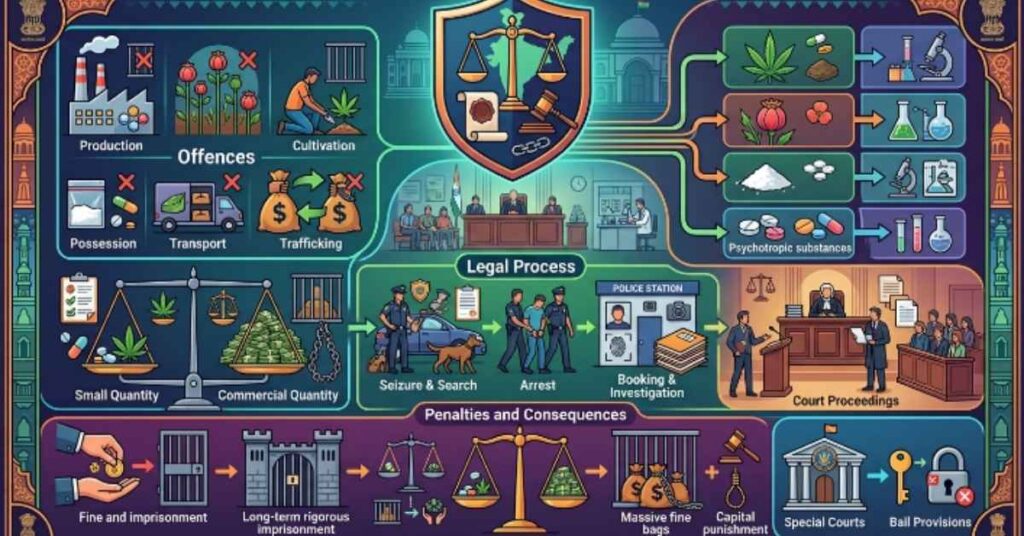
NDPS cases arise under the Narcotic Drugs and Psychotropic Substances Act, 1985, the primary law that regulates and penalises activities involving narcotic drugs and psychotropic substances in India. This includes possession, sale, purchase, transportation, cultivation, manufacture, and consumption of banned substances.
The Act classifies offences based on the quantity of the drug recovered:
- Small quantity: Minor offence, usually bailable, with lighter punishment.
- Intermediate quantity: Falls between small and commercial quantity, treated with moderate seriousness.
- Commercial quantity: The most serious category, attracting rigorous imprisonment and the strictest bail conditions.
The quantity threshold matters enormously because it decides which court can hear your bail application, how long the punishment can be, and whether the harsh Section 37 bail bar applies to your case at all. A case involving a few grams of a substance is treated very differently from one involving kilograms of the same substance.
Common charges under the Act include possession under Section 21, sale or purchase under Section 22, and financing or harbouring offenders under Section 27A. Each carries its own punishment structure tied to quantity.
Understanding Bail under the NDPS Act
Bail under the NDPS Act is not automatic, and it does not work the way bail works under ordinary criminal law. Under the Code of Criminal Procedure, bail is generally treated as the rule and jail as the exception. The NDPS Act reverses this presumption for serious offences, particularly those involving commercial quantity.
This means that even a first-time accused with no criminal history can find it difficult to get bail if the case involves a large recovery of narcotics. The legislature designed the Act this way to curb drug trafficking, but it also means that genuine cases of false implication or weak evidence need skilled legal representation to secure relief.
The Rigors of Section 37

Section 37 of the NDPS Act is the single biggest hurdle for anyone seeking bail in a commercial quantity case. It lays down what courts call the “twin conditions” that must be satisfied before bail can be granted:
- The Public Prosecutor must be given an opportunity to oppose the bail application.
- Where the prosecutor opposes bail, the court must be satisfied that there are reasonable grounds to believe the accused is not guilty of the offence, and that the accused is not likely to commit any offence while on bail.
Courts across the country have repeatedly held that these conditions are mandatory, not discretionary. The Supreme Court has clarified on multiple occasions, including in recent rulings through 2025 and 2026, that a special court or High Court cannot grant bail in a commercial quantity case without specifically recording satisfaction on both these conditions. Bail orders that skip this analysis are routinely set aside on appeal, even after the accused has already been released.
Importantly, the Supreme Court has also held that factors like prolonged incarceration or delay in trial cannot, by themselves, override the Section 37 bar. These factors can support a bail plea, but only alongside a genuine finding that the twin conditions stand satisfied. This is why NDPS bail applications need to be drafted with real legal precision rather than generic arguments about delay or custody period.
Confession under the NDPS Act: A Critical Turn
One of the most debated aspects of NDPS litigation is the evidentiary value of statements recorded by investigating officers during the probe. For years, prosecution agencies relied heavily on statements made by the accused to build their case, sometimes even in the absence of independent recovery witnesses.
This changed significantly after the Supreme Court’s landmark ruling in Tofan Singh v. State of Tamil Nadu, which examined whether officers empowered under the NDPS Act can be treated as police officers for the purpose of recording confessions.
The Status of Section 67 Statements
In Tofan Singh, a three-judge bench of the Supreme Court held that officers investigating under Section 53 of the NDPS Act are “police officers” within the meaning of the Indian Evidence Act. As a result, any confessional statement recorded by them under Section 67 of the NDPS Act cannot be used as a confession to convict the accused, since it falls within the same bar that applies to confessions made to the police.
This ruling changed the landscape for defence lawyers. Where the entire case against an accused rests on a Section 67 statement, without independent corroboration such as recovery, seizure witnesses, or forensic evidence, the case for bail becomes considerably stronger. Courts examining bail pleas now routinely look at whether the prosecution’s evidence goes beyond the disclosure statement, and if it does not, this is treated as a significant factor in favour of the accused.
That said, prosecuting agencies continue to argue this point differently in each case, and outcomes vary depending on the facts and the bench. This makes it essential to have the statement examined carefully by a lawyer who understands how this defence has actually played out in recent judgments.
Contact now- 91 9967315556
Key Grounds for Seeking Bail in NDPS Cases
While Section 37 makes bail difficult, it is not impossible. Courts have granted bail in commercial and intermediate quantity cases where the investigation shows clear procedural lapses or where prolonged detention becomes disproportionate to the alleged offence. Here are the grounds that carry real weight before the court.
1. Non-Compliance with Section 42
Section 42 requires officers to record, in writing, information received about a drug offence before conducting a search, arrest, or seizure without a warrant, and to send a copy of that record to a superior officer, generally within 72 hours. Courts have held that this requirement is intended to introduce a check on arbitrary raids.
When officers fail to record such information, or fail to forward it to their superior within the required time, the search and the resulting recovery can be questioned. While courts assess the impact of this lapse on a case-by-case basis, a clear breach of Section 42 is a strong point to raise at the bail stage, particularly when combined with other irregularities.
2. The Right to be Searched (Section 50)
Section 50 gives a person about to be searched the right to be taken to the nearest Gazetted Officer or Magistrate for that search, rather than being searched by the same officer who is conducting the raid. The Supreme Court has repeatedly stressed that this safeguard exists to ensure the search is conducted fairly, by someone independent of the raiding team.
If the accused was not clearly informed of this right, or if the notice given to them was vague or defective, this is treated as a serious procedural violation. Courts have granted bail and even quashed convictions where this mandatory requirement was not properly followed, since a large share of NDPS prosecutions rest entirely on what is recovered during a personal search.
3. Sampling and Inventory (Section 52A)
Section 52A lays down the procedure for drawing samples from the seized contraband and preparing an inventory, ideally in the presence of a Magistrate. This step matters because it determines whether the substance produced before the court during trial is genuinely the same substance that was seized at the time of arrest.
Delays in sampling, missing inventory records, or failure to follow the Magistrate-supervised procedure can raise doubts about the integrity of the seized material. When the defence can show that this chain of custody is broken or irregular, it becomes a meaningful ground to argue that the prosecution’s case is weak on its own facts, which directly feeds into the “not guilty” limb of Section 37.
4. Prolonged Incarceration
Article 21 of the Constitution guarantees the right to a speedy trial. NDPS trials often take years to conclude because of the volume of evidence, forensic reports, and the number of witnesses involved. When an accused has already spent a substantial period in custody with little realistic prospect of the trial finishing soon, courts have granted bail on humanitarian and constitutional grounds.
However, as reaffirmed by the Supreme Court in several recent decisions, prolonged custody alone cannot substitute for the Section 37 finding in commercial quantity cases. It works best as a supporting argument, presented alongside genuine weaknesses in the prosecution’s evidence, rather than as a standalone plea.
The Procedure for Bail in NDPS Cases in India
Filing and arguing an NDPS bail application involves several distinct stages. Here is how the process typically unfolds.
- Arrest and initial remand: After arrest, the accused is produced before the jurisdictional Magistrate or Special Court within 24 hours, and is generally remanded to judicial or police custody for investigation.
- Filing the bail application: Depending on the quantity involved, the application is filed before the Special Court designated to try NDPS offences, or before the High Court if relief is denied below.
- Notice to the Public Prosecutor: Under Section 37, the prosecutor must be heard before bail can be considered in cases involving commercial quantity, which is a mandatory step that cannot be skipped.
- Hearing and arguments: Both sides present their case. The defence typically argues on the grounds discussed above, procedural lapses, weak evidence, delay, and lack of corroboration, while the prosecution relies on the seizure memo, forensic report, and the gravity of the offence.
- Court’s satisfaction under Section 37: For commercial quantity cases, the court must specifically record its satisfaction on the twin conditions before granting bail.
- Bail order and conditions: If bail is granted, the court imposes conditions such as furnishing a bond and sureties, surrendering the passport, regular attendance before the investigating officer, and restrictions on leaving the jurisdiction without permission.
- Appeal, if refused: If the Special Court rejects bail, the accused can move the High Court, and thereafter the Supreme Court if required.
Every stage of this process depends on how well the facts of the case are presented and how effectively procedural lapses are identified from the case diary and seizure documents. A generic application rarely succeeds in NDPS matters, and courts expect specific, documented arguments.
Why Representation Matters: The Role of Adv. Dhanashree A. Bankhele
NDPS cases are technical, fact-heavy, and unforgiving of procedural shortcuts, which is exactly why the quality of legal representation makes a real difference to the outcome. Adv. Dhanashree A. Bankhele has handled NDPS matters at various stages, from remand and bail applications to trial and appellate proceedings, with close attention to procedural compliance under Sections 42, 50, and 52A.
A well-prepared NDPS bail plea requires going through the case diary line by line, checking timelines against statutory requirements, cross-checking the seizure and sampling record, and assessing whether the confession or disclosure statement can withstand scrutiny after Tofan Singh. This kind of detailed groundwork, combined with a clear understanding of how courts have been deciding Section 37 pleas recently, is what separates a bail application that gets rejected from one that succeeds.
If you are dealing with an NDPS case, whether for yourself or a family member, getting the right legal opinion early, ideally before the first remand hearing, can shape how the rest of the case unfolds.
Conclusion
Bail in NDPS cases is never a simple formality, and the seriousness of the law reflects how strictly Parliament wanted these offences treated. But strict does not mean impossible. Procedural safeguards under Sections 42, 50, and 52A exist precisely to check misuse of power during investigation, and genuine lapses in following them can and do result in bail being granted.
The key is to approach your case with a clear strategy rather than hope. Understand which quantity category applies to you, examine the search and seizure process carefully, look closely at any statement recorded under Section 67, and build your bail plea around specific, provable defects rather than general appeals for leniency. With the right documentation and the right lawyer, even a difficult NDPS case can find a path to bail.
FAQs
Is bail possible in a commercial quantity NDPS case?
Yes, but it is harder to obtain. The court must be satisfied that the twin conditions under Section 37 are met before granting bail in such cases.
How long does an NDPS bail application take to be decided?
There is no fixed timeline. It depends on the court’s workload, whether the Public Prosecutor has been heard, and the complexity of the case.
Can bail be granted just because the accused has been in custody for a long time?
Prolonged custody alone is usually not enough in commercial quantity cases. It supports the bail plea only when combined with other genuine grounds.
Is a confession recorded under Section 67 of the NDPS Act valid evidence?
No. Following the Tofan Singh judgment, such statements cannot be treated as a confession to convict the accused since the recording officer is considered a police officer.
What happens if the police do not follow Section 50 while searching a person?
Failure to properly inform the accused of the right to be searched before a Gazetted Officer or Magistrate can weaken the prosecution’s case and support a bail application.
Does small quantity possession lead to immediate bail?
Small quantity offences are generally bailable and less severe, so bail is comparatively easier to obtain than in intermediate or commercial quantity cases.
Which court should I approach for an NDPS bail application?
The application is usually filed before the Special Court designated for NDPS offences, with the option to move the High Court if bail is refused.
