

If you’re an advocate handling a fresh FIR, or a litigant trying to understand a notice you just received, chances are you’ve run into Section 126(2) BNS the wrongful restraint provision under the Bharatiya Nyaya Sanhita, 2023. It replaced the familiar Section 341 IPC on July 1, 2024, and while the core wording hasn’t changed much, the punishment, procedure, and bail mechanics under the new codes have. This guide breaks down the ingredients of the offence, the statutory defences, and the practical steps for bail, compounding, and trial under the BNS and BNSS.
Bail Bond Amount Calculator
Wondering what a court might expect as surety in a wrongful restraint matter? A rough bail bond estimate based on offence type, severity of the alleged act, and the accused’s prior record can help you plan before your first hearing. Since Section 126(2) BNS is bailable, the amount is usually modest and largely a matter of local court practice rather than a fixed statutory figure.
Legal Excellence at a Glance
| Detail | Under BNS/BNSS |
| Governing section | Section 126(2), BNS 2023 |
| Old IPC equivalent | Section 341, IPC 1860 |
| Maximum fine | ₹5,000 (up from ₹500 under IPC) |
| Imprisonment | Simple, up to 1 month |
| Bail status | Bailable |
| Compounding | Permitted without court’s leave |
Section 126(2) BNS Wrongful Restraint: Comparative Reference to IPC 341
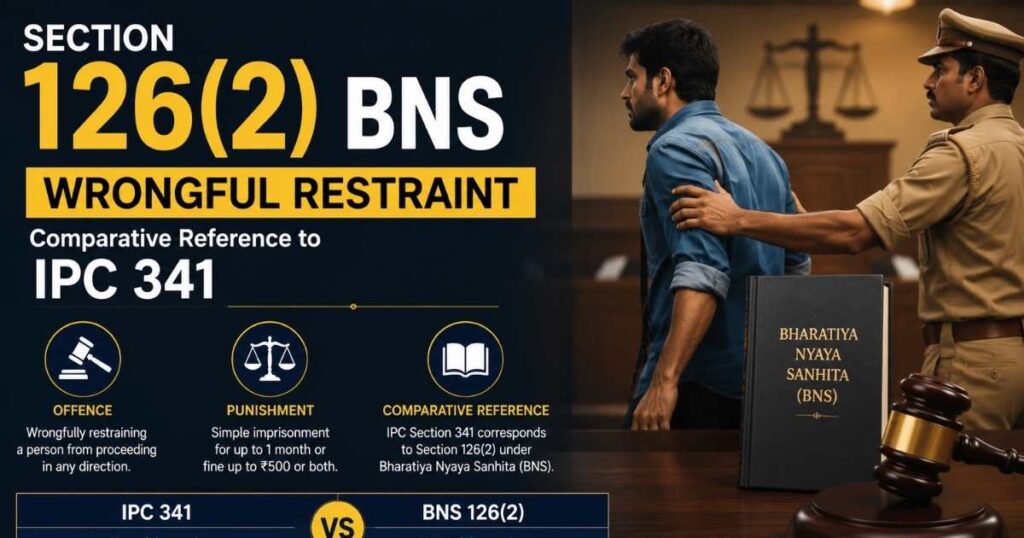
Wrongful restraint punishes anyone who voluntarily stops another person from moving in a direction they’re legally entitled to go. The definition sits in Section 126(1) BNS, while Section 126(2) prescribes the punishment. Under the old code, this was split across Section 339 IPC (definition) and Section 341 IPC (punishment) so if you’re cross-referencing an older judgment or a pending matter, that’s the section to look for.
The most visible change practitioners notice is financial. The IPC capped the fine at a token ₹500, which made the offence almost trivial to settle. The BNS raises that ceiling tenfold to ₹5,000, while keeping the one-month simple imprisonment term unchanged. This shift matters in plea discussions and compounding negotiations, since the monetary stakes are no longer negligible.
| Aspect | Old Law (IPC/CrPC) | New Law (BNS/BNSS) |
| Definition | Section 339 IPC | Section 126(1) BNS |
| Punishment | Section 341 IPC | Section 126(2) BNS |
| Fine cap | ₹500 | ₹5,000 |
| Bail | Section 436 CrPC | Section 482 BNSS |
| Compounding | Section 320 CrPC | Section 359 BNSS |
It’s worth remembering the transitional rule: offences committed before July 1, 2024 are still tried under the IPC and CrPC, even if the case is heard today. Only post-transition conduct falls under Section 126(2) BNS.
Related Post: Mobile Lost Complaint Online: CEIR & Police Portal Guide (2026)
Core Ingredients, Exceptions, and Bare Act Notes
To convict under Section 126(2) BNS, the prosecution has to prove three things:
- Voluntary act – the accused deliberately obstructed the complainant, knowing or intending that the act would block their movement.
- Actual prevention – the obstruction genuinely stopped the person from proceeding, not merely inconvenienced them.
- A pre-existing right to proceed – the complainant must have had a lawful right to use that specific path or direction at the time.
A purely verbal warning, without any physical act or credible threat of force, generally won’t meet the threshold. Courts have consistently distinguished wrongful restraint (blocking one route while others remain open) from wrongful confinement under Section 126(3) BNS, which is a total curtailment of liberty.
The statute also carries a built-in defence. The proviso to Section 126(1) protects a person who, in good faith, believes they have a lawful right to obstruct a private path over land or water. This is the single most important line for anyone defending a property or boundary dispute if your client had a genuine, honest belief in their ownership or right of way, the act isn’t an offence at all, regardless of whether that belief later turns out to be legally incorrect.
Filing and Bail Procedure under the BNSS
Because Section 126(2) BNS is bailable, the accused has a statutory right to release but that right is often complicated in practice when police club it with heavier charges. Here’s a step-by-step approach.
FIR Scrutiny and Section Verification
Check whether Section 126(2) BNS stands alone or has been bundled with a non-bailable offence such as criminal trespass or hurt. This single check often decides the entire bail strategy.
Demanding Station Bail under Section 482 BNSS
If wrongful restraint is the only offence in the FIR, the accused can insist on release directly from the police station by offering a personal bond or local surety, without waiting for a magistrate.
Filing Regular Bail before the Magistrate
Where police resist station bail, or additional sections are involved, a formal bail application under Section 480 BNSS before the Judicial Magistrate First Class is the next step.
Invoking the Compounding Process under Section 359 BNSS
Since the offence is compoundable without needing the court’s prior permission, a signed compromise between the parties can end the case at almost any stage, often before trial even begins.
Objecting to Summary Trial Escalation
If the magistrate opts for a summary trial under Section 283 BNSS, defence counsel should ensure the mandatory procedural steps recording evidence and the accused’s statement are properly followed, since shortcuts here are common grounds for appeal.
Jurisdictional Variations and High Court Jurisprudence
Practice on the ground isn’t uniform. Some registries are stricter than others about local sureties for out-of-state accused persons, and a few insist on a “section mapping” note connecting the old IPC provision to its BNS counterpart for smoother processing. Several High Courts have also reinforced that detaining a person beyond the standard production window for a bailable offence like this raises a constitutional liberty concern under Article 21. Advocates should check local registry practice notes before filing, since procedural rejections can delay a client’s release far more than the merits of the case itself.
Common Mistakes and Procedural Pitfalls in Wrongful Restraint Trials
- Citing the repealed Section 341 IPC for offences committed after the transition date.
- Treating a verbal objection as sufficient proof of restraint without any physical act.
- Forgetting to plead the private-way good-faith proviso in property disputes.
- Not objecting when digital evidence (CCTV, phone footage) is produced without the certificate required under the Bharatiya Sakshya Adhiniyam.
- Failing to challenge padded FIRs that add non-bailable sections just to justify custody.
- Overlooking early compounding, which can close a minor neighbourly dispute in weeks instead of years.
Trial Strategies, Cross-Examination, and Defense Tactics
A strong defence usually rests on three pillars: showing an alternative route existed, documenting any parallel civil dispute over the land or path, and testing the complainant’s version through cross-examination. Useful lines of questioning include asking whether the disputed path lies on the accused’s own registered property, whether any physical barrier (not just words) actually blocked movement, and whether the investigating officer verified revenue records before filing the charge sheet. Establishing any one of these convincingly is often enough to break the prosecution’s case.
Get BNS & Criminal Litigation Leads Join JuriGram

Understanding the new criminal codes keeps you sharp in court, but growing your practice takes more than legal knowledge. JuriGram connects advocates directly with clients who need criminal defence and bail representation no commission, no monthly fee, and a live profile within 24 hours.
More Guides in This Category
- Section 126(2) BNS bailable or non-bailable
- 115(2) BNS
- 126(2) BNS punishment
- 126 BNS in IPC section
- 126 BNS is bailable or not
- 115(2) BNS bailable or not
- 126 BNSS in CrPC section
- 126(2) BNS in Kannada
FAQ’s
Is Section 126(2) BNS bailable or non-bailable?
It is bailable, meaning the accused can claim release as a matter of right rather than at the court’s discretion.
What is the punishment under Section 126(2) BNS?
Simple imprisonment up to one month, a fine up to ₹5,000, or both.
Which IPC section does 126(2) BNS correspond to?
It corresponds to Section 341 of the erstwhile Indian Penal Code, 1860.
Is wrongful restraint under BNS compoundable?
Yes, the person restrained can compound it without needing the court’s prior permission.
Can a wrongful restraint case be settled out of court?
Yes, through the compounding process under Section 359 BNSS, once both parties agree.
Does obstructing a private path always amount to wrongful restraint?
No, if the obstruction is done in good faith with an honest belief of lawful right, the proviso to Section 126(1) BNS exempts it.
Conclusion
Section 126(2) BNS carries the same everyday relevance that Section 341 IPC once did most wrongful restraint disputes still grow out of boundary disagreements, tenancy friction, or neighbourhood flare-ups rather than serious criminality. What has genuinely changed is the framework around it: a steeper fine, new bail and compounding routes under the BNSS, and evidentiary rules under the Bharatiya Sakshya Adhiniyam that didn’t exist before. For anyone facing or defending such a charge, the fundamentals remain the same prove or disprove voluntary obstruction, a real prevention of movement, and a genuine right to proceed.
For advocates, the real skill lies in recognising when a “criminal” complaint is actually a civil property dispute wearing a first information report, and moving quickly to invoke the good-faith proviso, station bail, or compounding before a minor dispute turns into a prolonged trial. Staying current with these procedural shifts isn’t just good lawyering it’s what keeps clients out of avoidable custody and cases out of unnecessary courtrooms.
