
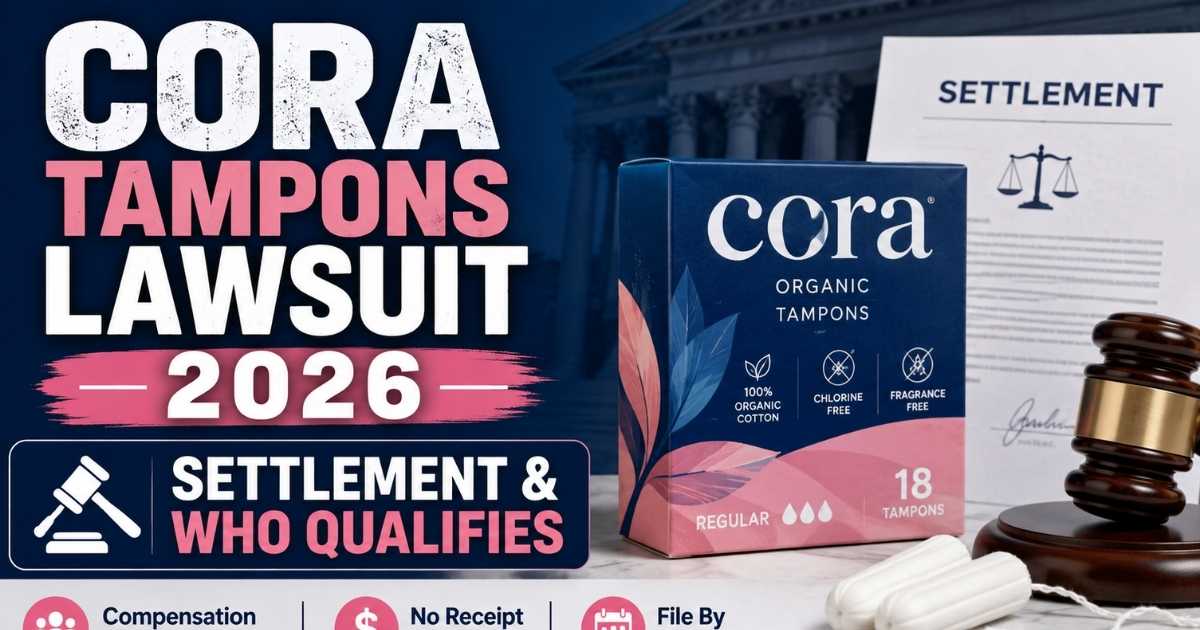

The Cora tampons lawsuit is making headlines in 2026 and for good reason. Millions of women bought Cora products believing they were safe, clean, and truly organic. Now independent lab testing has allegedly found PFAS chemicals inside those same products. PFAS are synthetic “forever chemicals” linked to serious health risks. If you purchased Cora tampons anytime between 2018 and 2025, you may already qualify for compensation. You don’t need to prove you got sick. You just need to have bought the product.
This lawsuit is a federal class action targeting false advertising and undisclosed chemical contamination. Courts are currently reviewing the evidence. A settlement is expected later in 2026. The claims window will open soon and it will close fast. Start gathering your purchase records now so you don’t miss your chance.
Cora Tampons Lawsuit: What You Need to Know in 2026
The Cora tampons lawsuit is a federal class action claiming that Cora’s tampons, pads, liners, and period underwear contained undisclosed synthetic chemicals specifically PFAS despite being marketed as organic, toxin-free, and “better for your body.”
Settlement negotiations are actively underway in 2026. Courts are evaluating both the class size and the chemical testing evidence submitted by plaintiffs. Unlike lawsuits targeting individual product defects, this case challenges Cora’s entire brand identity as a “clean period care” company.
Related Post: Section 106 BNS in Hindi
| Case Detail | Information |
| Lawsuit Type | Federal Class Action |
| Defendant | Cora (feminine hygiene brand) |
| Core Allegation | PFAS contamination + false organic advertising |
| Products Involved | Tampons, pads, liners, period underwear |
| Class Period | Approximately 2018–2025 |
| Current Status | Active; settlement negotiations ongoing |
| Court | U.S. Federal District Court |
What Is the Cora Tampon Lawsuit Actually About?
At its core, this lawsuit is about a broken promise. Cora built its brand around being the safer, cleaner alternative to conventional period products. That identity now under legal scrutiny is precisely what plaintiffs say deceived them.
The case rests on four legal theories:
- Product liability The products allegedly contained chemicals never disclosed on the label
- Consumer fraud Organic and “clean” marketing claims were allegedly misleading
- Unjust enrichment Consumers paid a premium price for safety they may not have received
- Breach of warranty Products did not perform as explicitly promised
Crucially, you don’t need to prove you got sick to have a valid claim. The false advertising angle means anyone who paid more for a product based on inaccurate marketing may be entitled to compensation.
Cora Organic Tampons Class Action: How It Started
The Cora class action traces its roots to a wave of independent lab testing conducted between 2022 and 2024. Consumer safety organizations and investigative journalists began submitting popular organic tampon brands to third-party chemical analysis laboratories.
When Cora products allegedly returned detectable PFAS levels in those tests, plaintiffs had the scientific foundation needed to file suit. The first complaints appeared in federal court in 2023 and 2024. As more consumers came forward with similar experiences, individual filings began consolidating into the broader class action structure we see in 2026.
The pattern mirrors earlier PFAS litigation in other industries independent testing reveals a gap between marketing claims and actual product contents, and large-scale litigation follows.
Cora Tampons Lawsuit Update
As of mid-2026, here is where the case stands:
| Litigation Track | Current Status |
| Class certification | Filed or pending |
| Discovery | Active internal documents being reviewed |
| Settlement negotiations | Ongoing |
| Preliminary court approval | Expected Q3 2026 |
| Personal injury track | Individual consultations ongoing |
Discovery has been particularly significant. Plaintiffs’ attorneys are reviewing internal company communications, product testing records, and manufacturing documents from Cora. Courts have not dismissed the core claims a strong signal that the plaintiffs’ legal theories have enough merit to move forward, which materially strengthens their settlement position.
Watch for a preliminary settlement announcement in the third quarter of 2026. That announcement triggers the formal claims filing period.
Are Cora Tampons Toxic? What the Testing Shows
Independent testing has detected what appear to be PFAS markers in certain Cora tampon products. Whether that constitutes “toxic” depends on concentration levels and duration of exposure a debate that continues in scientific circles.
What the testing confirmed, according to consumer advocacy groups, is that PFAS chemicals were present in products explicitly marketed as free of synthetic substances. That contradiction alone carries legal weight, regardless of where the toxicity debate lands.
| Testing Source | Key Findings |
| Independent consumer labs | Detectable PFAS in select Cora products |
| Environmental advocacy groups | PFAS levels above detection thresholds |
| Cora’s internal position | Products meet current regulatory standards |
| Scientific consensus | No established safe PFAS exposure level exists |
Cora has disputed characterizations of its products as dangerous and pointed to regulatory compliance. Plaintiffs counter that existing standards are outdated and that no safe exposure level for PFAS has ever been established.
PFAS in Organic Tampons: The Chemical Concern Explained
PFAS per- and polyfluoroalkyl substances are a group of more than 12,000 synthetic chemicals used in manufacturing for their resistance to water, heat, and staining. They appear in non-stick cookware, food packaging, firefighting foam, and, allegedly, some feminine hygiene products.
The reason PFAS in tampons raises such alarm is biology. Vaginal tissue is among the most permeable in the human body, meaning absorption rates for internally introduced chemicals can significantly exceed typical topical skin exposure.
Key facts about PFAS exposure risk:
- PFAS do not break down naturally in the body or environment hence the term “forever chemicals”
- Exposure is cumulative; health effects build over years of repeated use
- Scientific studies have linked PFAS to thyroid disruption, immune interference, elevated cancer risk, and reproductive harm
- No federal agency has set a safe PFAS limit specifically for feminine hygiene products
That regulatory gap doesn’t mean the exposure is safe. It means the standard hasn’t caught up yet and that gap is exactly what this litigation is addressing.
What PFAS Chemicals Were Found in Cora Tampons?
The specific compounds most frequently flagged in tampon-related PFAS testing across the industry include:
- PFOA (Perfluorooctanoic acid) Linked in studies to kidney and testicular cancer
- PFOS (Perfluorooctane sulfonate) Associated with immune and thyroid disruption
- Short-chain PFAS variants Newer chemical substitutes with growing health concern data
- Total organic fluorine indicators Used by some labs as a proxy for overall PFAS presence
The most credible test results in the Cora litigation come from labs using liquid chromatography-mass spectrometry the gold standard for PFAS detection. The exact compounds named in the filings are part of the evidentiary record, with more specifics expected to surface publicly as 2026 discovery proceeds.
Cora Tampon False Advertising Claims: What Plaintiffs Allege
The false advertising angle may actually be the strongest part of this lawsuit. Plaintiffs don’t need to prove individual health harm they need to prove that consumers paid more for a product than its actual value, based on claims that weren’t accurate.
Cora’s branding has prominently featured language like “organic cotton,” “free from harmful chemicals,” and “clean period care.” Those claims justify a higher price than conventional period products.
| Cora’s Marketing Claim | Plaintiff Allegation |
| “Organic cotton” | PFAS not associated with organic certification |
| “Free from harmful chemicals” | PFAS allegedly detected in independent testing |
| “Better for your body” | No health benefit if toxic chemicals are present |
| “Clean period care” | Definition of “clean” allegedly not met |
Under FTC guidelines, advertising claims must be truthful, not misleading, and backed by substantiation. Plaintiffs argue Cora failed on all three fronts.
Who Qualifies for the Cora Tampon Lawsuit?
You likely qualify if you purchased any Cora tampon, pad, liner, or period care product in the United States during the class period roughly 2018 through 2025.
You do not need to prove you were personally harmed. The consumer fraud class action claim covers anyone who paid for these products based on allegedly false advertising.
| Eligibility Factor | Details |
| Who qualifies | U.S. consumers who purchased Cora products |
| Purchase window | Approximately 2018–2025 |
| Proof of harm required | No for the consumer fraud/false advertising track |
| Health injury track | Separate; requires documented medical concerns |
| Geographic requirement | Must be a U.S. resident at time of purchase |
Cora Tampon Lawsuit Eligibility Requirements Broken Down
To qualify for the class action settlement, you must meet these criteria:
- You purchased Cora tampons, pads, liners, or related products in the U.S.
- Your purchase occurred within the defined class period
- You have not previously released Cora from related legal claims
- You are an individual consumer, not a business entity
- You were a U.S. resident at the time of purchase
Consumers who purchased through Cora’s subscription service may have an easier time documenting purchases, since subscription records already exist on file with the company.
Do You Need a Receipt to File a Cora Tampon Claim?
No most class action settlements of this type allow self-certification. You sign a declaration stating, under penalty of perjury, that you made qualifying purchases. Courts accept this because requiring receipts for everyday consumer products would shut out most legitimate claimants.
That said, documentation directly affects your payout tier. Acceptable records include:
- Bank or credit card statements showing a Cora purchase
- Email order confirmations from Cora’s website
- Amazon order history
- Subscription service shipment records
- Loyalty program purchase history from Target, CVS, or Walgreens
- Photos of packaging with visible lot numbers
Self-certified claims with no documentation typically receive a lower standard payment. Claims with supporting records qualify for a higher compensation tier.
Cora Tampon Lawsuit Settlement Amount: What’s on the Table?
No final settlement figure has been court-approved as of mid-2026. Legal analysts tracking comparable PFAS and false advertising consumer product cases estimate the total settlement fund could range from $15 million to over $100 million, depending on class size and evidence strength.
For individual claimants, expected per-person payouts break down roughly as follows:
| Claim Type | Estimated Payout Range |
| Basic claim, no documentation | $10 – $30 |
| Claim with purchase records | $30 – $150 |
| High-volume documented purchases | $150 – $300 |
| Documented health impact claim | $300 – $500+ |
| Personal injury track (separate) | Potentially higher, case by case |
These are estimates based on comparable settled cases. Final amounts depend on court approval and total claims filed.
How Much Will You Get from the Cora Tampon Lawsuit?
Your individual payout depends on three things: purchase volume, documentation quality, and total claims filed before the deadline.
That last point matters more than people realize. Class action settlements have a fixed money pool. More valid claims filed means a smaller share for each individual claimant which is a real reason to file early and file correctly.
A simple way to estimate your range:
- Occasional buyer, no records → $10–$30
- Regular buyer with some documentation → $50–$150
- Subscription customer with account history → Higher documentation tier
- Health concerns linked to PFAS exposure → Consult an attorney about the personal injury track
Cora Tampon Class Action Payout 2026: Payment Timeline
Settlement payments in federal class actions typically take 12 to 24 months from final court approval to reach claimants. Based on current case trajectory:
| Phase | Projected Timing |
| Settlement negotiations | Ongoing, mid-2026 |
| Preliminary court approval | Q3 2026 (estimated) |
| Claims filing period opens | Following preliminary approval |
| Objection and opt-out period | 30–60 days post-notice |
| Final approval hearing | Late 2026 (estimated) |
| Payment distribution | 2027, post-final approval |
Payments are typically distributed as checks, prepaid debit cards, or digital transfers via PayPal or Venmo, depending on the administrator’s chosen method.
How to File a Cora Tampon Lawsuit Claim Step by Step
- Confirm your eligibility Verify you purchased a qualifying Cora product during the class period
- Gather documentation Pull bank statements, emails, subscription history, or any other purchase records
- Access the official claims portal Once preliminary settlement approval is granted, a dedicated website will launch. Do not use third-party sites
- Complete the claim form Provide basic personal information, describe your purchases, and select your documentation tier
- Submit before the deadline Save your confirmation number or take a screenshot
- Wait for follow-up The administrator will contact you if additional information is needed
⚠️ Filing is always free. Never pay anyone to file your claim. Never provide your Social Security number to a third-party filer.
Cora Tampon Claim Deadline 2026: Do Not Miss This Date
The final claims deadline has not yet been set, as of mid-2026 the settlement is still awaiting preliminary court approval. Once the court approves the settlement structure, the claims window typically runs 60 to 120 days.
What you should do right now:
- Start collecting all purchase documentation immediately don’t wait for the notice
- Sign up for case updates through the official settlement administrator’s mailing list once announced
- If you believe you have PFAS-related health effects, consult an attorney separately about the personal injury track
- Be aware that the opt-out deadline is separate from the claims deadline missing the opt-out window means accepting the class settlement
Cora Tampon Lawsuit Status Update 2026
The Cora tampon lawsuit is real, active, and heading toward a settlement that will affect millions of consumers. Discovery is producing the most substantive evidence internal documents, testing records, and corporate communications that can shift negotiations significantly in the plaintiffs’ favor.
Courts have refused to dismiss the core claims, which signals that the legal theories are strong enough to proceed and gives plaintiff attorneys considerably more leverage at the negotiating table.
Related Lawsuits and Consumer Comparisons
Rael Tampons Lawsuit
The Rael class action lawsuit follows a nearly identical legal path. Plaintiffs allege that Rael Inc. marketed its tampons, pads, and liners as “natural” and “organic” while testing allegedly revealed synthetic fibers including polypropylene, polyethylene, and undisclosed chemical compounds. The case was filed in California federal court under the state’s Unfair Competition Law. In 2026, the settlement process was reopened to allow additional eligible consumers to file claims and recover a share of remaining settlement funds.
LOLA Tampons Lawsuit
LOLA faces a separate but related class action centered on false advertising claims. The lawsuit alleges that LOLA marketed its products as “100% organic cotton” while the tampons allegedly contained synthetic materials and potentially unlabeled substances. The brand’s “gynecologist-approved” labeling has been cited as a particularly strong hook in the false advertising argument, since consumers reasonably interpret that endorsement as a safety guarantee. Comparable cases including a $7 million Kotex settlement serve as precedent.
Tampax Class Action Lawsuit Claim Form
Tampax (Procter & Gamble) is facing dual-track litigation in 2026. One case (Bounthon v. P&G) alleges PFAS in its “Pure Cotton” line despite organic marketing. A second class action alleges lead levels in Tampax Pearl products between 12 and 40 times the EPA’s drinking water action threshold. As of March 2026, the PFAS case remains active in California federal court after P&G’s dismissal motion was denied. No open settlement claim form exists yet for Tampax.
Consumer Reviews and Discussions
Cora Tampons Review
Outside of legal scrutiny, Cora has maintained a loyal consumer base. Shoppers frequently cite soft texture, reliable absorption, and the brand’s plastic-free applicator as positives. The brand earns high marks on Target, Amazon, and its own website with many reviewers specifically mentioning they switched to Cora for health reasons. The lawsuit has not prompted a recall, and Cora products remain commercially available.
Cora Tampons Lawsuit Reddit
Reddit communities including r/TwoXChromosomes, r/PeriodAdvice, and r/ClassActionLawsuits have seen significant discussion around the Cora tampon lawsuit in 2026. Common threads include: consumer concern about PFAS exposure, questions about how to document purchases for claims, skepticism about whether small settlement payouts are worth the effort, and comparisons to the Rael and LOLA cases. Reddit discussions are not legal advice always verify information through official case sources.
Where to Buy Cora Tampons
Cora products remain widely available despite ongoing litigation. No court order or product recall has restricted sales.
Cora Tampons Near Me
Cora tampons are stocked at major pharmacy and grocery chains nationwide, including CVS, Walgreens, Walmart, Whole Foods, and most supermarkets with a health and beauty section.
Cora Tampons Target
Target is one of Cora’s largest retail partners. The full Cora product range tampons, pads, liners, and period underwear is available both in-store and through Target.com, often eligible for same-day delivery and the Target Circle loyalty program. Purchase history through Target Circle may serve as documentation for your lawsuit claim.
Conclusion
The Cora tampons lawsuit is one of the most significant consumer protection cases in the feminine hygiene industry in years. It challenges not just a single product, but an entire marketing category built on promises of purity that independent lab testing now calls into question. If you purchased Cora products between 2018 and 2025, your claim is worth filing even without a receipt, and even without documented health effects.
The most important action you can take right now is to start gathering purchase documentation before the claims portal opens. Bank statements, subscription records, Amazon history, and loyalty program purchases all count. Once the settlement administrator announces the official claims window expected in the second half of 2026 you’ll need to move fast. Class action deadlines are hard cutoffs with no exceptions for late filers. Don’t wait to be notified. Take your eligibility into your own hands today.
