
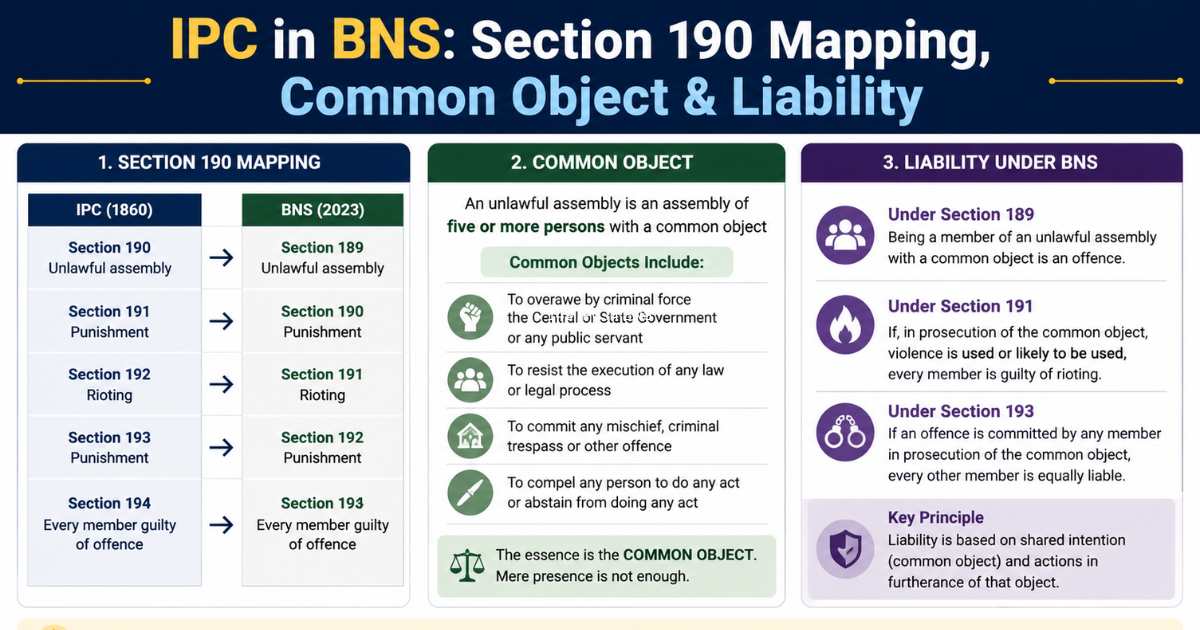

If you’re still searching for 149 IPC in BNS, here’s the short answer: Section 149 IPC has been replaced by Section 190 of the Bharatiya Nyaya Sanhita, effective July 1, 2024. The core principle holding every member of an unlawful assembly liable for offences committed in prosecution of a shared “common object” remains intact, but the procedural landscape around it has shifted significantly.
Digital evidence rules under the BSA and identification standards under the BNSS now shape how courts assess constructive liability. This guide unpacks the 149 IPC to BNS 190 mapping, what’s changed, and practical defense strategies for practitioners handling group-liability cases in 2026.
Bail Bond Amount Calculator
Estimate the likely bail amount and conditions for unlawful-assembly and related offences based on offence type, severity, and the accused’s prior record. Use this as a starting reference point before filing actual bail terms remain at the court’s discretion under Sections 481–483 BNSS.
Legal Excellence
| Parameter | Detail |
| BNS Section | 190 |
| Punishment | Same as the substantive offence committed |
| Bail | Depends on the underlying offence |
| Cognizability | Depends on the underlying offence |
| Old IPC Equivalent | Section 149 |
Section 190 BNS: Constructive Liability
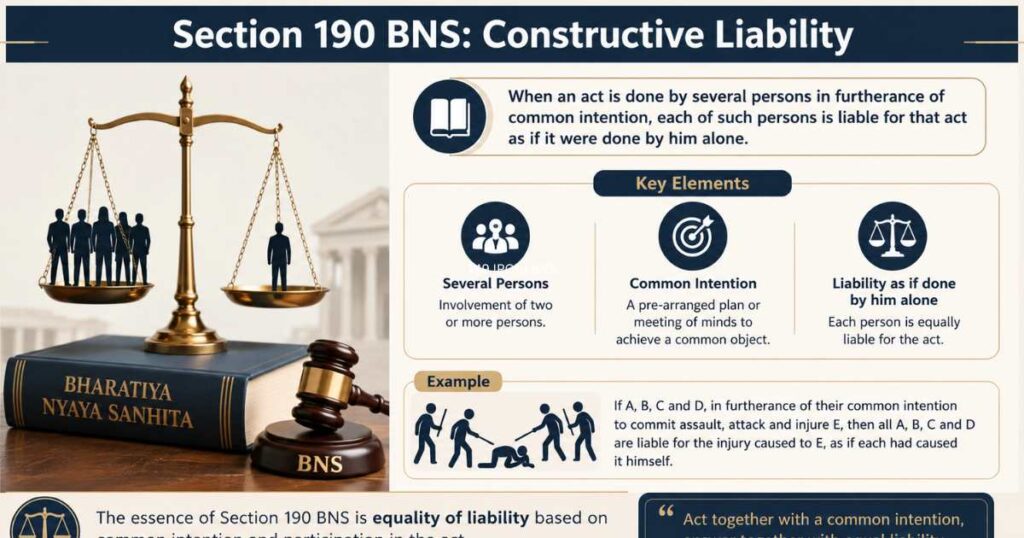
Section 190 BNS codifies the principle of constructive (or vicarious) liability for members of an unlawful assembly. In plain terms: if five or more people form an unlawful assembly and one member commits an offence in prosecution of the group’s shared object or an offence the members knew was likely to happen every member present at the time is guilty of that offence, even if they never lifted a finger.
This is what separates Section 190 from Section 3(5) BNS (formerly Section 34 IPC), which deals with common intention. Common object doesn’t require a pre-arranged plan; it only requires that the group shared one of the unlawful objects recognized under BNS’s unlawful assembly provisions.
| Element | IPC (Old) | BNS (New) | What It Means |
| Governing Section | 149 | 190 | Constructive joint liability provision |
| Minimum Group Size | 5 persons | 5 persons | Below this, it’s not an “unlawful assembly” |
| Basis of Liability | Common object | Common object | Shared unlawful purpose, not pre-planning |
| Second Limb | Knew likely to occur | Knew likely to occur | Foreseeability extends liability |
| Related Provision | S. 34 IPC | S. 3(5) BNS | Deals with common intention, not object |
A key tactical point: prosecution often struggles to establish that five distinct, identifiable members were part of the assembly. If even two names in an FIR are shown to be duplicated, fictional, or misidentified, the constructive liability chain under Section 190 can collapse pushing the case back toward individual liability, which is far easier to defend.
Related Post: Section 126(2) BNS: wrongful restraint ingredients and defence
Key Changes from IPC 149
While the wording of Section 190 closely tracks the old Section 149, the practical experience of litigating it has shifted considerably because of new evidentiary and procedural rules.
Three Major Practitioner Shifts:
- Digital proof of “common object.” Courts increasingly rely on pre-event WhatsApp chats, protest flyers, or social media posts to establish shared unlawful purpose. Under Section 63 BSA, such digital records need a proper certificate without it, this evidence is legally weak and can be challenged at the threshold.
- Video-based identification. CCTV and drone footage are now central to identifying assembly members under BNSS provisions on identification and seizure. If the chain of custody or synchronization of this footage isn’t properly documented, identification becomes vulnerable to challenge.
- Consolidated chapter placement. Offences against public tranquility, including unlawful assembly and Section 190, now sit together in a dedicated chapter of the BNS. Charging documents, bail applications, and case citations should reflect this updated numbering continuing to cite “149 IPC” in 2026 filings can cause avoidable procedural friction.
Arrest and Trial Procedure
A Section 190 case typically moves through a fairly predictable sequence under the BNSS framework.
FIR & Mass Identification
An FIR is registered following a riot, clash, or unlawful gathering. Investigators use CCTV and drone footage across multiple angles to identify participants and build the initial list of accused.
Arrest & Group Remand
Police often seek police custody to identify “lead organizers” within the assembly. Defense counsel should resist blanket custody requests for every accused where there’s no specific overt act attributed to a particular individual.
Bail Application
Bail is filed under the relevant BNSS provisions, with the central argument usually resting on distinguishing “mere presence” in a crowd from “active prosecution” of the assembly’s unlawful object.
Charge Scrutiny
At the framing-of-charges stage, the specific common object (for instance, to assault a person or damage property) must be clearly articulated by the prosecution. A vague or generalized “object” weakens the entire case.
Joint Trial Procedure
The trial proceeds according to the procedure for the main substantive offence. Each prosecution witness should be cross-examined specifically on the individual role of every accused, since this is often where the constructive-liability chain is broken.
Breaking the ‘Common Object’ Link
Defending a Section 190 accused means attacking the assumption that everyone present shared the same unlawful purpose. Useful strategies include:
- The “sudden outburst” argument If a gathering was originally lawful and violence erupted suddenly through one individual’s unplanned act, that act may not reflect the assembly’s common object.
- The “mere presence” defense Being visible in footage isn’t the same as active participation; someone standing apart from the group, or attempting to de-escalate, arguably falls outside the “unlawful core.”
- Digital alibi evidence Mobile location data can show that the accused had left the scene before the offence occurred, or was never near the point of the actual act.
- Testimonial inconsistency When prosecution witnesses disagree on what the assembly’s object actually was, that inconsistency itself creates reasonable doubt applicable to all accused under Section 190.
Critical Pitfalls for Practitioners
- Continuing to cite “149 IPC” in fresh 2026 filings instead of BNS 190, which can cause procedural objections.
- Ignoring the “five or more persons” threshold if the identified membership drops below five at any stage, Section 190 cannot legally apply.
- Assuming every accused automatically needs police custody, when custody should be justified individually.
- Failing to challenge digital evidence that lacks the required certification under the BSA.
- Using outdated templates that don’t reference the current BNSS provisions for charge and trial procedure.
Trial and Evidence Strategy
Strong defense outcomes in Section 190 matters usually come from a few disciplined habits: seeking discharge early where the “common object” rests on nothing more than people being in the same locality; separating the crowd into active and passive participants using video analysis; filing anticipatory bail promptly once co-accused names start appearing in remand records, since Section 190 cases often see new names added later; and, where the underlying offence is minor and bailable, exploring settlement or community-service alternatives to avoid a lengthy joint trial for low-involvement members.
Get Group Liability & Bail Leads
Practitioners handling multi-accused matters can benefit from structured tracking of bail trends, judgment updates, and procedural changes under Section 190 BNS as courts continue to interpret the new code through 2026 and beyond.
More Guides in This Category
- Section 3(5) BNS vs Section 34 IPC: Common Intention Explained
- Unlawful Assembly Under BNS: Elements and Defenses
- BNSS Bail Provisions: A Complete Practitioner’s Guide
- Digital Evidence Certification Under Section 63 BSA
FAQs
What is Section 190 BNS equivalent to under the old law?
Section 190 BNS is the direct replacement for Section 149 IPC, covering constructive liability of unlawful assembly members.
How many people are needed to form an unlawful assembly under Section 190?
At least five persons must be part of the assembly for Section 190 to apply.
Can someone be acquitted under Section 190 if they were merely present?
Yes, if the accused can show they didn’t share the common object or were not part of the “unlawful core,” mere presence alone isn’t enough for conviction.
Is bail available under Section 190 BNS?
Bail eligibility depends entirely on the nature of the underlying substantive offence committed by the assembly.
What role does digital evidence play in Section 190 cases today?
CCTV, drone footage, and digital communications are now central to proving or disproving common object, but must meet certification requirements under the BSA.
Conclusion
The shift from Section 149 IPC to Section 190 BNS is less about a change in legal principle and more about a change in how that principle gets proven and contested in court. Constructive liability for unlawful assembly remains one of the most consequential tools available to prosecutors, capable of pulling every member of a group into criminal liability for the acts of just one or two individuals. For defense counsel, this makes precision essential in verifying the headcount of the assembly, scrutinizing digital evidence certification, and separating active participants from bystanders caught in a crowd.
As courts continue to interpret Section 190 through 2026, practitioners who stay current with BNSS procedural requirements and BSA evidentiary standards will be far better positioned to secure bail, challenge weak identification, and, where the facts support it, break the common-object link entirely. Staying updated isn’t just good practice it’s now a baseline requirement for effective representation under India’s new criminal justice framework.
