
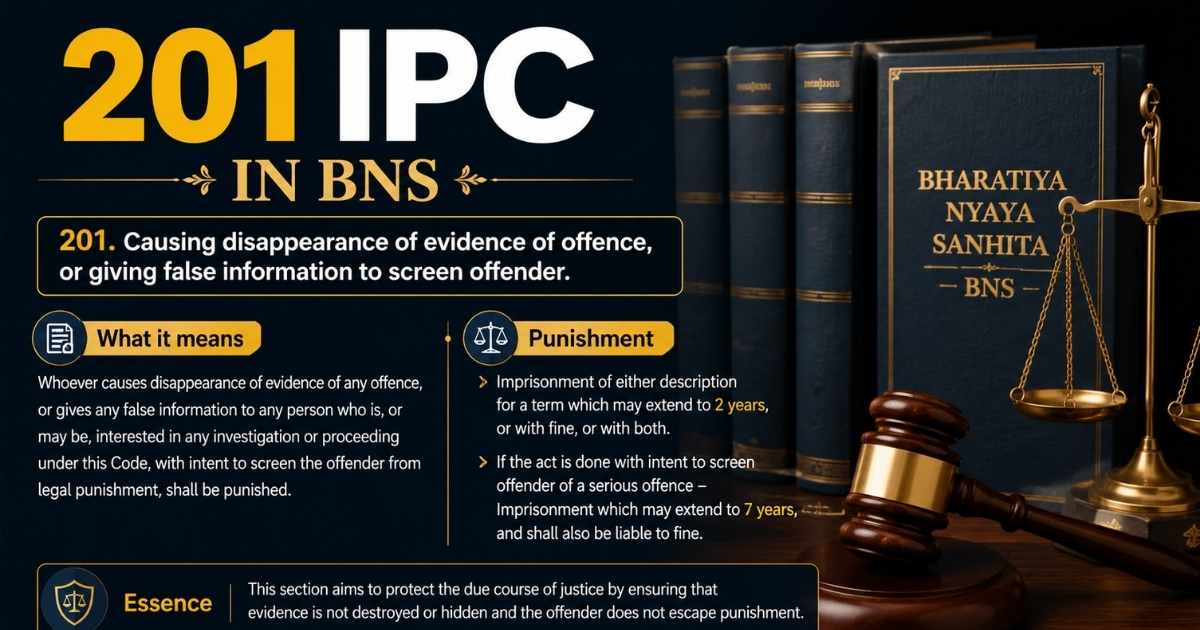

Understanding 201 IPC in BNS is essential for anyone tracking India’s shift from the old Penal Code to the Bharatiya Nyaya Sanhita, 2023. Section 201 IPC, which punished causing evidence to disappear or giving false information to shield an offender, now exists as Section 238 under the new criminal law framework.
This renumbering isn’t just cosmetic it comes bundled with tighter forensic protocols, mandatory crime-scene videography, and revised remand timelines under the BNSS. For lawyers, law students, and accused persons alike, mapping 201 IPC in BNS correctly is the first step toward building an accurate defense or prosecution strategy in 2026.
Bail Bond Amount Calculator
There’s no fixed bail bond figure under Section 238 BNS magistrates set the amount based on the severity of the primary offence, the accused’s flight risk, and local court practice. As a rough working range:
| Nature of Primary Offence | Typical Bail Bond Range |
| Minor/bailable primary offence | ₹10,000 – ₹25,000 |
| Offence punishable up to 10 years | ₹25,000 – ₹75,000 |
| Life imprisonment/death penalty offence linked | ₹75,000 – ₹2,00,000+ |
These figures are indicative only. The actual bond amount is fixed by the magistrate or sessions court on a case-by-case basis, and a competent criminal lawyer should always verify current local benchmarks before filing.
Legal Excellence
This article draws on statutory text of the BNS, BNSS, and BSA, along with reported judicial interpretation of the erstwhile Section 201 IPC, to give practitioners and litigants a reliable, up-to-date reference. Because Section 238 is a fairly new provision, courts continue to lean on decades of IPC 201 precedent while adapting it to the reformed procedural code and that continuity is the thread this article follows.
Section 238 BNS: Tampering with Evidence
Section 238 BNS penalizes anyone who, knowing or having reason to believe an offence has been committed, causes evidence of that offence to disappear, or gives false information to the police, with the specific intention of screening the offender from legal punishment. It is the direct successor to Section 201 IPC and is most commonly invoked against relatives, friends, drivers, or associates of a primary accused who try to “clean up” after a crime.
The essential ingredients the prosecution must establish are:
- Knowledge or reason to believe that an offence has been committed
- An overt act destroying, concealing, or altering evidence, or supplying false information
- Specific intent to screen the offender from legal punishment
Missing even one ingredient particularly intent is usually fatal to the prosecution’s case, a principle courts have consistently applied under the old IPC provision and are expected to carry forward under BNS 238.
Related POST: IPC to BNS Section Conversion Table Complete 2026 Guide
Punishment Scalability:
Unlike many BNS offences with a flat sentence, Section 238 punishment scales with the gravity of the original offence being concealed:
| Primary Offence Concealed | Punishment Under Section 238 BNS |
| Punishable with death | Up to 7 years imprisonment + fine |
| Punishable with life imprisonment or imprisonment up to 10 years | Up to 3 years imprisonment + fine |
| Any other offence | One-fourth of the longest term prescribed for that offence, or fine, or both |
This scalable structure means an advocate’s first task in any Section 238 matter is establishing exactly what the “principal offence” is the entire sentencing exposure flows from that classification.
Key Changes from IPC 201
While the substance of the offence is largely unchanged, the transition to BNS brought several procedural and interpretive shifts worth flagging:
| Aspect | IPC Section 201 | BNS Section 238 |
| Numbering | Section 201, IPC 1860 | Section 238, BNS 2023 |
| Core offence | Same disappearance of evidence / false information | Same, renumbered and re-worded for clarity |
| Investigative backbone | CrPC 1973 | BNSS 2023 (mandatory FIR videography, stricter forensic mandates) |
| Digital/forensic evidence rules | Indian Evidence Act, 1872 | Bharatiya Sakshya Adhiniyam, 2023 (Section 63 electronic evidence certificate) |
| Remand provision | CrPC Section 167 | BNSS Section 187 |
| Bailability | Generally bailable, non-cognizable | Continues to be bailable and non-cognizable in most fact patterns |
The practical effect is that the offence definition barely moved, but the evidentiary ecosystem around it mandatory videography of crime scenes, tighter chain-of-custody rules for digital evidence, and stricter remand timelines makes it considerably harder for an accused to argue that tampering went undetected.
Remand and Bail Procedure
A Section 238 case typically moves through five distinct stages, each of which offers the defense a strategic opportunity.
FIR & Scene Videography
Under BNSS, videography of the crime scene during search and seizure is now mandatory in many categories of offences. This creates a contemporaneous record that either supports or undermines a later “tampering” allegation making the FIR and scene footage the first document any defense counsel should demand.
Arrest & Station Bail
Since Section 238 is typically bailable, an accused can often secure release directly from the police station by executing a bail bond, provided the arresting officer is satisfied of identity and address. Refusal to grant station bail in a clearly bailable matter is itself a ground for immediate representation before the magistrate.
Digital Forensics (BSA 63)
Where the “vanishing evidence” involves deleted call records, wiped devices, or altered CCTV footage, the prosecution must comply with Section 63 of the BSA the certificate requirement for electronic evidence. A missing or defective certificate is one of the strongest technical challenges available to the defense.
Remand (Section 187)
If custodial interrogation is sought, police custody under BNSS Section 187 can now be granted for up to 15 days, but that custody must be exhausted within the first 40 days (for offences carrying up to 10 years) or 60 days (for offences carrying 10 years or more) of the total 60- or 90-day investigation period. Unlike the old CrPC regime, this custody can be sought in parts meaning the investigating officer can return weeks later with fresh grounds. Defense counsel must track this rolling window closely rather than assuming the custody risk ends after the first 15 days.
Charge-sheet Supply
Once the charge-sheet is filed, the accused is entitled to free copies of all relied-upon documents. If the charge-sheet is not filed within the statutory 60- or 90-day period, the accused acquires an indefeasible right to default (statutory) bail a right that remains one of the most effective bail tools in a 238 matter.
Challenging ‘Intent to Screen’ and ‘Knowledge’
The single biggest battleground in Section 238 prosecutions is intent. Courts, following the settled position under IPC 201, have repeatedly held that the offence can survive even if the primary crime isn’t conclusively proven but only if the prosecution shows the accused knowingly acted to shield the offender. Effective defense arguments typically include:
- The accused had no knowledge that an offence had occurred at the time of the alleged act
- The act (e.g., cleaning a room, disposing of an item) was routine or innocent, unconnected to any concealment motive
- There is no direct link between the accused’s conduct and an intention to protect a specific offender
- The evidence said to have “disappeared” was never proven to exist in the first place
Suspicion, proximity to the accused, or mere presence at the scene is not enough the prosecution carries the burden of proving deliberate, purposive conduct.
Critical Pitfalls for Practitioners
Advocates handling Section 238 matters commonly encounter these traps:
- Conflating Section 238 with the main offence a client can be acquitted of the primary charge yet still be convicted under 238 if concealment intent is separately proven.
- Overlooking Section 61(2) BNS for police officers who collude in evidence destruction a distinct, more serious accountability provision.
- Missing the BSA Section 63 certificate defect when digital evidence forms the backbone of the prosecution’s case.
- Failing to compute the default bail clock accurately under the new staggered remand scheme of BNSS 187.
- Ignoring family-member exceptions close relatives sheltering an offender may attract lesser liability depending on the specific facts, a nuance worth raising early.
Trial and Evidence Strategy
At trial, the defense strategy should center on dismantling each ingredient methodically rather than attacking the case as a whole. Cross-examination of the investigating officer should probe the exact sequence of scene videography, seizure memos, and forensic handling any gap in the chain of custody weakens the “disappearance” narrative. Where digital evidence is central, insist on production of the BSA Section 63 certificate at the earliest stage; its absence can render electronic material inadmissible outright. Finally, always separate the trial of the principal offence from the 238 charge in argument conflating the two in submissions often dilutes an otherwise strong intent-based defense.
Conclusion
201 IPC in BNS comes down to one core idea: the offence hasn’t changed, but the machinery around it has. Section 238 BNS carries forward the same knowledge-plus-intent test that defined Section 201 IPC, while layering in mandatory scene videography, the BSA’s electronic evidence certificate, and a staggered remand process under BNSS Section 187.
For advocates and litigants navigating 201 IPC in BNS, the winning strategy remains consistent challenge intent early, scrutinize the forensic chain of custody, and use default bail provisions wherever the charge-sheet timeline slips. Mastering this mapping is now essential for effective 2026 criminal defense practice.
