
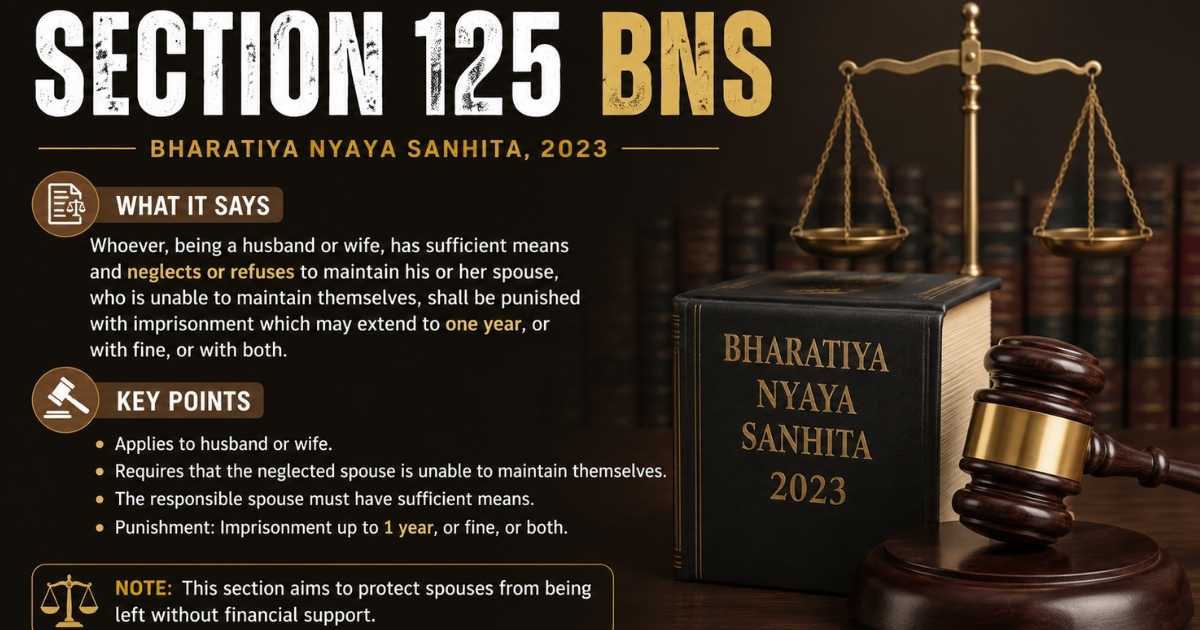

Section 125 BNS is a law that many people search about today. It deals with careless or rash acts. These acts put other people’s lives at risk. Section 125 BNS does not require any bad intention. Simple carelessness is enough to attract this law. It covers things like reckless driving, unsafe construction work, and careless handling of machinery. Section 125 BNS applies even when no one gets hurt.
This guide explains Section 125 BNS in plain words. You will learn if Section 125 BNS is bailable or not. You will also learn about punishment, fine, and arrest powers under Section 125 BNS. We compare Section 125 BNS with the old IPC sections it replaced. By the end, you will understand Section 125 BNS clearly and confidently.
What is Section 125 BNS? Meaning in Simple Words
Section 125 of the Bharatiya Nyaya Sanhita (BNS), 2023, punishes anyone whose rash or negligent act endangers human life or the personal safety of others. It sits in Chapter VI, which deals with offences affecting the human body. The law doesn’t require proof of intention to hurt anyone carelessness itself is enough to attract liability. In short, if your negligence puts someone else at risk, you can be prosecuted even if nobody actually gets hurt.
Section 125 BNS Explained: Rash and Negligent Acts Endangering Human Life
The provision targets everyday risky conduct: speeding through a crowded street, leaving construction debris unsecured, mishandling hazardous chemicals, or firing celebratory gunshots at a wedding. The law scales the punishment based on outcome:
- No injury caused, but life or safety was endangered
- Simple hurt caused as a result of the act
- Grievous hurt caused as a result of the act
The more serious the consequence, the harsher the penalty but even a near-miss with no injury is punishable.
Section 125(a) vs Section 125(b) BNS: Key Differences
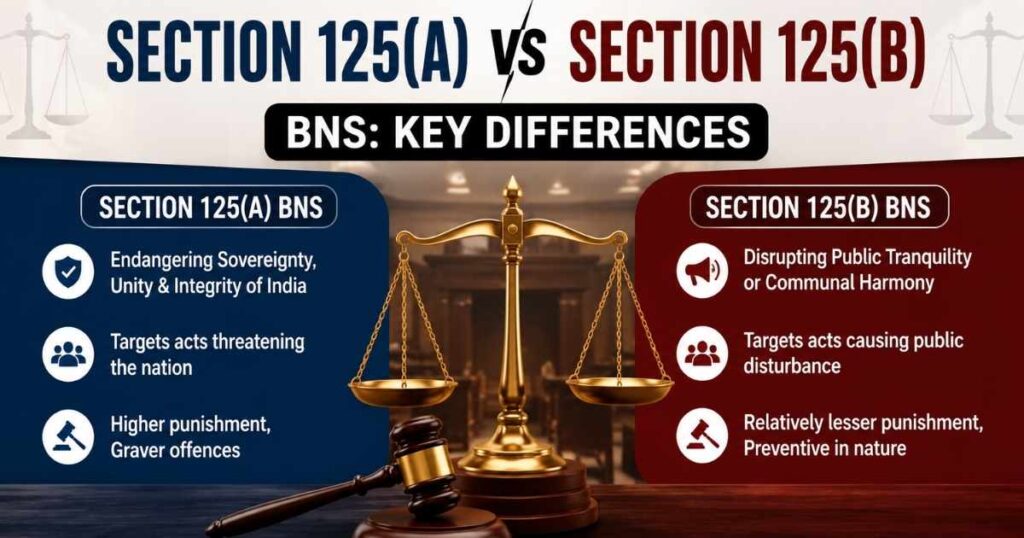
Most legal commentary splits Section 125 into two practical categories based on outcome.
Section 125(a) BNS Punishment
Covers the base offence a rash or negligent act that endangers life or personal safety without causing any actual injury. Punishment: imprisonment up to 3 months, or fine, or both.
Section 125(a) BNS Fine Amount
The maximum fine is ₹2,500. This is a sharp increase from the ₹250 ceiling under the old IPC provision.
Section 125(b) BNS Punishment
Applies where the rash or negligent act actually causes hurt to a person for example, a minor cut or bruise from a falling object. Punishment: imprisonment up to 6 months, or fine, or both.
Section 125(b) BNS Fine Amount
The maximum fine here is ₹5,000, up from ₹500 under the earlier law.
Where the act causes grievous hurt fractures, permanent disability, or severe burns the punishment rises further to imprisonment up to 3 years or a fine up to ₹10,000, or both. This tier is treated as an aggravated form of the same offence.
Related Post: Court Marriage Documents List (2026) – Gujarat + India
Is Section 125 BNS Bailable or Non-Bailable?
Yes Section 125 BNS is a bailable offence in its entirety, across every degree of harm (no injury, hurt, or grievous hurt). This means bail is a matter of right, not judicial discretion, and the accused can be released on furnishing a bail bond.
Is Section 125(a) BNS Bailable or Not?
Yes, bailable. The accused can be granted bail as a matter of right at the police station itself.
Is Section 125(b) BNS Bailable or Not?
Yes, also bailable. Even though the punishment is higher than the base offence, the bailable status doesn’t change.
Is Section 125 BNS Cognizable or Non-Cognizable? Police Arrest Powers
Section 125 BNS is generally treated as a cognizable offence, meaning police can register an FIR and investigate and in some cases arrest without prior magistrate approval. Because the offence is also bailable, an arrested person must be released on bail bonds by the station house officer rather than being sent into judicial custody. Some legal commentators classify the base clause (no injury) as closer to non-cognizable in practice, so it’s worth confirming the exact classification with a local advocate or the applicable First Schedule entry before relying on it in an actual case.
Section 125 BNS Legal Parameters
| Parameter | Details |
| Nature of Offence | Rash or negligent act endangering human life or personal safety |
| Punishment | 3 months to 3 years, depending on harm caused |
| Fine | ₹2,500 to ₹10,000, depending on harm caused |
| Bail | Bailable (all tiers) |
| Cognizable Status | Generally cognizable |
| Triable Court | Any Magistrate |
| Compoundable or Not | Non-compoundable |
Section 125 BNS vs IPC Sections 336 & 337: What Changed?
Section 336 IPC vs Section 125(a) BNS
Section 336 IPC covered acts endangering life or personal safety without causing hurt. Its equivalent, Section 125(a) BNS, keeps the same 3-month imprisonment term but raises the fine ceiling from ₹250 to ₹2,500.
Section 337 IPC vs Section 125(b) BNS
Section 337 IPC dealt with causing hurt by a rash or negligent act. Section 125(b) BNS retains the 6-month imprisonment term while increasing the fine cap from ₹500 to ₹5,000.
Comparison Table
| Aspect | Old IPC | New BNS |
| Base offence fine | ₹250 | ₹2,500 |
| Hurt-caused fine | ₹500 | ₹5,000 |
| Grievous hurt fine | ₹1,000 (approx.) | ₹10,000 |
| Imprisonment terms | Unchanged | Unchanged |
| Governing sections | 336, 337, 338 IPC | 125 BNS |
Section 125 BNS in IPC: Old Law vs New BNS
Section 125 BNS essentially consolidates three separate IPC provisions 336, 337, and 338 into a single, tiered section. The imprisonment terms remain the same, but fines have been multiplied roughly ten-fold to reflect current economic realities and to strengthen deterrence.
Section 281 BNS and Its Connection with Section 125 BNS
Section 281 BNS specifically penalises rash or negligent driving on a public road (the old Section 279 IPC). Section 125 BNS, by contrast, is a broader, general provision covering rash or negligent acts anywhere on the road, at a construction site, in a factory, or at a private event. A rash driving case can sometimes attract both sections together if the driving also endangers life under Section 125’s general test.
Real-Life Examples of Section 125 BNS Offences
- Rash Driving Endangering Human Life speeding through a crowded market and nearly hitting pedestrians
- Medical Negligence a careless clinical error that puts a patient’s safety at risk
- Construction Site Negligence failing to install safety nets, causing debris to fall on passers-by
- Industrial Accident mishandling machinery or chemicals in a factory, endangering workers
- Fire Safety Violations ignoring fire safety norms in a commercial building, creating a hazard for occupants
Investigation, FIR, Bail and Trial Procedure under Section 125 BNS
Case Investigation Lifecycle
- Incident Report the injured party or a witness reports the rash/negligent act
- Police Investigation & Arrest police assess the complaint and may arrest, subject to the bailable nature of the offence
- FIR Registration a formal FIR is lodged detailing the act and consequences
- Chargesheet Filing police file a chargesheet once investigation is complete
- Magistrate Trial the case is tried summarily or as a regular trial before a Magistrate
- Judgment and Appeal the Magistrate delivers a verdict; either party may appeal to a higher court
Sample Bail Application under Section 480 BNSS
Bail applications for offences under the Bharatiya Nyaya Sanhita are filed under the Bharatiya Nagarik Suraksha Sanhita (BNSS), 2023 the code that replaced the CrPC. A typical application includes:
- Case details (FIR number, police station, sections invoked)
- A brief statement of facts and grounds for bail
- A submission that the offence is bailable in nature
- An undertaking to cooperate with the investigation and appear before the court
Since Section 125 BNS is bailable, courts and even police stations are expected to grant bail as a matter of right on furnishing the required bond and sureties.
Section 125 BNS in Hindi (लापरवाही का अपराध)
धारा 125 बीएनएस उस व्यक्ति को दंडित करती है जो लापरवाही या जल्दबाजी से ऐसा कार्य करता है जिससे किसी अन्य व्यक्ति के जीवन या सुरक्षा को खतरा हो। यदि इस कार्य से चोट लगती है तो सजा बढ़ जाती है, और यदि गंभीर चोट लगती है तो सजा और अधिक कठोर हो जाती है। यह अपराध जमानती है।
FAQ’s
Is Section 125 BNS Bailable or Not?
Yes, it is fully bailable across all degrees of harm.
Is Section 125(a) BNS Bailable or Not?
Yes, bail is available as a matter of right.
Is Section 125(b) BNS Bailable or Not?
Yes, this clause is also bailable.
What is the Punishment under Section 125(a) BNS?
Imprisonment up to 3 months, or fine, or both.
What is the Punishment under Section 125(b) BNS?
Imprisonment up to 6 months, or fine, or both.
What is the Fine Amount under Section 125(a) BNS?
Up to ₹2,500.
What is the Fine Amount under Section 125(b) BNS?
Up to ₹5,000.
Is Section 125 BNS Cognizable or Non-Cognizable?
It is generally treated as cognizable, though the base clause is sometimes classified differently in practice.
Which IPC Sections Correspond to Section 125 BNS?
Sections 336, 337, and 338 of the erstwhile Indian Penal Code.
What is the Relationship Between Section 125 BNS and Section 281 BNS?
Section 281 covers rash driving on public roads specifically, while Section 125 is the general provision for all rash or negligent acts.
Which Court Tries Offences Under Section 125 BNS?
Any Magistrate.
Can Police Arrest Without a Warrant Under Section 125 BNS?
Generally yes, since the offence is treated as cognizable, but bail must still be granted promptly given its bailable nature.
What Is the Difference Between Section 125(a) and Section 125(b) BNS?
Section 125(a) applies when no injury results from the negligent act; Section 125(b) applies when the act actually causes hurt, carrying a higher punishment and fine.
Conclusion
Section 125 BNS plays a quiet but important role in India’s criminal justice framework. It doesn’t wait for tragedy to strike it holds people accountable the moment their carelessness puts someone else’s life or safety at risk. Whether it’s a contractor skipping safety protocols, a driver weaving through traffic, or someone firing a gun into the air at a celebration, the law recognises that harm doesn’t have to be intended to be punishable.
For anyone facing a complaint under this section, the good news is that the offence is bailable at every level of severity, so an arrest doesn’t mean an extended stay in custody. That said, a conviction even for a bailable offence can still affect employment background checks and personal reputation, so it’s worth taking any notice or FIR seriously and consulting a criminal lawyer early. Understanding where your case falls no injury, simple hurt, or grievous hurt will shape both the strategy and the likely outcome.
