


The renumbering of 509 IPC in BNS is one of the most searched legal questions of 2026, and for good reason. The offence once known simply as “Section 509” now carries a new number, a new procedural code, and a new evidence framework. For advocates and complainants alike, getting this mapping right is the first step to handling a modesty-insult case correctly.
This shift means more than learning a new section number it means knowing how bail, digital evidence, and intent are now assessed under the BNSS and BSA. This guide walks through exactly what has changed, what remains the same, and how to build a strong case strategy in 2026.
Legal Excellence
Getting the section right in the FIR, in bail applications, and in trial submissions is a baseline marker of competence that magistrates, police officers, and clients alike now expect from criminal law practitioners.
Section 79 BNS: Insulting Modesty
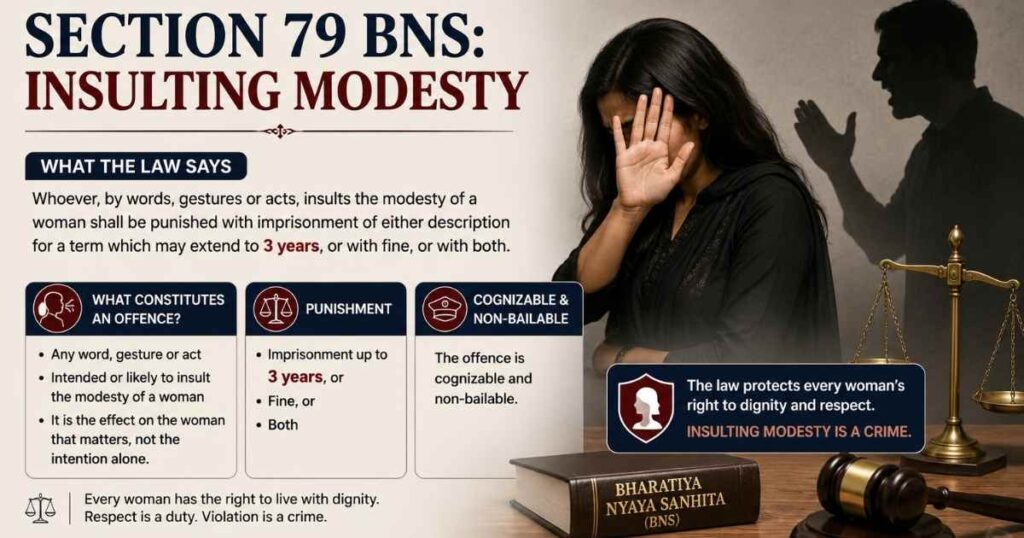
Section 79 of the BNS criminalises any word, sound, gesture, or object intended to insult a woman’s modesty, along with intrusion upon her privacy. The offence is made out where the accused intends the woman to hear the word, see the gesture, or is aware that the act intrudes on her private space.
Courts insist on two things before a conviction can stand: a clearly identifiable woman as the target, and an act meant to be perceived by her. Generalised abuse hurled at a crowd, or remarks made only to third parties, typically falls outside the section’s first limb, though it may still attract other offences.
| Element | IPC 509 (Old) | BNS 79 (New) | Practical Note |
| Offence type | Insulting modesty | Insulting modesty | Covers words, gestures, sounds, objects |
| Punishment | Up to 3 years | Up to 3 years | Fine is now compulsory, not discretionary |
| Bail status | Bailable | Bailable | Triable by any magistrate |
| Privacy intrusion | Covered | Covered, with sharper digital scope | Includes unauthorised photography, voice notes, online circulation |
| Governing evidence law | Indian Evidence Act | Bharatiya Sakshya Adhiniyam (BSA) | Section 63 certificate needed for electronic records |
Key Changes from IPC 509
The core definition carried over almost verbatim from the old provision, but three shifts change how the offence is charged and defended in practice.
Three Major Practitioner Shifts:
- Fine is now mandatory. Under IPC 509, fine was left to judicial discretion in many cases. Section 79 BNS treats the fine as a standard component of sentencing, often used by magistrates to compensate victims for public humiliation or online distress.
- Digital intrusion is spelled out. Courts have already extended “utterance” and “intrusion” to cover emails, social media posts, and unwanted photography a trend the Bombay High Court affirmed when it held that offensive written communication can satisfy the section just as spoken words do. BNS 79 builds this digital reading directly into how the offence is understood.
- Electronic evidence has a formal gatekeeper. Any WhatsApp chat, voice note, or CCTV clip relied on by the prosecution must carry a Section 63 BSA certificate of authenticity, or it risks being ruled inadmissible.
Arrest and Bail Procedure
The BNSS lays out a fairly linear, evidence-heavy path from complaint to trial for a Section 79 case.
FIR & Electronic Evidence Seizure
The FIR is registered, and investigating officers seize phones, laptops, or CCTV footage relevant to the complaint. Seizure of digital devices must be videographed under Section 105 BNSS to preserve the chain of custody.
Station Bail
Because the offence is bailable, the accused is entitled to release on a bond at the police station itself under Section 481 BNSS. Counsel should push back immediately if the bond amount set is disproportionate to the offence.
FSL (Digital) Referral
Where audio or video evidence exists, it goes to a forensic science laboratory for analysis. Under the BSA framework, the resulting expert report needs a digital authenticity stamp before it can be relied upon.
Related Post: 411 IPC in BNS: Section 317 Mapping, Stolen Property & Bail
Victim Statement
The magistrate records the complainant’s statement under Section 183 BNSS. Defense counsel should scrutinise this statement closely against the FIR and any supplementary documents for inconsistencies.
Magistrate Trial
The matter proceeds by summons trial. Since Section 79 turns heavily on intent, the “context of the speech or gesture” typically becomes the central battleground at this stage.
Defending Against ‘Word or Gesture’
Section 79 cases are won or lost on how a court reads intent and context, not just on whether words were spoken.
- Ambiguity of language. Many words carry more than one meaning. If the language used doesn’t specifically target modesty, the defense can argue it amounts to ordinary criticism or slang rather than an offence under this section.
- General or public interaction. Where a remark or gesture is aimed at a crowd, or at an object, and the complainant merely happened to be present, courts have repeatedly held this does not satisfy the requirement that the act be intended for her specifically. The Kerala High Court applied exactly this reasoning in a case where remarks made to third parties, without any intention that the complainant hear them, were found insufficient to sustain the charge.
- Digital spoofing or morphing. With deepfake audio and images now common, a private cyber-forensic expert engaged under Section 61 BSA can help demonstrate that a voice note or image was fabricated or altered to implicate the client.
- Mutual altercation. Heated exchanges arising from unrelated civil disputes a parking dispute, a workplace disagreement where the language used is generic abuse rather than gender-targeted, may fit lower provisions like simple insult (Section 352 BNS) or criminal intimidation (Section 351 BNS) rather than Section 79.
Critical Pitfalls for Practitioners
Even experienced counsel slip up on procedural detail when a law is this new. Watch for these recurring errors.
- Citing the old section number. Referring to “IPC 509” in station representations or bail applications signals outdated preparation; always cite Section 79 BNS.
- Overlooking the privacy limb. If a client was photographing a public location and the complainant happened to appear in the frame, argue absence of intrusion rather than focusing only on the “word or gesture” limb.
- Not challenging add-on non-bailable sections. Police sometimes stack a non-bailable provision alongside a Section 79 charge to keep an accused in custody longer. This should be contested at the remand stage itself.
- Ignoring the missing BSA certificate. An IT report or chat log without a proper Section 63 BSA certificate is inadmissible this is often the single fastest route to weakening the prosecution’s evidence.
- Using outdated trial templates. Document supply and case-management timelines now run through Section 230 BNSS; templates built around the old CrPC schedule need updating.
Trial and Evidence Strategy
Beyond procedure, a handful of tactical habits consistently strengthen a Section 79 defense.
- Scrutinise the transcript. Police transcriptions of audio recordings sometimes “fill in” ambiguous words with harsher language than what was actually said cross-check the original recording line by line.
- Move for early discharge. At the charge-framing stage, an application under Section 250 BNSS is worth filing wherever the modesty element is not clearly borne out by the words or gestures alleged.
- Establish prior enmity. A documented history of disputes workplace friction, civil litigation, family disagreements can support a motive-to-frame argument, particularly since modesty provisions are increasingly invoked in retaliatory disputes.
- Consider anticipatory bail as a precaution. Even though the offence is bailable, a station arrest can be reputationally damaging. Where a false complaint appears likely, filing for anticipatory bail under Section 482 BNSS ahead of time can spare a client that experience.
Get Modesty & Harassment Leads Join JuriGram
Practitioners handling Section 79 BNS matters need a steady pipeline of well-qualified clients, not just legal clarity. JuriGram connects criminal law advocates with verified leads in modesty and harassment matters, so your expertise reaches the people who need it.
More guides in this category
- IPC to BNS Section Conversion Table Complete 2026 Guide
- Section 354 BNS: Assault or Criminal Force to Woman with Intent to Outrage Modesty
- Section 74 BNS: Assault or Use of Criminal Force with Intent to Disrobe
- BSA Section 63 Certificate: Drafting and Filing Guide for Digital Evidence
- Anticipatory Bail Under Section 482 BNSS: A Step-by-Step Guide
Is Section 79 BNS bailable?
Yes. Section 79 BNS remains a bailable offence, and the accused is entitled to release on a bond directly at the police station under Section 481 BNSS.
What is the punishment under Section 79 BNS?
Simple imprisonment of up to three years, along with a mandatory fine.
Can WhatsApp chats be used as evidence in a Section 79 BNS case?
Yes, but only if accompanied by a valid Section 63 BSA certificate confirming the electronic record’s authenticity.
Does Section 79 BNS apply to online harassment?
Courts have interpreted the equivalent IPC provision to cover emails and social media posts, and this digital reading carries forward under Section 79 BNS.
What’s the difference between Section 79 and Section 354 BNS?
Section 79 deals with words, gestures, and non-physical intrusion, while Section 354 involves actual assault or criminal force used with intent to outrage modesty.
Conclusion
Understanding 509 IPC in BNS ultimately comes down to recognizing that this is a genuinely reworked provision, not just a renamed one. The core test intent to insult a woman’s modesty through word, gesture, sound, or intrusion still guides how courts read these cases, but the surrounding procedure has changed considerably. Mandatory fines, explicit digital-intrusion coverage, and stricter certification requirements for electronic evidence all shape how a case moves from FIR to trial today.
For defense counsel, success now depends heavily on procedural discipline: verifying evidence certificates, challenging improper bail treatment, and catching mismatched charges early. For those advising complainants, the clearer digital-harassment language offers stronger grounds to act on online misconduct. Either way, treating this section with the seriousness of a fresh law rather than old wine in a new number is what holds up before a magistrate.
