
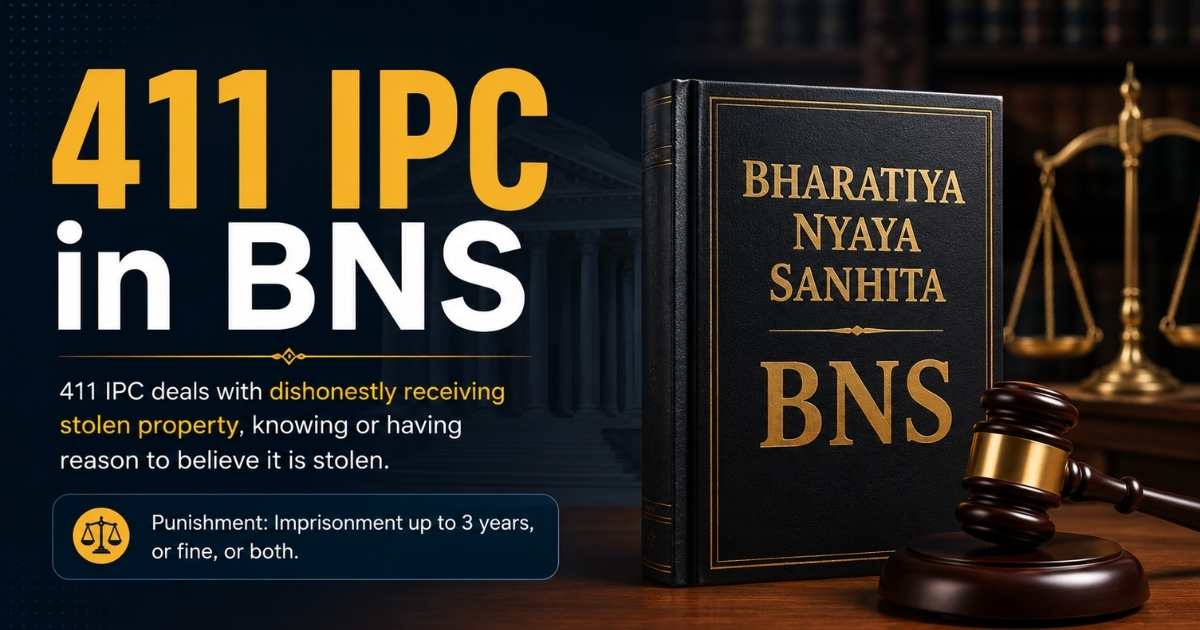

411 IPC in BNS is a term many people search for after India’s criminal laws changed in 2024. The old law on stolen property got a new home under the Bharatiya Nyaya Sanhita. If you have heard of this offence but feel confused about where it stands today, you are not alone. This law affects more people than you might think. It applies to buyers, sellers, and even small repair shop owners who deal in second-hand goods.
This guide breaks down the topic in simple terms. We explain the new section number and how it maps to the old one. We cover the punishment and bail rules too. Most of the core law remains the same. But a few changes matter, and they can affect real cases. Read on for a clear, practical explanation of where this offence stands under the new code.
Legal Excellence
Criminal law in India has undergone a major overhaul with the Bharatiya Nyaya Sanhita (BNS), 2023 replacing the old Indian Penal Code (IPC). One provision that lawyers, police officers, and the public frequently search for is 411 IPC the offence of dishonestly receiving stolen property. If you have been arrested, named in an FIR, or are simply trying to understand where this law stands today, this guide explains everything you need to know about its new avatar, Section 317 BNS, in plain language.
What is 411 IPC in BNS?
Section 411 of the Indian Penal Code dealt with a person who knowingly receives or keeps property that was stolen. Since July 1, 2024, this offence no longer exists under that number. It has been re-enacted as part of Section 317 of the Bharatiya Nyaya Sanhita, 2023, which is a consolidated provision covering everything related to stolen property from simple receiving to habitual dealing and dacoity-linked possession.
In short, whenever someone refers to “411 IPC” today, they actually mean Section 317(2) of BNS. The core legal test hasn’t changed: the accused must have received or retained property while knowing, or having reason to believe, that it was stolen.
Section 317 BNS: Dishonestly Receiving Stolen Property
Section 317 is a broad chapter-style section. It doesn’t just criminalize receiving stolen goods it also defines what “stolen property” actually means and lists escalating punishments depending on how the property was obtained and how the accused dealt with it.
Related Post: BNS Section 281: Rash Driving Case, Fine and Compounding
Essential Ingredients of Section 317 BNS
For a conviction, the prosecution generally has to establish:
- The property in question qualifies as “stolen property” under the law.
- The accused was in possession of, received, or retained that property.
- The accused had actual knowledge, or reason to believe, that it was stolen.
- The act of receiving or retaining was done dishonestly.
If even one of these ingredients is missing, the charge cannot stand.
Meaning of Stolen Property
Under Section 317(1) BNS, property becomes “stolen property” if possession of it was transferred through theft, extortion, robbery, cheating, criminal misappropriation, or criminal breach of trust. Interestingly, the BNS specifically added “cheating” to this list a term that wasn’t expressly part of the corresponding IPC provisions. Once such property is legally returned to its rightful owner, it stops being “stolen property” in the eyes of the law.
Who Can Be Charged Under Section 317 BNS?
This section is not limited to thieves or burglars. It commonly applies to:
- Second-hand mobile phone or electronics dealers
- Scrap and metal traders
- Pawnbrokers and jewellers
- Anyone found in possession of goods later linked to a theft or robbery
- Individuals who helped conceal or dispose of stolen items on behalf of someone else
IPC 411 to BNS Section 317 Mapping
Comparison Table: IPC 411 vs Section 317 BNS
| Aspect | IPC Section 411 | BNS Section 317 |
| Offence | Dishonestly receiving stolen property | Same offence, now sub-section 317(2) |
| Effective From | Enacted 1860 | Effective July 1, 2024 |
| Punishment | Up to 3 years imprisonment, or fine, or both | Up to 3 years imprisonment, or fine, or both |
| Cognizable | Yes | Yes |
| Bailable | No | No |
| Trial Court | Any Magistrate | Any Magistrate |
| Related Provisions | Sections 410, 412, 413, 414 IPC | All merged into Section 317(1) to 317(5) BNS |
Has the Law Changed Under BNS?
The punishment and the basic legal test remain substantially the same. What has changed is the structure: instead of five separate sections (410–414) scattered across the chapter, BNS has consolidated the entire subject definition, receiving, dacoity-linked receiving, habitual dealing, and assisting in concealment under one umbrella section with numbered sub-clauses.
Key Changes from IPC 411
Three Major Practitioner Shifts
- Consolidation of sections – What used to be five different IPC sections (410 to 414) is now compressed into sub-sections (1) to (5) of Section 317 BNS, making cross-referencing easier but requiring lawyers to cite the correct sub-clause carefully.
- Addition of “cheating” – The definition of stolen property now expressly includes property obtained through cheating, widening the scope compared to the IPC.
- Procedural alignment with BNSS and BSA – Recovery of stolen property, search procedures, and evidence rules now follow the Bharatiya Nagarik Suraksha Sanhita (BNSS) and the Bharatiya Sakshya Adhiniyam (BSA) instead of the old CrPC and Evidence Act.
Arrest and Bail Procedure
FIR and Recovery Search
Once a complainant reports that stolen goods have surfaced with a particular person, police register an FIR, and a search or seizure is conducted, typically documented with a recovery memo and, increasingly, video evidence of the seizure itself.
Arrest and Police Custody Remand
Since the offence is cognizable, police can arrest without a warrant. The accused must be produced before a Magistrate within 24 hours, who then decides whether police custody or judicial custody is warranted for further investigation.
Bail Application Process
Because Section 317(2) is non-bailable, bail is not a matter of right and must be argued before a Magistrate or Sessions Court. Courts typically weigh the value of the property, the accused’s explanation for possession, prior antecedents, and flight risk before granting bail.
Framing of Charges
If the Magistrate finds sufficient material after the police file a chargesheet, formal charges under Section 317 BNS are framed, and the trial proceeds on that basis.
Property Restoration
Courts have the power to order interim or final restoration of the recovered property to its rightful owner, often well before the trial concludes, provided ownership is not disputed.
How Courts Prove “Knowledge” of Stolen Property
What Counts as Knowledge?
Knowledge doesn’t always mean direct, provable awareness. Courts also convict where the accused had “reason to believe” the goods were stolen meaning a reasonable person in that position would have suspected something was wrong, even without absolute proof.
Innocent Purchase vs Dishonest Possession
A person who buys goods at a fair market price, with a proper bill or receipt, is generally treated differently from someone who buys the same goods at a suspiciously low price with no documentation. The price paid, the mode of payment, and the identity verification of the seller often become decisive factors.
Important Judicial Principles
- Mere possession of stolen property is not, by itself, sufficient for conviction.
- The prosecution must prove that someone other than the accused possessed the property before the accused acquired it.
- Unexplained possession shortly after a theft can allow courts to draw an adverse inference against the accused.
- Long delays between theft and recovery can weaken the identification of the property and benefit the defence.
Trial and Defense Strategy
Common Defence Arguments
- The accused had a legitimate, verifiable source for the property (invoice, digital payment trail).
- There is no evidence linking the accused to knowledge that the goods were stolen.
- The identity of the seized property doesn’t conclusively match the stolen item.
- The accused is a bona fide dealer who followed standard trade practices.
Burden of Proof
While the overall burden remains on the prosecution to prove guilt beyond reasonable doubt, once possession of recently stolen property is established, the accused may be expected to offer a reasonable explanation for that possession, failing which courts can draw an inference against them.
Evidence Required by Prosecution
- Proof that the property was actually stolen
- Proof of possession by the accused
- Circumstances showing knowledge or reason to believe the property was stolen
- Recovery memo, witness testimony, and, where applicable, digital or documentary evidence
Critical Pitfalls for Practitioners
- Failing to challenge the identification of the recovered property early in the trial
- Overlooking the difference between “receiving” (317(2)) and merely “assisting in concealment” (317(5)), which carry different punishment ranges
- Ignoring digital payment records (UPI, bank transfers) that can strongly support a genuine-purchase defence
- Missing the opportunity to move for discharge at the charge-framing stage when the prosecution’s material is weak
- Treating the offence as compoundable it technically is not, though courts sometimes permit settlement-based quashing when property is restored
411 IPC Punishment
Punishment Under IPC 411
Imprisonment of either description for a term extending up to three years, or a fine, or both.
Punishment Under Section 317 BNS
Section 317(2) retains the identical punishment structure imprisonment up to three years, or fine, or both for simple dishonest receiving of stolen property.
Is 411 IPC Bailable or Not?
411 IPC was a non-bailable offence, meaning bail could not be claimed as a matter of right and had to be sought through a formal application before the court.
Is Section 317 BNS Bailable?
No. Section 317 BNS continues to be non-bailable, keeping the position exactly as it was under the IPC.
Cognizable or Non-Cognizable
Both under the erstwhile IPC 411 and the current Section 317 BNS, the offence is cognizable, allowing police to register an FIR and arrest without prior court permission.
379 and 411 IPC in BNS
Section 303 BNS (Theft)
Theft, previously Section 379 IPC, is now covered under Section 303 of the BNS, with punishment of imprisonment up to three years, or fine, or both, depending on the value and circumstances involved.
Section 317 BNS (Receiving Stolen Property)
Section 317 deals specifically with what happens after a theft namely, who receives, retains, or helps dispose of the stolen goods.
Relationship Between Theft and Receiving Stolen Property
Theft and receiving stolen property are separate offences that often arise from the same set of facts. A person can be charged under Section 317 even if they had no role in the original theft, so long as they knowingly dealt with the proceeds of that theft.
Section 317(4) BNS Corresponding IPC Provision
Section 317(4) BNS, which punishes habitual dealing in stolen property, corresponds to the erstwhile Section 413 of the IPC.
Section 317(2) BNS Corresponding IPC Provision
Section 317(2) BNS, the standard “dishonestly receiving stolen property” clause, corresponds directly to Section 411 of the IPC.
Section 3(5) BNS Explained
Section 3(5) of the BNS lays down the general principle of joint and constructive liability where multiple people share a common intention to commit an act, each is liable for that act as if done by them individually. This provision often becomes relevant in stolen property cases involving more than one accused acting in concert.
414 IPC in BNS
IPC 414 Corresponding BNS Section
Section 414 IPC, which punished voluntarily assisting in concealing or disposing of stolen property, now corresponds to Section 317(5) of the BNS.
Difference Between Section 317 and Section 318 BNS (if applicable)
Section 317 deals with stolen property offences, while Section 318 BNS covers cheating and related offences an entirely distinct chapter dealing with dishonest inducement rather than possession of stolen goods. The two are sometimes invoked together where a theft was facilitated by deception, but they punish conceptually different wrongs.
411 IPC Triable by Which Court?
Jurisdiction of Trial Court
Simple offences of dishonestly receiving stolen property under Section 317(2) BNS are triable by any Magistrate. However, the more serious sub-sections 317(3) involving dacoity-linked property and 317(4) involving habitual dealing are triable by the Court of Session given their higher punishment range.
Limitation Period
Given that the maximum punishment under Section 317(2) exceeds three years in the more serious sub-clauses, and equals three years for the base offence, there is generally no fixed limitation period restricting when prosecution can be initiated for this category of offence.
Conclusion
The shift from 411 IPC in BNS of the BNS is more of a structural renumbering than a substantive rewrite. The core legal principles dishonest receiving, knowledge or reason to believe the property was stolen, and non-bailable, cognizable status remain intact. What has genuinely changed is the consolidation of related offences under one section, the express inclusion of “cheating” within the definition of stolen property, and the procedural overlay of the BNSS and BSA for recovery, evidence, and trial.
For anyone facing an FIR under this provision, or for lawyers building a defence, the practical battle still centers on one question: can the prosecution prove knowledge? A clean paper trail, a fair purchase price, and a credible explanation for possession remain the strongest tools available, just as they were under the old law. Understanding this continuity rather than treating BNS as an entirely new code is the key to navigating stolen property cases confidently in 2026.
