
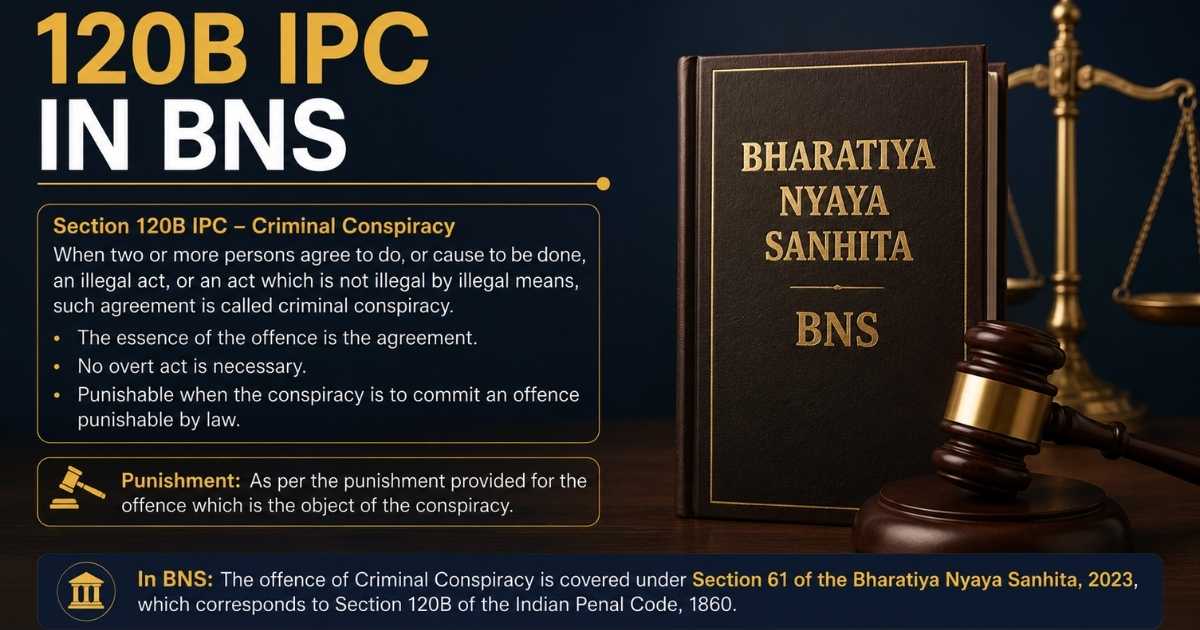

If you’re searching for 120B IPC in BNS, you’ve probably run into an FIR, a bail hearing, or a chargesheet that no longer cites the old IPC number. That confusion is common right now, since India’s criminal laws changed on 1 July 2024, and conspiracy provisions moved to a new address entirely.
Here’s the short answer: 120B IPC in BNS is now Section 61, covering both the definition and punishment for criminal conspiracy under one consolidated provision. This guide breaks down that mapping, the ingredients courts still demand, bail realities, and trial strategy everything a litigant or advocate needs before stepping into a 2026 courtroom.
Legal Excellence
Getting a conspiracy charge right or successfully challenging one depends on precision. Courts do not convict on suspicion, guesswork, or mere association. Every conspiracy case turns on whether the prosecution can prove an actual “agreement” between two or more persons, and every defence turns on breaking that same chain of proof. That is exactly why understanding the new BNS numbering, the ingredients of the offence, and the evidentiary standards under the Bharatiya Sakshya Adhiniyam (BSA) matters so much in 2026.
Section 61 BNS: The Conspiracy Mapping
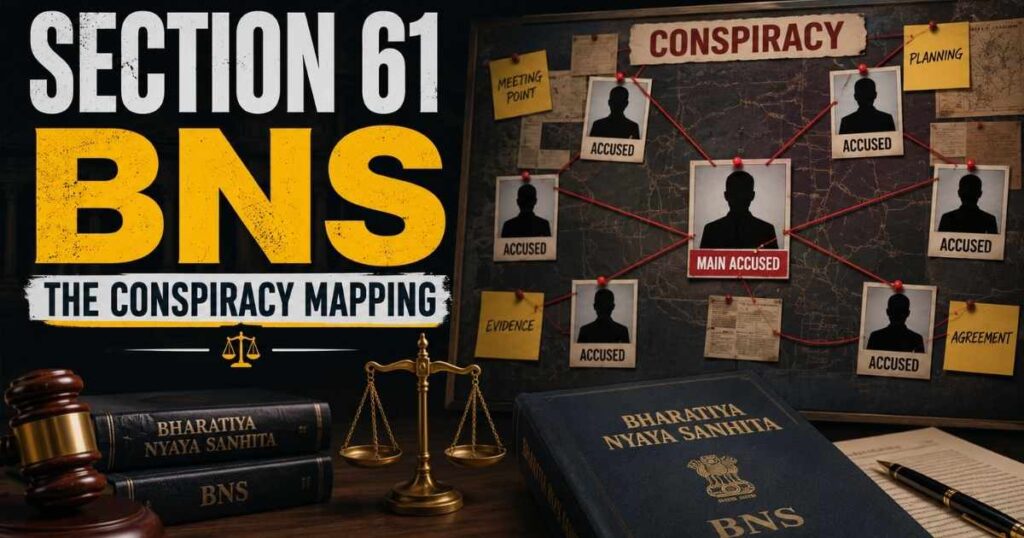
Effective 1 July 2024, the IPC stands repealed and replaced by the BNS. Criminal conspiracy, earlier spread across two separate sections of the IPC, is now consolidated into a single provision Section 61 of the BNS.
IPC 120A and 120B Explained
Under the old law, Section 120A IPC defined criminal conspiracy as an agreement between two or more persons to do an illegal act, or a legal act by illegal means. Section 120B IPC prescribed the punishment for being party to such a conspiracy. The two provisions worked together one defined the offence, the other punished it.
120 IPC in BNS
The definitional part of the old law, Section 120A, now corresponds to Section 61(1) of the BNS. The wording is largely retained, with one notable addition: the phrase “with the common object” has been inserted into the definition, aligning the statutory language with decades of judicial interpretation that had already treated shared intent as essential.
Section 120B(2) IPC in BNS
There is no “120B(2)” in the old IPC this search term usually refers to the punishment clause of Section 120B IPC, which now maps to Section 61(2) of the BNS. This sub-section prescribes punishment in two tiers, discussed in detail below.
34 IPC in BNS
Conspiracy charges are frequently combined with common intention under Section 34 IPC, which has now moved to Section 3(5) of the BNS. While conspiracy punishes the agreement itself, common intention under Section 3(5) fixes joint liability for an act actually committed in furtherance of that shared intention. Practitioners often see both invoked together in chargesheets.
| Old IPC Provision | New BNS Provision | Subject Matter |
| Section 120A IPC | Section 61(1) BNS | Definition of criminal conspiracy |
| Section 120B IPC | Section 61(2) BNS | Punishment for criminal conspiracy |
| Section 34 IPC | Section 3(5) BNS | Common intention / joint liability |
| Section 149 IPC | Section 190 BNS | Unlawful assembly, common object |
Key Changes from IPC 120B
While the substance of conspiracy law remains largely intact, the drafting style and a few textual insertions carry real consequences for how cases are argued.
Three Major Practitioner Shifts:
- Consolidation of definition and punishment into one section, simplifying charge-framing
- Express statutory insertion of “common object,” inviting courts to distinguish it from “common object” under unlawful assembly (Section 190 BNS)
- Heavier reliance on digital evidence rules under the BSA for proving the “meeting of minds”
Changes in Investigation
Investigating officers must now cite Section 61 BNS in the FIR and case diary for offences occurring on or after 1 July 2024. Digital evidence call detail records (CDRs), WhatsApp chats, and location data has become central to establishing agreement, and must satisfy the certification requirements under Section 63 of the BSA (the successor to Section 65B of the old Evidence Act) to be admissible.
Changes in Criminal Liability
The insertion of “common object” arguably raises the bar marginally for the prosecution, since it is not enough to show mere knowledge or passive presence. Courts must still find a genuine agreement, but the statutory language now nudges judges toward examining shared purpose more explicitly at the framing-of-charge stage.
Changes in Trial Procedure
Framing of charges under conspiracy is now governed by Section 263 of the Bharatiya Nagarik Suraksha Sanhita (BNSS), the replacement for the CrPC. Joint trials of co-conspirators continue to be permitted, but defence counsel now have sharper tools to object to weak digital evidence at an earlier stage.
Related POST: 509 IPC in BNS: Section 79 Mapping, Modesty Insult & Bail
Procedure and Joint Liability
FIR & Call Log Seizure
An FIR alleging conspiracy under Section 61 BNS is typically followed swiftly by seizure of phones, call logs, and messaging data. Advocates should immediately verify whether the seizure memo and certificate comply with BSA requirements, since defective seizure can be challenged later.
Arrest of ‘Conspirators’
Arrest of an alleged co-conspirator does not require that the substantive offence be completed the agreement itself is sufficient for arrest where the underlying offence is cognizable. Counsel should check whether an overt act, where legally required, has actually been shown in the case diary.
Bail Application (IPC 120B is Bailable or Not?)
This is one of the most searched questions, and the answer is conditional, not fixed. The bailable or non-bailable nature of a Section 61 BNS conspiracy charge depends entirely on the underlying offence that was the object of the conspiracy:
| Nature of Underlying Offence | Bail Status of Conspiracy Charge |
| Underlying offence is non-bailable | Conspiracy charge is generally non-bailable |
| Underlying offence is bailable | Conspiracy charge is generally bailable |
Bail applications should always cite Section 61 BNS, not the repealed Section 120B citing outdated section numbers in a 2026 bail plea signals a lack of preparation to the bench.
Approval for Interception
Where the prosecution relies on intercepted calls to prove agreement, the defence should verify that lawful sanction for interception was obtained and that the chain of custody for the recording is intact, since unauthorised interception evidence remains vulnerable to challenge.
Joint Trial
Multiple accused in a single conspiracy are usually tried together. Joint trial is procedurally efficient for the prosecution but places a heavier burden on defence lawyers to ensure that evidence admissible only against one co-accused (such as an extrajudicial confession) is not allowed to spill over and prejudice the others.
Breaking the ‘Meeting of Minds’
The phrase “meeting of minds” is the emotional core of every conspiracy trial. Without it, there is no conspiracy only coincidence, association, or independent action toward a similar goal.
120B IPC Ingredients
Courts distil the ingredients of criminal conspiracy, whether under old Section 120A/120B or the present Section 61 BNS, into the following elements:
- There must be an agreement between two or more persons.
- The agreement must be to do an illegal act, or a legal act by illegal means.
- The agreement itself not the completed crime constitutes the offence.
- For non-offence conspiracies, some overt act beyond the agreement must be shown.
- Each conspirator need not know every other member or every detail of the plan.
The Supreme Court has repeatedly held that mere knowledge, discussion, or association is not sufficient; there must be a genuine consensus to commit the unlawful act.
Critical Pitfalls for Practitioners
- Citing repealed Section 120B in fresh pleadings instead of Section 61 BNS
- Failing to object when digital evidence lacks a proper BSA certificate
- Overlooking the overt-act requirement in non-offence conspiracies
- Treating a co-accused’s confession as strong standalone proof of conspiracy, when it is legally weak evidence
- Ignoring that call records alone prove contact, not the content of an agreement
Trial and Evidence Strategy
Effective defence strategy in a Section 61 BNS trial centres on attacking the quality, not just the quantity, of circumstantial evidence. Since conspiracies are rarely proven by direct evidence, courts rely on conduct, communication, and coordination but each strand must be tested for authenticity and relevance before it is allowed to support a conviction.
Supreme Court Judgement on Section 120B IPC
Landmark rulings continue to guide Section 61 BNS cases despite the renumbering. In Kehar Singh v. State (Delhi Administration), the Supreme Court held that even indirect or circumstantial evidence could establish conspiracy if it clearly reveals agreement and intent. In Sudhir Shantilal Mehta v. CBI, the Court reiterated that meeting of minds is essential, and mere knowledge or discussion does not amount to conspiracy.
120B IPC Punishment
Punishment under Section 61(2) BNS mirrors the old Section 120B IPC structure:
| Type of Conspiracy | Punishment |
| To commit an offence punishable with death, life imprisonment, or rigorous imprisonment of two years or more | Same punishment as if the person had abetted that offence |
| Any other criminal conspiracy | Imprisonment up to six months, or fine, or both |
Conclusion
The move from 120B IPC in BNS Section 61 is best understood as a reorganisation rather than a reinvention. The core legal test an agreement between two or more persons, coupled now with an express “common object” remains rooted in the same jurisprudence that Indian courts have built over decades. What has genuinely changed is the procedural and evidentiary environment around conspiracy trials: digital certification requirements under the BSA, revised charge-framing procedure under the BNSS, and a sharper judicial focus on distinguishing conspiracy from mere association.
For practitioners, the practical takeaway is straightforward. Always plead and argue under Section 61 BNS for offences after 1 July 2024, scrutinise digital evidence for proper certification, and never treat a co-accused’s statement as conclusive proof of agreement. For the accused and their families, understanding that bail eligibility tracks the underlying offence not a fixed rule can shape realistic expectations early in a case. As with any serious criminal charge, timely consultation with an experienced criminal lawyer remains the single most important step in navigating a Section 61 BNS conspiracy allegation.
