
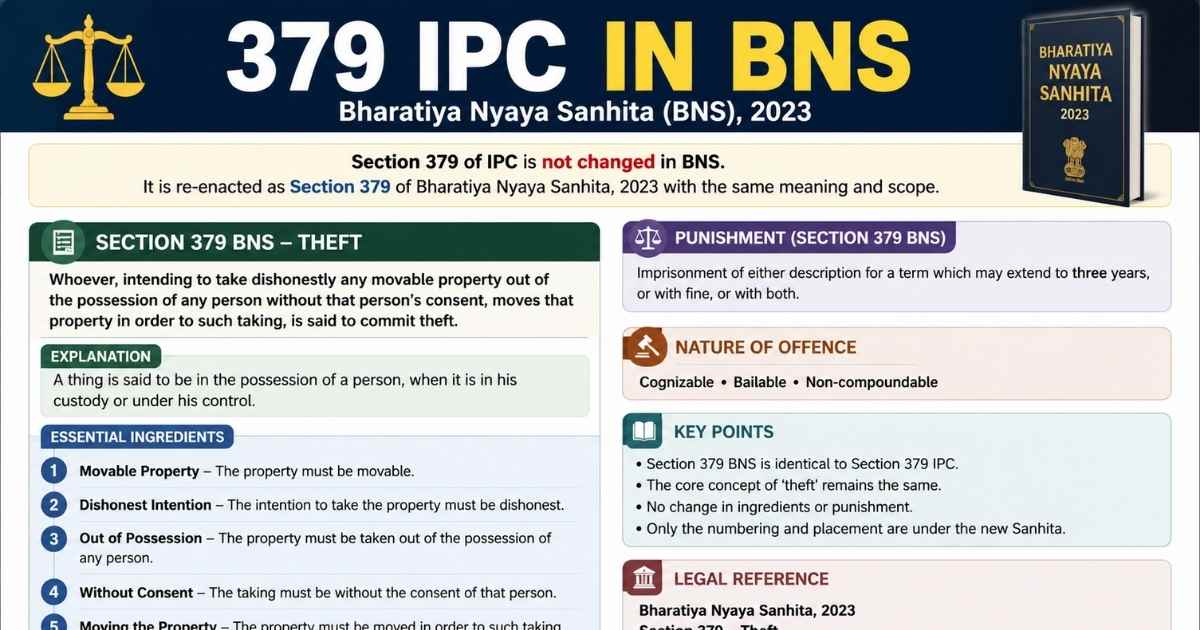

The Indian Penal Code is gone now. A new law called the Bharatiya Nyaya Sanhita took its place. If you search for 379 IPC in BNS, you will find one answer. The old Section 379 IPC is now Section 303(2) BNS. This change matters a lot. Lawyers, students, and police officers must know 379 IPC in BNS clearly. Old files still use the term 379 IPC. But new cases must use BNS numbers only. Getting 379 IPC in BNS right helps avoid mistakes in court.
This guide explains 379 IPC in BNS in simple words. We cover the punishment, the bail rules, and the trial steps. We also show how 379 IPC in BNS changes the way theft cases work today. By the end, you will understand 379 IPC in BNS fully.
Bail Bond Amount Calculator
Estimate the likely bail amount and conditions for a theft-related offence based on the property value involved, whether it’s a first offence, and the nature of the charge. Use this as a starting reference point before a bail hearing actual amounts remain at the Magistrate’s discretion.
Legal Excellence
- 303(2) BNS Section
- 3 Years (up to) Maximum Punishment on first conviction
- Bailable below ₹5,000 Bail Status depends on property value
- Cognizable Cognizability (non-cognizable only under the ₹5,000 threshold)
Section 303(2) BNS: Legal Mapping
The BNS restructured theft-related law by splitting definition and punishment into separate sub-sections instead of keeping them in two standalone provisions the way the IPC did.
| Element | IPC 379 (Old) | BNS 303(2) (New) | Remarks |
| Offence Type | Punishment for Theft | Punishment for Theft | Definition itself sits in Section 303(1) BNS |
| Base Punishment | Up to 3 years or fine, or both | Up to 3 years, or fine, or both | Wording is nearly identical to the old law |
| Repeat Offence | Not specifically addressed | Rigorous imprisonment of 1–5 years plus mandatory fine | New addition a major shift for habitual offenders |
| Bail Status (value ≥ ₹5,000) | Non-bailable in practice | Non-bailable | Accused needs a formal bail order |
| Bail Status (value < ₹5,000) | No separate carve-out | Non-cognizable and bailable | Applies only to first-time convictions |
| Cognizability | Cognizable | Cognizable (value-dependent exception below ₹5,000) | Police can arrest without a warrant above the threshold |
| Trial Court | Any Magistrate | Any Magistrate | No change in forum |
Tactical note: The single biggest mistake young practitioners make is treating Section 303(2) as automatically bailable. It isn’t. The bailable, non-cognizable status only kicks in when the stolen property is valued under ₹5,000 and it’s the accused’s first conviction. Get the valuation argument wrong, and your client’s bail strategy collapses with it.
Key Changes from IPC 379
Section 303(2) BNS reads: “Whoever commits theft shall be punished with imprisonment of either description for a term which may extend to three years, or with fine, or with both; and in case of second or subsequent conviction of the same offence, shall be punished with rigorous imprisonment which shall not be less than one year but which may extend to five years, and shall also be liable to fine.”
There’s also a proviso attached: where the value of the stolen property is less than ₹5,000 and the person is convicted for the first time, the court may order community service instead of jail, once the property or its value is returned.
Related POST: Bare Act BNS BNSS BSA: 2026 Official PDF Download Guide
Three Major Practitioner Shifts:
- Community Service for Petty Theft: For a first-time offender where the stolen property is worth under ₹5,000, the Magistrate can substitute community service for a custodial sentence. This is now the strongest first line of defense for young or first-time clients, and it should be raised at the earliest possible stage.
- Mandatory Minimum for Repeat Offenders: A second conviction no longer leaves sentencing discretion at “up to” a number it fixes a minimum of one year, rising to a maximum of five years, with a mandatory fine. This makes any prior-conviction dispute a high-stakes battle at the charge-framing stage.
- Valuation Now Decides Case Category: Under the IPC, the property’s value mainly influenced sentencing. Under the BNS, it decides whether the offence is cognizable and bailable at all. A well-argued valuation objection can shift the entire trajectory of the case.
Arrest and Bail Procedure
The BNSS lays out a tighter, more document-heavy roadmap for how a Section 303(2) case moves from FIR to trial.
FIR & Investigation
An FIR is registered under Section 303(2) BNS. If the property value is below ₹5,000, police generally require a Magistrate’s prior order before registering the case, since it’s technically non-cognizable at that threshold.
Property Seizure
The Investigating Officer seizes the stolen property and, under the newer BNSS practice, is expected to document the seizure through videography and upload records to the centralized digital system promptly.
Bail Application
Where the offence qualifies as bailable (value under ₹5,000, first conviction), counsel can move for bail under Section 480 BNSS. Where it doesn’t, a formal bail application before the Magistrate or Sessions Court is required, backed by verified surety and property documents.
Superdari (Property Release)
The complainant can apply for interim release of the seized property (superdari) so it doesn’t sit indefinitely in the Malkhana. The BNSS pushes for faster disposal timelines than the old CrPC framework.
Summary Trial
Given the relatively low maximum punishment, many Section 303(2) matters are eligible for summary trial procedures, which helps clear the docket faster but also compresses the time available for defense preparation plan accordingly.
Property Recovery and Evidence
Recovery evidence remains the backbone of most theft prosecutions, and it’s where cases are typically won or lost.
- Independent Witnesses (Panchas): Check whether the same “independent” witnesses appear across multiple unrelated FIRs from the same station a common credibility weak point.
- CCTV and Digital Evidence: Under Section 63 of the Bharatiya Sakshya Adhiniyam (BSA), footage is reliable only when the original device or a properly certified copy is produced.
- Valuation Reports: Contest inflated valuation figures. Pushing the value below ₹5,000 can be the difference between custody and community service.
- Digital Trail: If the item was allegedly resold online, marketplace transaction logs can help establish or disprove involvement.
Critical Pitfalls for Practitioners
- Assuming automatic bail: Not every Section 303(2) case is bailable at the station. Confirm the property value before advising a client.
- Citing old CrPC provisions: Default bail arguments must now cite Section 187 BNSS, not Section 167(2) CrPC outdated citations weaken credibility before the bench.
- Not contesting police custody requests: Object when police seek custodial interrogation solely for property recovery in low-value, cooperative cases.
- Ignoring the snatching distinction: Pickpocketing or grab-and-run incidents are sometimes wrongly booked under 303(2) instead of the newly separate snatching provision, Section 304 BNS this misclassification can unfairly affect bail eligibility.
- Skipping the videography objection: Failing to challenge missing seizure videography at the first hearing lets a real procedural defect go unchallenged.
Trial and Defense Strategy
- Possession Isn’t Automatically Theft: If the prosecution can’t prove the accused actually took the property, argue for a lesser charge such as receiving stolen property, which carries a different intent standard.
- Verify the Site Plan: Confirm the IO’s site plan matches the actual location of the offence a theft from a dwelling falls under a different, more serious provision than street theft.
- Use Plea Bargaining: Chapter XXVI of the BNSS makes plea bargaining a practical route for first-time or young offenders, especially where the property has already been returned to the complainant.
- Push the Valuation Argument Early: Since valuation decides both bail category and sentencing option, raise it at the first opportunity rather than waiting for trial.
FAQs
Is theft under Section 303(2) BNS bailable?
It depends on the property’s value. Theft of property worth ₹5,000 or more is non-bailable; below that threshold, for a first conviction, it is non-cognizable and bailable.
What is the maximum punishment under Section 303(2) BNS for a first offence?
Imprisonment of up to three years, or a fine, or both.
What happens on a second theft conviction under Section 303(2)?
The court must impose rigorous imprisonment of at least one year, extending up to five years, along with a mandatory fine.
Can community service replace jail time under Section 303(2)?
Yes, but only for a first conviction where the stolen property is valued under ₹5,000 and it is returned or its value repaid.
Which court tries Section 303(2) BNS cases?
Any Magistrate has the jurisdiction to try offences under this section.
Conclusion
379 IPC in BNS is now clear. The old Section 379 IPC lives on as Section 303(2) BNS. This shift is simple once you learn it. 379 IPC in BNS changes how theft cases move through court. It changes bail rules too. Lawyers must use the new name in every filing.
Understanding 379 IPC in BNS helps everyone. It helps lawyers argue better. It helps students learn faster. It helps citizens know their rights. 379 IPC in BNS is not hard once explained simply. Keep this guide close. Use it whenever theft law comes up. 379 IPC in BNS is the new standard now.
