
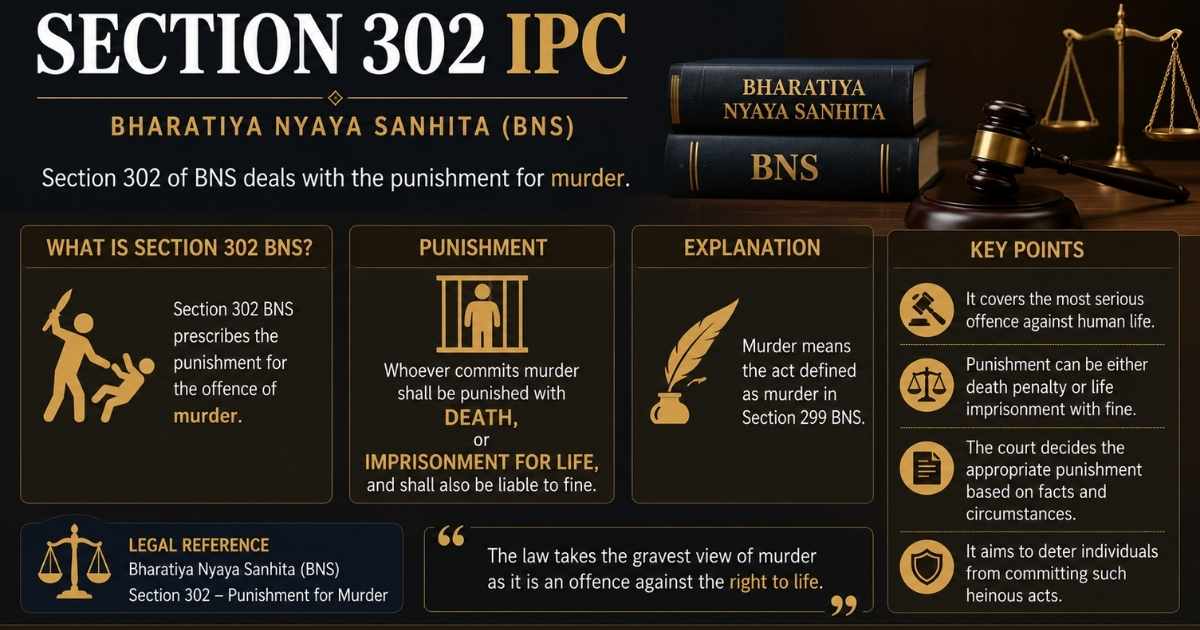

Every criminal lawyer once knew Section 302 IPC by heart the section that decided whether a client faced life imprisonment or the gallows. That number no longer exists on paper. 302 IPC in BNS is now called Section 103(1), and while the punishment for murder hasn’t really changed, almost everything around it has.
For advocates handling trials in 2026, understanding 302 IPC in BNS means more than memorizing a new number. It means mastering fresh forensic rules, tighter court timelines, and a completely different evidence code guiding every murder case today.
Legal Excellence
Murder is the offence every criminal lawyer eventually has to face across the table the file that keeps you up at night. For over 160 years, Section 302 of the Indian Penal Code was the section every FIR, chargesheet, and judgment cited when a death was alleged to be intentional. That number is gone. Since July 1, 2024, murder is prosecuted under Section 103(1) of the Bharatiya Nyaya Sanhita (BNS), 2023, tried under the procedural scaffolding of the Bharatiya Nagarik Suraksha Sanhita (BNSS), and proved through the evidentiary rules of the Bharatiya Sakshya Adhiniyam (BSA).
For advocates, investigating officers, and law students working through cases in 2026, the renumbering isn’t cosmetic. The substance of murder law hasn’t changed much but the trial pathway, the forensic obligations, and the timelines around it have. This guide walks through the mapping, the punishment, the bail and cognizability position, and the sessions trial procedure step by step, so you know exactly where you stand when a 103(1) FIR lands on your desk.
What is Section 103(1) BNS? IPC 302 to BNS Mapping
Section 103(1) BNS is the direct successor to Section 302 IPC. It prescribes the punishment for murder it does not define murder itself. The definition of murder continues to live in Section 101 BNS, just as it previously lived in Section 300 IPC.
| IPC Provision | BNS Provision | Subject Matter |
| Section 299 IPC | Section 100 BNS | Culpable homicide (definition) |
| Section 300 IPC | Section 101 BNS | Murder (definition) |
| Section 301 IPC | Section 102 BNS | Culpable homicide of a person other than the intended victim |
| Section 302 IPC | Section 103(1) BNS | Punishment for murder |
| — | Section 103(2) BNS | New: murder by a group of five or more on identity grounds |
According to the official BNS-to-IPC comparison published by the Bureau of Police Research and Development, Section 302 IPC has been carried into the BNS with no substantive change, except that it is now framed as sub-section (1) of Section 103. The essential ingredients a prosecutor must still establish are unchanged: an act causing death, done with the intention or knowledge described under Section 101 BNS, without falling into one of the five statutory exceptions that pull the offence down to culpable homicide.
Section 103(1) BNS Punishment
Section 103(1) reads, in substance, that whoever commits murder shall be punished with death or imprisonment for life, and shall also be liable to fine. The structure mirrors old Section 302 almost word for word.
- Minimum punishment: Imprisonment for life (meaning imprisonment for the remainder of the convict’s natural life, not a fixed term of 14 or 20 years)
- Maximum punishment: Death penalty, reserved for cases the courts classify as “rarest of rare”
- Fine: Now an explicit and mandatory component of sentencing, often factoring into victim compensation directions under the BNSS
Because the BNS carries forward decades of Supreme Court precedent on sentencing in murder cases, prior case law on the death penalty, life imprisonment, and the rarest-of-rare doctrine continues to apply to Section 103(1) trials.
Related Post: Court Marriage Documents List (2026) – Gujarat + India
Is Section 103(1) BNS Bailable or Non-Bailable?
No. Section 103(1) BNS is a non-bailable offence. That label is frequently misunderstood, so it’s worth being precise about what it actually means for practice:
- Bail is not a matter of right for the accused.
- A formal bail application must be moved, ordinarily before the Court of Session or the High Court.
- The court weighs the gravity of the allegation, the strength of the evidence on record, flight risk, and the possibility of witness tampering before deciding.
- Anticipatory bail is granted only in rare and exceptional situations, given the severity of the charge.
Bail outcomes in murder trials frequently turn on the principle of parity whether co-accused with a similar role in the alleged offence have already been granted bail along with delay in trial and the quality of the recovered evidence.
Is Section 103(1) BNS Cognizable or Non-Cognizable?
Section 103(1) BNS is a cognizable offence. This means the police can:
- Register an FIR on receiving information about a murder
- Begin investigation immediately, without needing a Magistrate’s prior permission
- Arrest the accused without a warrant
Murder under the BNS is also non-compoundable it does not appear in the list of compoundable offences under Section 359 BNSS, so the complainant’s family cannot “settle” the case privately to withdraw it. Only a High Court, in rare and exceptional circumstances, can quash such proceedings using its inherent powers under Section 528 BNSS.
Key Changes from IPC 302 to Section 103(1) BNS
While the punishment structure has stayed largely intact, several procedural and evidentiary shifts materially change how a 103(1) trial is fought:
| Element | IPC 302 (Old Regime) | BNS 103(1) (2026 Regime) |
| Definition | Under Section 300 IPC | Under Section 101 BNS |
| Fine | Discretionary in practice | Framed as an explicit, mandatory component |
| Forensic visit | Not mandatory in most cases | Mandatory for offences carrying 7+ years, under Section 176 BNSS |
| Search & seizure | Videography optional/inconsistent | Videography mandated under Section 105 BNSS |
| Trial timelines | No fixed statutory windows | BNSS pushes for defined timelines and fewer adjournments |
| Digital evidence | Governed by Evidence Act, 1872 | Governed by BSA, with expanded provisions on electronic and digital records |
Three Major Practitioner Shifts
For advocates transitioning their murder practice into the BNS/BNSS/BSA framework, three changes deserve the most attention:
- Mandatory forensic visits are now a compliance checkpoint. Under Section 176(3) BNSS, a forensic expert must visit the crime scene for offences punishable with seven years or more, which squarely includes Section 103(1). If the investigating officer skips this step, it becomes a real ground to challenge the investigation’s integrity.
- Videography of search and seizure is a new evidentiary battleground. Section 105 BNSS effectively makes video documentation of search and seizure part of standard procedure. Gaps or inconsistencies in this record can be used to question the chain of custody of the weapon or other recovered material.
- Faster-moving trials demand earlier trial readiness. The BNSS’s push toward defined trial timelines means defence counsel can no longer rely on repeated adjournments to buy preparation time. Cross-examination strategy, expert witnesses, and forensic rebuttals need to be lined up much earlier in the process.
Sessions Trial Procedure under Section 103(1) BNS
A Section 103(1) case is tried exclusively as a Sessions Trial, following the sequence below.
FIR Registration & Mandatory Forensic Visit
The process begins with FIR registration, since murder is cognizable. Given the mandatory forensic requirement under Section 176 BNSS, the forensic team’s visit to the scene and its documentation becomes part of the record from day one, along with the required videography of the scene.
Remand & Police Investigation
The accused is produced before the jurisdictional Magistrate for remand. Because weapon recovery and other custodial disclosures are often central to a murder case, police custody for the maximum permissible period under Section 187 BNSS is commonly sought at this stage.
Committal to the Court of Session
Once investigation concludes, the Magistrate commits the case to the Court of Session under Section 232 BNSS, after ensuring the accused has been served all relevant documents, including digital copies of the chargesheet and supporting material.
Framing of Charges
The Public Prosecutor opens the case, and charges are framed under Section 251 BNSS. This is the defence’s earliest real opportunity to argue for discharge, or to press for a lesser charge such as culpable homicide not amounting to murder under Section 106(1) BNS.
Prosecution Evidence, Defence Evidence & Judgment
The trial proceeds with prosecution witnesses (including the investigating officer and forensic experts), followed by the defence’s evidence and cross-examination, closing arguments, and finally judgment. If convicted, sentencing arguments are heard separately, given the possibility of a death sentence.
Section 103(2) BNS (Mob Lynching): Difference from Section 103(1)
Section 103(2) is an entirely new provision with no direct IPC equivalent. It targets murder committed by a group of five or more persons acting in concert, where the killing is on grounds such as race, caste, community, sex, place of birth, language, or personal belief.
The key distinctions from Section 103(1):
- Number of accused: 103(2) requires five or more persons acting together; 103(1) can apply to a single accused or any number acting with common intention.
- Motive element: 103(2) requires an identity-based ground for the killing; 103(1) has no such requirement.
- Bail precedent: Older bail precedents built under IPC 302 do not automatically transfer to 103(2) cases, since the communal or identity-based element introduces fresh judicial scrutiny.
Section 103(2) BNS Punishment
Section 103(2) prescribes death, imprisonment for life, or imprisonment for a term of not less than seven years, along with a mandatory fine for each member of the group found guilty.
Critical Pitfalls for Practitioners
- Ignoring Section 176 BNSS non-compliance. A missed or delayed forensic visit is one of the strongest procedural challenges available in a 2026 murder trial don’t overlook it while focused on merits.
- Treating 103(2) as “103(1) with extra people.” The motive requirement changes the entire evidentiary approach, from witness examination to bail arguments.
- Assuming old case law applies uncritically. While substantive murder law carries over from the IPC, procedural precedents built around the old Cr.P.C. and Evidence Act need to be re-checked against the BNSS and BSA equivalents before you cite them in court.
- Underestimating digital evidence rules. The BSA’s expanded treatment of electronic records means call detail records, tower locations, and device data now play a larger role in both the prosecution’s chain of circumstantial evidence and the defence’s alibi strategy.
Defence and Evidence Strategy
A strong defence in a Section 103(1) trial in 2026 typically works across a few fronts:
- Chain of custody: Scrutinise whether the weapon and body were recovered, photographed, and videographed as required. Gaps here can seriously weaken the prosecution’s case.
- Digital alibi: Location data, device timelines, and call records can directly contradict eyewitness accounts and break a purely circumstantial chain.
- Independent medical review: In cases built on forensic conclusions, an independent expert opinion on cause of death can open the door to alternative explanations such as accident or suicide.
- Charge reduction arguments: Where intention is genuinely in dispute, pressing for reclassification to culpable homicide under Section 106(1) BNS at the charge-framing stage can materially change the client’s exposure.
Get High-Stakes Criminal Leads Join JuriGram
If you handle sessions trials and want a steady pipeline of murder, bail, and criminal defence briefs, JuriGram connects practising advocates with clients actively searching for representation in serious criminal matters. Build your profile, showcase your BNS/BNSS trial experience, and get discovered by people who need a lawyer right now.
More Guides in This Category
- IPC 304 to BNS: Culpable Homicide Not Amounting to Murder
- IPC 307 to BNS 109: Attempt to Murder, Punishment & Bail
- Bail Procedure Under the BNSS: A Practitioner’s Checklist
- Chain of Custody Under the BSA: What Changed From the Evidence Act
Conclusion
The shift from 302 IPC in BNS is less about a new definition of murder and more about a new discipline of proof. The core question a court still asks hasn’t moved did the accused cause death with the intention or knowledge that makes it murder rather than culpable homicide. What has moved is everything around that question: mandatory forensic visits, videographed search and seizure, tighter trial timelines, and an evidence code that gives digital records real weight in the courtroom.
For advocates, that means the fight in a 2026 murder trial is won or lost as much on procedural compliance as on the facts of the killing itself. Knowing exactly where Section 103(1) sits against the old Section 302, how bail and cognizability work under it, and how a Sessions trial actually unfolds under the BNSS isn’t optional background reading anymore it’s the baseline competence every criminal practitioner needs walking into court.
