
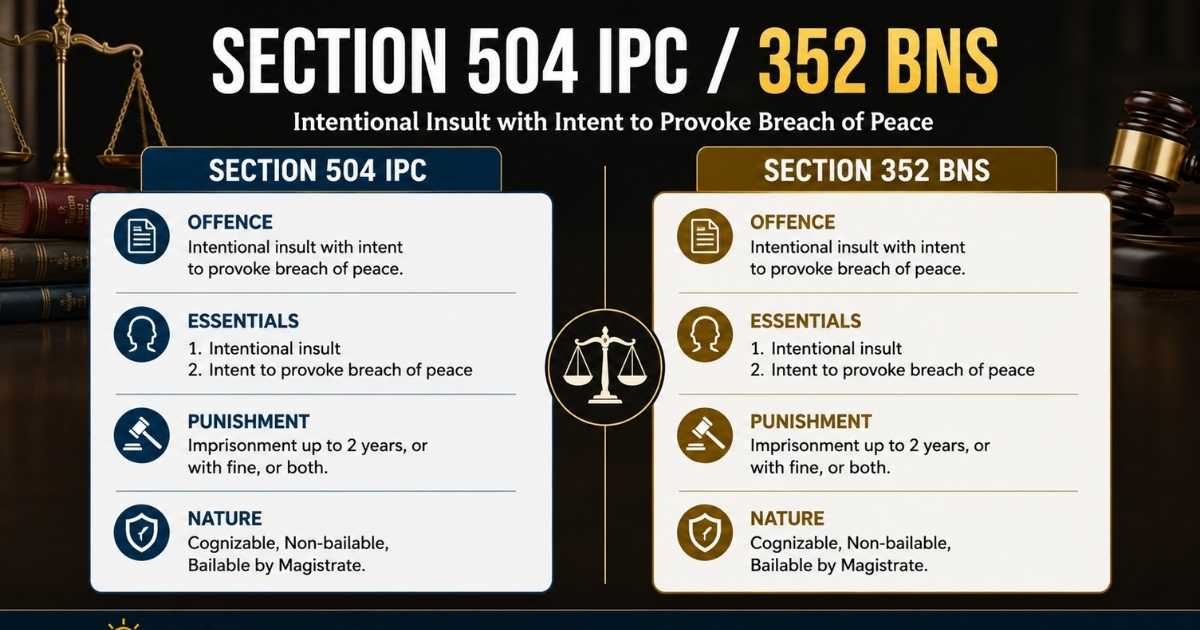

Section 504 IPC / 352 BNS deals with intentional insult. It covers words or actions meant to provoke someone. Section 504 IPC / 352 BNS was once known only as Section 504 under the old law. Today it exists as Section 352 under the new Bharatiya Nyaya Sanhita. Many people search for Section 504 IPC / 352 BNS when they face a sudden police complaint. Others search for it when someone insults them in public. This law protects public peace. It does not punish every rude word.
Section 504 IPC / 352 BNS applies only when the insult is deliberate. It applies when the insult is likely to cause trouble. Section 504 IPC / 352 BNS is bailable. It is also non-cognizable. This guide explains the punishment. It explains the bail process. It explains your rights under Section 504 IPC / 352 BNS in simple words.
What is Section 352 BNS (Earlier Section 504 IPC)?
Section 352 BNS punishes a person who deliberately insults another in a manner likely to provoke that person into breaking public peace or committing an offence. The provision came into effect on 1 July 2024, replacing Section 504 IPC almost word for word.
The official text reads:
“Whoever intentionally insults in any manner, and thereby gives provocation to any person, intending or knowing it to be likely that such provocation will cause him to break the public peace, or to commit any other offence, shall be punished with imprisonment of either description for a term which may extend to two years, or with fine, or with both.”
In simple terms, the law isn’t triggered by every rude remark. It applies only when an insult is calculated — or reasonably expected — to push someone toward violence or public disorder.
Related POST: 324 IPC = BNS 118(1): NOW Non-Bailable Punishment, Bail & Defence 2026
Essential Ingredients of Section 352 BNS
To convict someone under this section, the prosecution must prove three connected elements.
Intentional Insult
The insult must be deliberate, not accidental or casual. It can be verbal, written, gestural, or — increasingly — digital, such as a social media post or WhatsApp message.
Intent to Provoke a Breach of Peace
The accused must have intended the insult to provoke the victim, or must have known that provocation was a likely outcome.
Likelihood of Public Disorder
The insult should carry a real risk of the victim breaking public peace or committing another offence. Purely private hurt feelings, without any public angle, generally fall outside this section.
Punishment Under Section 352 BNS
| Particulars | Details |
| Imprisonment | Up to 2 years |
| Fine | As decided by the court |
| Combined penalty | Imprisonment and fine, or either |
| Trial court | Any Magistrate |
The court has discretion to decide the punishment based on the severity of the insult, the intent behind it, and the actual disturbance it caused.
Is Section 352 BNS Bailable or Non-Bailable?
Section 352 BNS is a bailable offence. This means bail is a matter of right, not judicial discretion. An accused can secure release by furnishing a personal bond and local sureties, without needing to file a formal bail application in most cases.
Is Section 352 BNS Cognizable or Non-Cognizable?
Section 352 BNS is classified as non-cognizable. This has a direct practical impact:
- Police cannot register an FIR or arrest the accused on their own
- A Magistrate’s permission is required before police can investigate
- Most cases proceed through a private complaint filed directly before the Magistrate
Complaint Procedure in Non-Cognizable Cases
Because the offence is non-cognizable, the legal process follows a specific path under the Bharatiya Nagarik Suraksha Sanhita (BNSS).
NCR Entry by Police
The police record the incident in the Non-Cognizable Report (NCR) register and direct the complainant to approach the Magistrate, since they cannot investigate on their own.
Private Complaint Under BNSS
The complainant (usually through an advocate) files a private complaint before the Magistrate. The complainant’s statement is recorded on oath.
Magistrate’s Summoning Order
If the Magistrate finds a prima facie case, summons are issued directing the accused to appear in court.
Bail Procedure
As the offence is bailable, the accused is released promptly upon executing bail bonds once they appear before the court or police.
Summary Trial Process
Trials under Section 352 BNS are usually conducted as summary trials, relying heavily on oral testimony, witness statements, and — where relevant — digital evidence.
Key Changes from Section 504 IPC to Section 352 BNS
| Aspect | Section 504 IPC (Old) | Section 352 BNS (New) |
| Offence definition | Same wording | Same wording |
| Punishment | Up to 2 years, fine, or both | Up to 2 years, fine, or both |
| Cognizable status | Non-cognizable | Non-cognizable |
| Bailable status | Bailable | Bailable |
| Digital evidence | Not explicitly addressed | Recognised under the Bharatiya Sakshya Adhiniyam |
| Effective date | Repealed | In force from 1 July 2024 |
The core legal principle hasn’t changed — only the numbering, procedural cross-references, and explicit recognition of digital evidence have been updated.
How to Challenge ‘Intent’ and ‘Provocation’
Proving intent is often the hardest part of a Section 352 BNS case, which opens up several defence angles:
- Show that the words were part of a generic argument rather than a targeted provocation
- Argue that a reasonable person would not have been provoked into breaching public peace by the specific words used
- Highlight the absence of any actual disturbance following the alleged insult
Common Defences in Section 352 BNS Cases
- No public element: If the insult occurred in a private space or a direct message with no public audience, argue that “public peace” could never have been at risk
- Lack of intent or knowledge: Demonstrate that the accused had no reason to believe the words would provoke a breach of peace
- Fair comment or criticism: If the statement was part of a genuine debate or critique, it may lack the malicious intent required under this section
- Evidentiary gaps: Challenge screenshots, audio, or video evidence that lacks proper authentication under the Bharatiya Sakshya Adhiniyam
Trial and Evidence Strategy
- Cross-examine the complainant on whether any actual violence or disorder followed the alleged insult
- Scrutinise digital evidence for chain-of-custody and certification requirements
- Explore settlement options where facts are not seriously disputed, since prolonged litigation over a two-year-maximum offence rarely benefits either side
- Use witness statements to establish (or rebut) the context in which the words were spoken
Important Supreme Court Judgments on Section 504 IPC / Section 352 BNS
Indian courts have repeatedly clarified that mere abusive language is not enough to attract this provision unless it is accompanied by intent to provoke a breach of peace. Judicial precedents under Section 504 IPC continue to guide interpretation of Section 352 BNS, since the wording and legislative intent remain unchanged. Courts have consistently held that:
- Insults exchanged in the heat of an ordinary quarrel, without a deliberate design to provoke disorder, do not automatically attract this section
- The insult must be assessed in context — the relationship between parties, the setting, and the likely reaction of a reasonable person all matter
- FIRs or complaints that only allege hurt feelings, without any risk to public peace, are liable to be quashed
Difference Between Section 504 IPC and Section 352 BNS
| Point of Comparison | Section 504 IPC | Section 352 BNS |
| Legislation | Indian Penal Code, 1860 | Bharatiya Nyaya Sanhita, 2023 |
| Applicable from | Repealed after 30 June 2024 | 1 July 2024 onwards |
| Wording of offence | Nearly identical | Nearly identical |
| Digital evidence handling | Governed by Indian Evidence Act | Governed by Bharatiya Sakshya Adhiniyam |
| Citation in new cases | Should not be used for post-2024 incidents | Mandatory for incidents after 1 July 2024 |
FAQ’s
What is the punishment under Section 352 BNS?
Imprisonment for up to two years, a fine, or both, depending on the facts of the case.
Is Section 352 BNS bailable?
Yes, it is a bailable offence, so bail is available as a matter of right.
Is Section 352 BNS cognizable?
No, it is non-cognizable, meaning police need a Magistrate’s direction to investigate or arrest.
Can police arrest without a warrant?
Generally no, since the offence is non-cognizable; arrest typically requires a Magistrate’s order or warrant.
How can an accused get bail?
By furnishing a personal bond and local sureties before the police or the Magistrate, since bail is a statutory right in bailable offences.
Can the case be quashed by the High Court?
Yes, if the FIR or complaint fails to disclose the essential ingredients of intent and likelihood of breach of peace, the High Court can quash proceedings.
Related BNS Sections
- Section 351 BNS – Criminal Intimidation
- Section 74 BNS – Assault or Criminal Force Against a Woman
- Section 79 BNS – Word, Gesture or Act Intended to Insult the Modesty of a Woman
Conclusion
Section 504 IPC / 352 BNS is an important law. It protects public peace from harmful insults. Section 504 IPC / 352 BNS does not punish every angry word. It only punishes insults meant to cause trouble. This law is bailable. This law is also non-cognizable. That makes the process less scary for the accused.
Anyone facing a case under Section 504 IPC / 352 BNS should stay calm. They should understand their rights first. A good lawyer can help build a strong defence. Section 504 IPC / 352 BNS balances free speech with public order. Knowing this law helps you act wisely and protect your interests.
