
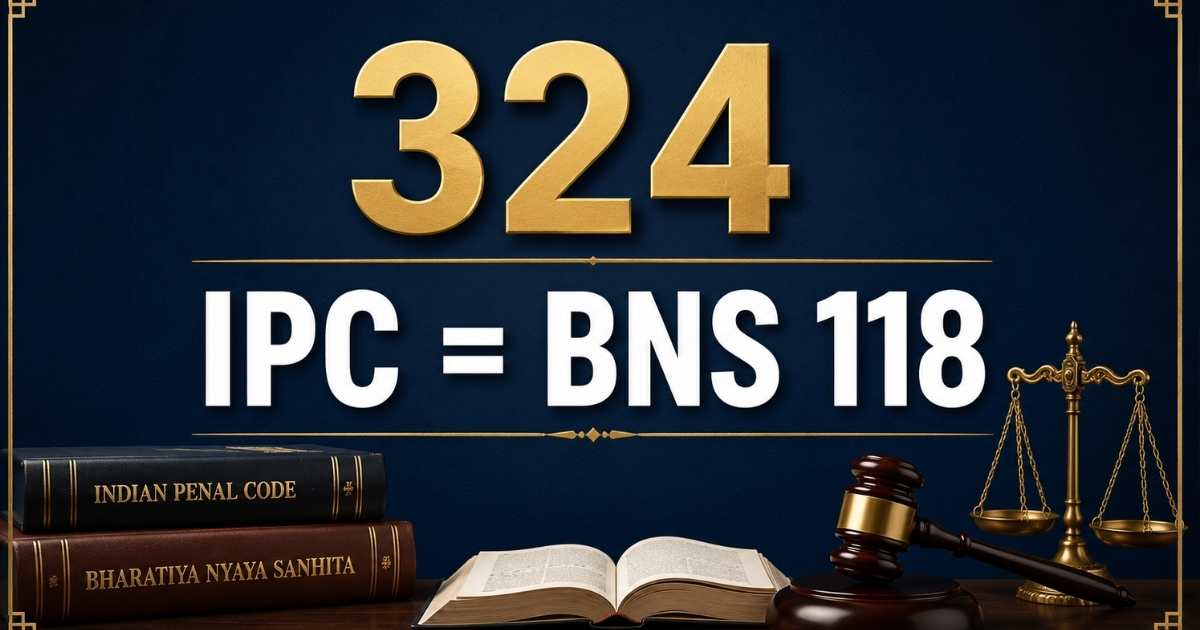

324 IPC = BNS 118 is one of the most important changes in Indian criminal law today. Section 324 IPC used to deal with hurt caused by a dangerous weapon. Now, 324 IPC = BNS 118 under the new criminal code. This change is not just a number swap. 324 IPC = BNS 118 also brings a major shift in bail rules. The old law was mostly bailable. The new law is non-bailable. This makes 324 IPC = BNS 118 a serious concern for lawyers and clients alike.
Every advocate handling weapon-injury cases must understand 324 IPC = BNS 118 in detail. The punishment stays close to three years. The fine can go up to twenty thousand rupees. Knowing 324 IPC = BNS 118 helps you build a strong defence from day one. This shift changes how bail, arrest, and trial work in 2026.
Legal Excellence
| Metric | Detail |
| ⚖️ BNS Section | 118(1) |
| ⚖️ Bail Status | Non-Bailable |
| ⚖️ Punishment | Up to 3 years imprisonment / ₹20,000 fine, or both |
| ⚖️ Cognizability | Cognizable |
Section 118(1) BNS: Dangerous Weapon Hurt
Section 118(1) BNS punishes hurt caused by an instrument used for shooting, stabbing, or cutting, or any instrument which, when used as a weapon, is likely to endanger life. It also folds in harmful substances fire, heated objects, poison, corrosive material, or explosives that were separately worded under the old Section 324.
In simple terms, three things must be established for a 118(1) charge to stick:
- The accused voluntarily caused hurt (not grievous hurt, which falls under 118(2)).
- The means used were “dangerous” capable of causing death or serious harm.
- There was intent or knowledge that the act was likely to cause hurt.
Tactical note: the nature of the object used is almost always the real battleground. If the item say, a plastic bottle or a bare hand isn’t inherently capable of causing death, defence counsel should push for the charge to be reduced to simple hurt under Section 115(2) BNS, which remains bailable.
Related POST: Section 118 of BNS in Hindi
Key Changes from IPC 324 (Bail Shift)
| Element | IPC 324 (Old) | BNS 118(1) (New) | Practical Impact |
| Offence Type | Hurt by weapon | Hurt by weapon | Now expressly includes fire, poison, explosives |
| Bail Status | Bailable in most jurisdictions | Non-bailable | Biggest shift for practitioners |
| Fine | Left to court’s discretion | Capped at ₹20,000 (usual practice) | Sentencing predictability improves |
| Trial Forum | Any Magistrate | Any Magistrate | No change summary or warrant trial |
| Governing Bail Provision | Section 437/439 CrPC | Section 481 BNSS | New procedural citation required |
Three Major Practitioner Shifts:
- Non-Bailable Status Bail is no longer a matter of right. The accused must move a formal bail application under Section 481 BNSS, and the counsel’s job is to show the accused’s role was minor or that the alleged weapon doesn’t meet the “dangerous” threshold.
- Mandatory Videography (Section 105 BNSS) Whenever police recover a knife, rod, or similar object from the accused, the recovery must be videographed and the digital record produced at the remand stage. A missing video is one of the strongest defence arguments available in 2026.
- Evidence Certification (Section 63 BSA) Any CCTV or mobile footage relied on by the prosecution needs a certificate under Section 63 of the Bharatiya Sakshya Adhiniyam. Without it, courts routinely disregard the footage altogether.
Arrest and Bail Strategy
The BNSS roadmap for a 118(1) case follows a fairly predictable sequence, but each stage carries its own defence opportunity.
FIR & MLC Recording
The FIR is registered and the victim’s Medico-Legal Certificate (MLC) is prepared. If a weapon is recovered on the spot, videography under Section 105 BNSS becomes mandatory from this point onward.
Arrest & Production
Because the offence is non-bailable, once arrested the accused must be produced before a Magistrate within 24 hours. Any delay beyond this window is itself a ground for challenging custody.
Bail Application
Counsel files the bail plea under Section 481 BNSS, highlighting the absence of lethality in the weapon used, or a “false plant” argument if the recovery wasn’t videographed as required.
Forensic Analysis
The seized weapon is sent for FSL examination, and any digital evidence CCTV, phone recordings must carry the Section 63 BSA authentication certificate before it can be relied upon.
Warrant Trial
The matter proceeds as a warrant case. The eyewitness account and the treating Medical Officer’s testimony typically decide the outcome, making cross-examination of both central to the defence.
Challenging the ‘Weapon’ and ‘Intent’
A conviction under 118(1) requires proof that a genuinely dangerous weapon was used with intent to cause hurt. Defence strategy usually rests on a few recurring arguments:
- Non-Dangerous Nature Defence everyday objects picked up in the heat of a sudden quarrel, such as a mobile phone or a pen, don’t automatically qualify as “dangerous weapons.”
- Right of Private Defence if the accused picked up an object only to fend off a group attack, this can be argued under the general exceptions in Sections 34–44 BNS.
- Digital Witness Record neighbourhood CCTV or bystander mobile footage, once properly certified under Section 61 BSA, can show the complainant was the actual aggressor.
- Medical Discrepancy if the FIR describes a stabbing but the MLC records only blunt trauma, the foundation of the 118(1) charge becomes shaky and open to challenge.
Critical Pitfalls for Practitioners
A few recurring mistakes weaken otherwise strong defences in 118(1) matters:
- Citing the old IPC 324 label in filings always plead Section 118(1) BNS; outdated citations invite rejection at the registry stage.
- Accepting non-videographed recoveries at face value a missing recovery video under Section 105 BNSS is grounds to press for discharge or attack the charge sheet’s credibility.
- Ignoring improper Police Custody requests once the weapon has already been recovered, police cannot ordinarily seek further Police Custody under Section 187 BNSS for the same incident.
- Skipping a cross-MLC if the client also sustained injuries, get them medically examined immediately. A cross-MLC can reframe the incident as a mutual altercation, which materially improves bail prospects.
Trial and Evidence Strategy
A few practical cross-examination and procedural tips consistently help the defence in weapon-hurt trials:
- Ask the Medical Officer directly whether the injury is consistent with an accidental fall against a sharp surface a “yes” answer can undercut the entire 118(1) framing.
- Confirm the prosecution has filed the mandatory Section 63 BSA certificate for any video evidence; without it, courts treat the footage as inadmissible.
- Explore compounding under Section 359 BNSS where the court permits it and the injury is genuinely minor many 118(1) disputes settle at this stage.
- File for anticipatory bail under Section 482 BNSS at the earliest possible sign of an FIR, since the non-bailable status makes pre-arrest protection the priority move.
FAQs
Is BNS Section 118(1) bailable or non-bailable?
Section 118(1) BNS is a non-bailable offence, meaning bail depends on judicial discretion rather than being an automatic right.
What is the punishment under BNS 118(1)?
The punishment extends up to three years’ imprisonment, a fine of up to ₹20,000, or both.
Which section of BNSS governs bail applications for 118(1)?
Bail applications for BNS 118(1) are filed under Section 481 of the Bharatiya Sakshya Nyaya Sanhita (BNSS).
Can BNS 118(1) charges be reduced to a lesser offence?
Yes if the object used isn’t genuinely capable of causing death, courts may reduce the charge to simple hurt under Section 115(2) BNS, which is bailable.
Is BNS 118(1) the same as IPC 324?
Yes, BNS 118(1) is the direct successor to IPC 324, covering the same core offence with an updated bail status and fine structure.
Conclusion
324 IPC = BNS 118 is a change every lawyer must know. It shapes how bail works now. It shapes how trials move forward. 324 IPC = BNS 118 makes the offence non-bailable. This means clients need strong legal help early. Understanding 324 IPC = BNS 118 is the first step to a good defence.
324 IPC = BNS 118 will keep shaping criminal cases in 2026. Lawyers must stay updated on 324 IPC = BNS 118 rules. Clients must act fast once charged. Quick action and clear knowledge of 324 IPC = BNS 118 protect rights. Stay informed. Stay prepared.
