


Unlawful assembly is a legal concept concerning a group of people who gather with a legally prohibited common object. In Pakistan, the main provision is Section 141 of the Pakistan Penal Code, 1860 (PPC). It applies when five or more persons share one of the unlawful objects specified by the law.
The law also covers what happens when a person knowingly joins such a group, remains in it, carries a deadly weapon, refuses to disperse after a lawful command, or becomes connected with an offence committed in furtherance of the assembly’s common object. These matters are addressed mainly through Sections 142 to 149 PPC.
What Is Unlawful Assembly?
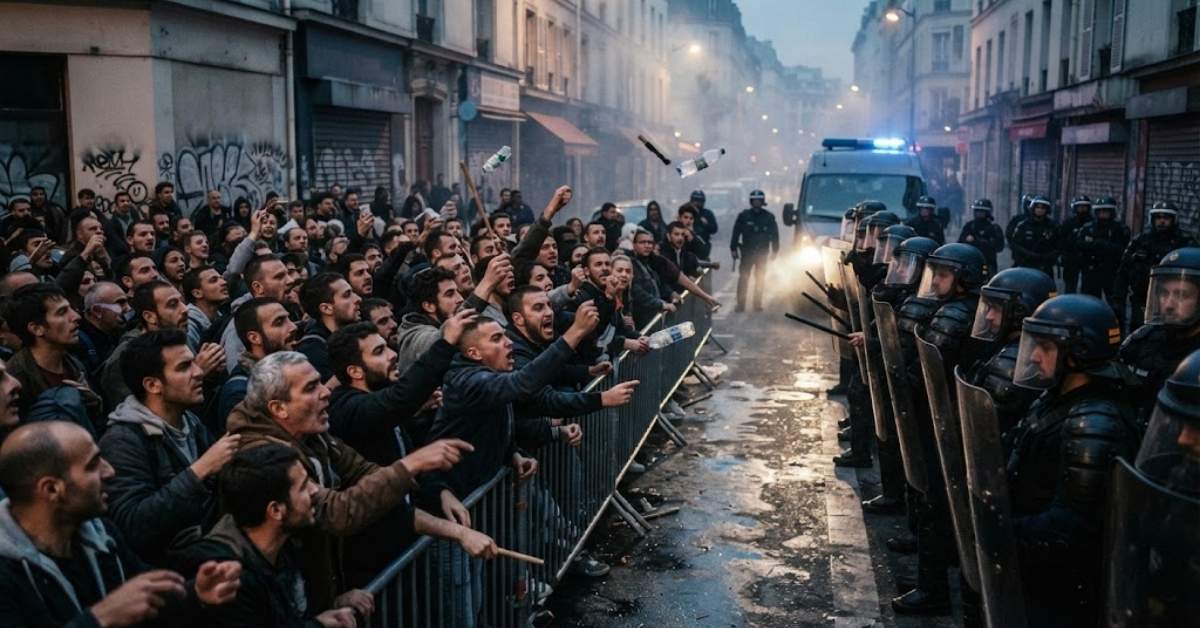
Under Section 141 PPC, an assembly of five or more people becomes an unlawful assembly when its common object falls within any of the five categories specified by law.
In simple terms, the number of people alone does not make a gathering unlawful. The common object of the group is a central requirement.
The five categories broadly concern:
- Using or threatening criminal force to overawe the Federal or Provincial Government, Legislature, or a public servant acting lawfully.
- Resisting the execution of a law or legal process.
- Committing mischief, criminal trespass, or another offence.
- Using criminal force to obtain property, interfere with certain rights, or enforce a claimed right.
- Using criminal force to make someone do something they are not legally required to do, or prevent them from doing something they are legally entitled to do.
A significant point is that a gathering does not have to be unlawful from the moment it forms. The law expressly recognizes that an assembly can subsequently become unlawful.
Essential Elements of Unlawful Assembly
Several elements are important when determining whether Section 141 PPC applies.
Five or More Persons
The statutory definition requires an assembly of five or more persons. However, the number is only one part of the legal test.
The group must also have a qualifying common object described in Section 141.
Common Object
The idea of a common object is central to unlawful assembly cases.
It means the shared purpose that connects the members of the group. Courts may examine the surrounding circumstances to determine what that purpose actually was.
The common object does not necessarily have to be proved through a written agreement or formal plan. Courts can consider the conduct and circumstances of the assembly when assessing it. Pakistani case law recognizes the importance of examining the behavior and circumstances of members when determining common object.
Knowledge of the Unlawful Nature
Section 142 deals with a person who knows the facts that make an assembly unlawful and intentionally joins it or continues to remain in it.
Therefore, simply being physically present near a group is not automatically the same thing as knowingly becoming a member of an unlawful assembly.
Section 141 PPC vs Section 142 PPC
These provisions perform different functions.
| Section | Main subject |
|---|---|
| Section 141 | Defines unlawful assembly |
| Section 142 | Explains who is considered a member |
| Section 143 | Provides punishment for membership |
| Section 144 | Covers membership while armed with a deadly weapon |
| Section 145 | Covers remaining after an order to disperse |
| Section 146 | Defines rioting |
| Section 147 | Provides punishment for rioting |
| Section 148 | Covers rioting while armed with a deadly weapon |
| Section 149 | Deals with liability for offences committed in prosecution of the common object |
The provisions work together, but each has a separate legal function.
Punishment for Unlawful Assembly in Pakistan
Under Section 143 PPC, a person who is a member of an unlawful assembly may face imprisonment for up to six months, a fine, or both.
Other circumstances can lead to different or additional offences.
For example, Section 145 addresses knowingly joining or continuing in an unlawful assembly after it has been lawfully commanded to disperse. The maximum imprisonment under that provision is two years, or a fine, or both.
The exact consequences therefore depend on the facts and the particular sections included in the case.
Unlawful Assembly and Rioting
Unlawful assembly and rioting are related but not identical.
An unlawful assembly exists when the statutory requirements of Section 141 are satisfied.
Rioting under Section 146 PPC requires the use of force or violence by the unlawful assembly, or by a member of it, in furtherance of the assembly’s common object.
Section 147 provides punishment for rioting, while Section 148 addresses the more serious situation described by the statute involving a deadly weapon.
So, an unlawful assembly does not automatically mean that rioting has occurred. The additional legal elements of rioting must also be established.
Section 149 PPC and Common Object
Section 149 PPC is particularly important in cases involving unlawful assemblies.
It provides a form of constructive liability where an offence is committed by a member of an unlawful assembly in prosecution of the assembly’s common object, or where members knew that the offence was likely to be committed in pursuing that object.
This does not mean that every person found near a group automatically becomes responsible for every offence committed by another person.
Pakistani case law stresses the importance of proving the relevant common object and its connection with the offence. Courts have also considered whether evidence establishes the necessary participation or awareness rather than relying solely on a person’s presence at the scene.
Is Mere Presence Enough?
Mere presence at the scene is not necessarily sufficient to establish liability under Section 149 PPC.
The prosecution still has to establish the legal requirements for constructive liability, including the relevant common object or the required knowledge concerning the offence.
Pakistani judicial decisions have emphasized that the circumstances must support the conclusion that the accused shared the relevant common object.
This distinction is important because a crowd can contain people with different purposes and levels of involvement.
Can an Assembly Become Unlawful Later?
Yes.
Section 141 expressly states that an assembly that was lawful when it initially gathered may subsequently become unlawful.
For example, people might initially gather for an ordinary lawful purpose. If the group’s common object later changes into one of the prohibited purposes described by Section 141, the legal position may change.
The facts and evidence in each case matter.
What Happens After a Lawful Order to Disperse?
Section 145 PPC deals with a person who joins or continues in an unlawful assembly while knowing that the assembly has been lawfully commanded to disperse. The provision carries imprisonment of up to two years, a fine, or both.
The legality of the order, the person’s knowledge, and the circumstances of the assembly can therefore become important issues.
Important Related Sections of PPC
The unlawful assembly provisions should usually be understood as a group rather than as isolated sections.
Section 142 PPC
It concerns knowingly and intentionally joining or continuing in an unlawful assembly.
Section 143 PPC
It provides the basic punishment for being a member of an unlawful assembly.
Section 144 PPC
It addresses membership of an unlawful assembly while armed with a deadly weapon or another item covered by the statutory wording.
Section 145 PPC
It concerns knowingly joining or remaining in an unlawful assembly after a lawful command to disperse.
Section 146 PPC
It defines rioting as the use of force or violence by an unlawful assembly, or a member of it, in furtherance of its common object.
Section 147 PPC
It provides punishment for rioting.
Section 149 PPC
It establishes constructive liability for certain offences committed in furtherance of the unlawful assembly’s common object.
Is Unlawful Assembly a Criminal Offence?
Yes. Pakistani criminal law specifically provides offences and punishments connected with unlawful assembly.
The basic punishment for membership is found in Section 143 PPC. Additional circumstances can trigger other provisions and potentially more serious consequences.
The final legal position depends on the facts, evidence, charges, and provisions applied in the individual case.
Unlawful Assembly and Freedom of Peaceful Assembly
Not every gathering is unlawful.
People can have legitimate reasons to gather, including lawful meetings, demonstrations, community activities, and other forms of collective expression. The legal question is whether the gathering falls within the prohibited purposes and circumstances established by applicable law.
This is why the purpose and circumstances of the assembly matter more than simply counting the people present.
Difference Between Common Intention and Common Object
The terms common intention and common object are sometimes used together, but they are not identical legal concepts.
Section 34 PPC concerns acts done by several persons in furtherance of a common intention. Section 149 concerns offences committed by members of an unlawful assembly in prosecution of its common object or within the statutory knowledge described in that provision. Pakistani legal materials distinguish these principles of joint liability.
Understanding this distinction is especially important for law students and anyone reading a criminal case involving several accused persons.
Pakistan vs India: An Important Legal Difference
Readers should not automatically apply Indian law to a Pakistani case.
In Pakistan, unlawful assembly is primarily addressed under Sections 141 onward of the Pakistan Penal Code, 1860.
India has changed its criminal-law framework. The Bharatiya Nyaya Sanhita, 2023 (BNS) addresses unlawful assembly under Section 189, replacing the earlier IPC framework for current offences.
Therefore, a search result discussing Section 141 IPC may be outdated or jurisdictionally irrelevant when the question concerns current Indian law. For a Pakistani case, the PPC should be consulted instead.
Why Section 149 PPC Matters in Group Crime Cases
Section 149 can significantly affect cases involving several accused persons because it concerns liability arising from an unlawful assembly’s common object.
Courts therefore examine questions such as:
- Was there an unlawful assembly?
- Were there at least five members?
- What was the common object?
- Did the accused knowingly and intentionally become a member?
- Was the offence committed in prosecution of that common object?
- Did members know that the offence was likely to be committed?
These questions help distinguish genuine constructive liability from liability based only on association or physical presence.
What Evidence Can Matter in an Unlawful Assembly Case?
The evidence depends on the particular case. Courts may assess the complete circumstances rather than relying on one isolated fact.
Potentially relevant evidence can include:
- Witness testimony
- The conduct of people at the scene
- The circumstances in which the group gathered
- The nature and purpose of the gathering
- Statements made by participants
- Documentary or other legally admissible evidence
- Evidence concerning the alleged common object
Pakistani case law shows that courts can consider the overall circumstances and conduct of assembly members when determining common object.
Key Takeaways
- An unlawful assembly generally requires five or more persons under Section 141 PPC.
- The group’s common object is a central requirement.
- A lawful gathering can later become unlawful.
- Section 142 concerns knowingly joining or continuing in an unlawful assembly.
- Section 143 provides the basic punishment for membership.
- Section 146 defines rioting.
- Section 149 deals with constructive liability for certain offences connected with the common object.
- Mere presence should not automatically be confused with proof of every element required for criminal liability.
- Pakistani law should not be confused with the current Indian criminal-law framework.
FAQs About Unlawful Assembly
What is unlawful assembly under Section 141 PPC?
It is an assembly of five or more persons having a common object falling within one of the unlawful purposes specified in Section 141 PPC.
How many people are needed for an unlawful assembly?
Section 141 PPC requires an assembly of five or more persons, along with a qualifying common object.
What is the punishment under Section 143 PPC?
Membership of an unlawful assembly may result in imprisonment of up to six months, a fine, or both under Section 143 PPC.
What is Section 149 PPC?
Section 149 deals with liability for an offence committed by a member of an unlawful assembly in prosecution of its common object or within the circumstances specified by the section.
Is every crowd an unlawful assembly?
No. A crowd is not automatically unlawful. The statutory requirements, including the qualifying common object, must be considered.
Can a lawful gathering become unlawful?
Yes. Section 141 expressly recognizes that an assembly can become unlawful after it has already assembled.
What is the difference between unlawful assembly and rioting?
Unlawful assembly concerns the prohibited common object, while rioting additionally involves force or violence used in furtherance of that common object.
Does mere presence prove liability under Section 149?
Not necessarily. Courts examine whether the required common object and other elements of constructive liability have been established by the evidence.
Is Section 141 PPC still relevant in Pakistan?
Yes. Section 141 remains part of the Pakistan Penal Code framework governing unlawful assembly.
Does Indian Section 141 apply to Pakistan?
No. Pakistani cases generally require reference to the Pakistan Penal Code. India now uses the Bharatiya Nyaya Sanhita framework, where unlawful assembly is covered by Section 189.
Conclusion
Unlawful assembly is an important part of Pakistan’s criminal law concerning public tranquillity and group conduct. Section 141 PPC focuses on an assembly of five or more people and its prohibited common object. Sections 142 onward address membership, punishment, dispersal, rioting, and related liability.
The most important concept to understand is common object. Simply being near a group does not by itself answer every question of criminal liability. Courts consider the evidence, circumstances, conduct, and legal requirements applicable to the particular offence. Section 149 can create significant constructive liability, but its requirements still need to be established.
For an actual criminal case, the relevant FIR, charges, evidence, procedural law, and current case law should be reviewed by a qualified lawyer. This article provides general legal information and is not a substitute for professional legal advice.
