


Dacoity has always been treated as one of the gravest property offences under Indian criminal law, and with the rollout of the Bharatiya Nyaya Sanhita (BNS) 2023 on July 1, 2024, the offence once defined under Section 395 of the Indian Penal Code (IPC) now finds its home under Section 310(2) of the BNS. For practicing advocates, investigating officers, and law students, understanding this transition isn’t just academic it directly affects how FIRs are drafted, how bail pleas are argued, and how Sessions trials are conducted in 2026.
This guide breaks down the 395 IPC in BNS 310(2) mapping, punishment structure, bail position, trial procedure, and the practical shifts every criminal law practitioner needs to know.
IPC 395 in BNS – Which Section Replaced It?
Section 395 IPC, which prescribed the punishment for dacoity, has been replaced by Section 310(2) of the BNS. However, the mapping isn’t a simple one-to-one swap. The BNS has consolidated several related IPC provisions Sections 391, 395, 396, 399, 400, and 402 into a single, structured Section 310 dealing with dacoity in all its forms, from the basic definition to aggravated circumstances like murder during dacoity and preparation to commit dacoity.
In short, Section 310(2) BNS is the direct successor to Section 395 IPC for the core offence of “punishment for dacoity,” while the surrounding sub-sections of Section 310 absorb what were earlier standalone IPC sections.
What is Section 310(2) BNS? (Earlier IPC 395)
Section 310(2) of the BNS states that whoever commits dacoity shall be punished with imprisonment for life, or with rigorous imprisonment for a term which may extend to ten years, and shall also be liable to fine.
Dacoity itself is defined under Section 310(1) BNS as robbery committed conjointly by five or more persons including those who aid or are present at the scene, even if they don’t directly participate in the act. The number of participants is the sole distinguishing factor between robbery (Section 309 BNS) and dacoity (Section 310 BNS).
Related Post: 149 IPC in BNS: Section 190 Mapping, Common Object & Liability
IPC 395 vs Section 310(2) BNS: Key Changes
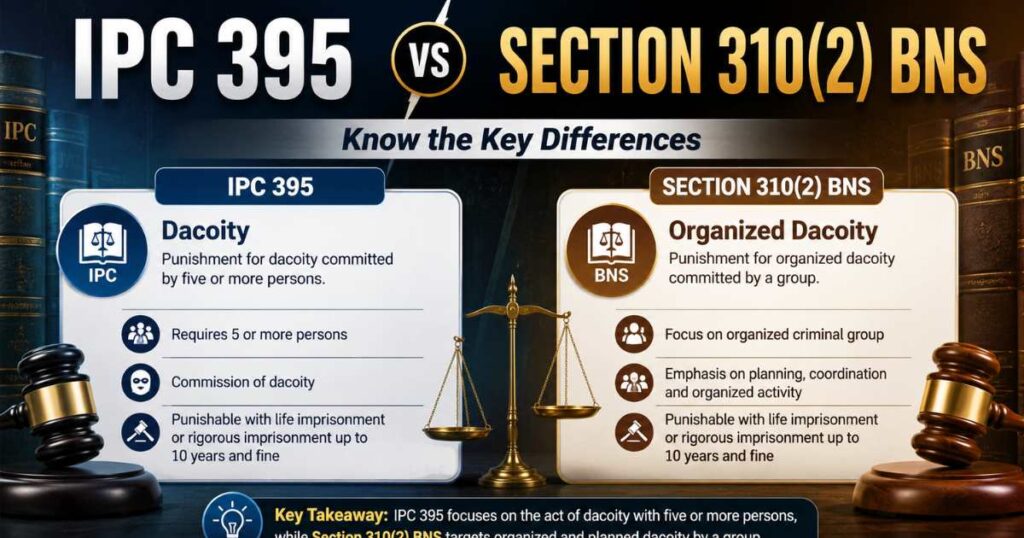
While the substantive punishment remains largely unchanged, the procedural and evidentiary landscape around the offence has shifted considerably under the accompanying Bharatiya Nagarik Suraksha Sanhita (BNSS) and Bharatiya Sakshya Adhiniyam (BSA).
| Aspect | IPC 395 (Old Law) | Section 310(2) BNS (New Law) |
| Governing Code | Indian Penal Code, 1860 | Bharatiya Nyaya Sanhita, 2023 |
| Punishment | Life imprisonment or up to 10 years rigorous imprisonment + fine | Same life imprisonment or up to 10 years rigorous imprisonment + fine |
| Related sections | Spread across Ss. 391, 395, 396, 399, 400, 402 | Consolidated under Section 310 (sub-sections) |
| Forensic requirement | Not mandatory in most states | Mandatory forensic visit and videography (Section 176 BNSS) |
| Search/seizure recording | Discretionary | Videography of recovery strongly encouraged/required |
| Trial code | Code of Criminal Procedure (CrPC) | Bharatiya Nagarik Suraksha Sanhita (BNSS) |
| Evidence law | Indian Evidence Act, 1872 | Bharatiya Sakshya Adhiniyam (BSA), 2023 |
| Bail/custodial provisions | CrPC Chapter XXXIII | BNSS equivalent chapters, updated timelines |
Three Major Practitioner Shifts
- Mandatory forensic scene visits – For offences carrying a potential life sentence, such as dacoity, Section 176 BNSS makes it mandatory for a forensic expert to visit the crime scene, and for evidence collection to be videographed. This gives defence counsel a strong ground to challenge investigations where this step was skipped.
- Digital and videographic evidence – Recoveries, identification parades, and search proceedings increasingly rely on video documentation, which is now scrutinized closely under the BSA’s rules on digital evidence.
- Stricter procedural compliance at arrest and remand – BNSS timelines for filing charge sheets, producing accused persons, and completing investigation are tighter, directly impacting bail arguments.
Punishment Under Section 310(2) BNS
The punishment prescribed under Section 310(2) BNS is:
- Imprisonment for life, OR
- Rigorous imprisonment up to 10 years, AND
- Fine (mandatory in addition to either term of imprisonment)
Key classification details:
- Cognizable offence – police can arrest without a warrant
- Non-bailable offence – bail is not a matter of right
- Non-compoundable – parties cannot settle the case privately to end proceedings
- Triable by Court of Session – not a Magistrate’s court
Is Section 310(2) BNS Bailable?
No. Section 310(2) BNS is a non-bailable offence. Bail can only be granted by a competent court typically the Sessions Court or High Court after considering factors like the nature of the accusation, severity of punishment, evidence of participation, criminal antecedents, and possibility of the accused influencing witnesses or fleeing.
Courts generally examine:
- Whether the accused was named in the FIR or identified later
- Recovery of stolen property from the accused’s possession
- Role attributed (active participant vs. mere presence)
- Delay in FIR registration and consistency of witness statements
- Health, age, and flight risk of the accused
Bail Bond Amount Calculator
Bail bond amounts in dacoity cases vary significantly by state, court, and case facts, but practitioners commonly see the following ranges as a starting reference point:
| Factor | Typical Bail Bond Consideration |
| First-time accused, minor role | Lower end of Sessions Court discretion |
| Property recovered from accused | Bond amount often increased |
| Repeat offender / gang involvement | Higher bond + sureties demanded |
| Juvenile or aged accused | May attract relaxed conditions |
| Absconding history | Bail frequently denied outright |
Since no fixed statutory bail bond figure exists under Section 310(2) BNS, the final amount is entirely at the discretion of the Sessions Court or High Court based on case-specific facts.
Sessions Trial Procedure Under Section 310(2) BNS
FIR Registration & Recovery Videography
The process begins with FIR registration under Section 173 BNSS. Given the life-term potential, investigating officers are now required to ensure a forensic expert visits the scene and that recovery of stolen property, weapons, or other evidence is videographed as part of the mandatory documentation.
Arrest & Joint Personal Search
Arrests in dacoity cases often involve multiple accused persons apprehended together or in a series. Joint personal searches, seizure memos, and recovery panchnamas must be carefully documented, as procedural lapses here are a common ground for bail and later for trial-stage challenges.
Bail Application
Given the non-bailable nature of the offence, a formal bail application before the Sessions Court (or Magistrate for interim relief in limited circumstances) is essential. Strong bail applications focus on inconsistencies in identification, absence of recovery, and delay in naming the accused.
Committal to Sessions Court
Since dacoity is triable exclusively by the Court of Session, the Magistrate commits the case after completion of investigation and filing of the charge sheet (final report) under the applicable BNSS provisions.
Sessions Trial
The Sessions trial follows the standard structure framing of charges, prosecution evidence, statement of the accused, defence evidence, and final arguments but now governed by BNSS timelines and BSA evidentiary standards, including stricter rules on electronic and video evidence admissibility.
Collective Liability and Identity
A defining feature of dacoity is collective liability. Under Section 310(1) BNS, even a person who is merely present and aids the commission of the offence without directly committing violence or theft can be held liable as a dacoit, provided the total number of participants (active and aiding) is five or more. However, courts have consistently clarified that innocent bystanders who happen to be present cannot be automatically implicated; there must be some act or omission demonstrating participation or facilitation.
Difference Between IPC 392, IPC 397 & IPC 395 in BNS
| Old IPC Section | New BNS Section | Offence | Key Distinguishing Factor |
| IPC 392 | Section 309 BNS | Robbery | Committed by fewer than 5 persons |
| IPC 395 | Section 310(2) BNS | Dacoity | Committed by 5 or more persons |
| IPC 397 | Section 309(6) / (7) BNS (aggravated robbery) | Robbery/dacoity with deadly weapon or attempt to cause death/grievous hurt | Use of deadly weapon during the act |
The core distinction between robbery and dacoity remains purely numerical five or more persons acting conjointly converts robbery into dacoity. The use of a deadly weapon or infliction of grievous hurt during the act (formerly IPC 397) now attracts enhanced minimum sentencing provisions within the restructured BNS framework.
Important Judicial Interpretations
Courts, even post-BNS implementation, continue to rely on long-settled principles from IPC-era dacoity jurisprudence:
- Mere presence at the scene does not automatically make a person a dacoit; some act, omission, or common intention must be shown.
- If fewer than five persons are proven to have participated, the charge may be reduced from dacoity to robbery.
- Show of force sufficient to terrify victims into non-resistance satisfies the requirement of force, even without actual physical violence.
- Courts have exercised inherent powers to quash dacoity charges where “dishonest intention” was absent and parties reached an amicable settlement, particularly in property/civil-dispute-adjacent facts.
Critical Pitfalls for Practitioners
- Skipping forensic documentation – Failure to conduct a mandatory forensic visit or videograph recovery under Section 176 BNSS can be used to challenge the investigation at the remand or trial stage.
- Weak identification evidence – Relying solely on delayed test identification parades without corroborating recovery evidence weakens the prosecution’s case.
- Ignoring the “five or more” threshold – Defence counsel should always scrutinize whether the prosecution has actually established five or more participants, including those alleged to be “aiding.”
- Overlooking compounding restrictions – Since the offence is non-compoundable, settlement between parties does not automatically end proceedings; a formal quashing petition is required.
- Mismanaging bail timelines – Missing statutory deadlines for charge sheet filing under BNSS can be leveraged for default bail applications.
Trial and Defense Strategy
A strong defence in Section 310(2) BNS cases typically builds around:
- Challenging the “chain of information” and procedural compliance at every stage FIR, arrest, search, and recovery
- Testing whether forensic and videography mandates under Section 176 BNSS were actually followed
- Highlighting inconsistencies in witness identification and recovery panchnamas
- Arguing for reduction to the lesser offence of robbery where the five-person threshold isn’t firmly established
- Pursuing bail aggressively given the severe custodial consequences of a life-term offence
Legal Excellence
Handling a Section 310(2) BNS matter demands precision from the first remand hearing to final arguments in the Sessions trial. Advocates who stay updated on BNSS procedural timelines and BSA evidentiary standards are better positioned to secure favourable outcomes for their clients, whether that means bail, charge reduction, or acquittal.
Get High-Stakes Criminal Leads
Criminal lawyers building a practice around serious offences like dacoity, robbery, and organized property crime can benefit from platforms that connect them with clients actively searching for experienced Sessions-trial counsel in their city.
FAQ’s
395 IPC in BNS in Hindi
IPC धारा 395 (डकैती के लिए दंड) अब BNS की धारा 310(2) के अंतर्गत आती है, जो 1 जुलाई 2024 से प्रभावी है।
395 IPC Section Details
Section 395 IPC dealt with punishment for dacoity robbery committed by five or more persons acting together, now covered under Section 310(2) BNS.
395 IPC Punishment
Life imprisonment, or rigorous imprisonment up to 10 years, along with a mandatory fine.
395 IPC Bailable or Not
No, it is a non-bailable offence; bail is granted only at the court’s discretion after considering case facts.
397 IPC in BNS
IPC 397 (robbery/dacoity with deadly weapon or attempt to cause death) now falls under the aggravated sub-sections of Section 309/310 BNS with enhanced minimum sentencing.
IPC 395 and 397 Difference
IPC 395 covers basic dacoity by five or more persons, while IPC 397 dealt specifically with cases involving deadly weapons or attempts to cause death or grievous hurt during the offence.
392 IPC in BNS
IPC 392 (robbery) has been replaced by Section 309 BNS, applicable when fewer than five persons commit the offence.
310(2) BNS in IPC
Section 310(2) BNS corresponds to the erstwhile Section 395 IPC, which prescribed punishment for dacoity.
More Guides in This Category
- IPC 392 in BNS: Robbery Punishment & Bail Explained
- IPC 397 in BNS: Deadly Weapon Robbery Provisions
- BNS Section 309: Complete Guide to Robbery Law
- BNSS Bail Procedure: Step-by-Step for Non-Bailable Offences
Conclusion
The shift from IPC 395 to Section 310(2) BNS reflects India’s broader move toward a more structured, forensic-driven, and procedurally rigorous criminal justice framework. While the punishment for dacoity life imprisonment or up to ten years of rigorous imprisonment with fine remains substantially unchanged, the surrounding investigative and trial process has evolved significantly under the BNSS and BSA.
For practitioners, the real shift lies not in the punishment clause itself but in procedural compliance: mandatory forensic visits, videographed recoveries, and stricter evidentiary standards now shape how dacoity cases are built and defended. Staying current with these changes isn’t optional for anyone handling Sessions trials in 2026 it’s the difference between a case won on merit and one lost on a missed procedural safeguard. Whether you’re drafting a bail application or preparing trial strategy, anchoring your approach in the updated BNS-BNSS-BSA framework is now essential.
