

Legal Excellence
If you’re a criminal defense lawyer, you’ve probably had a dozen conversations this year that start the same way: “Wait, which section is this under now?” That confusion is real, and it’s costing practitioners time in courtrooms across India. Understanding 354 IPC in BNS isn’t just an academic exercise anymore it’s a daily necessity. Every FIR, every bail application, and every cross-examination now hinges on getting the new numbering right.
This shift from the Indian Penal Code to the Bharatiya Nyaya Sanhita touched almost every offence on the books, but few changes matter as much to everyday practice as the one affecting assault and criminal force against women. Lawyers who still cite the old code risk delays, objections, and worse a client who pays the price for an outdated citation. So let’s walk through exactly what changed, why it changed, and how you can use that knowledge to build a sharper defense.
Section 74 BNS: Modesty and Force
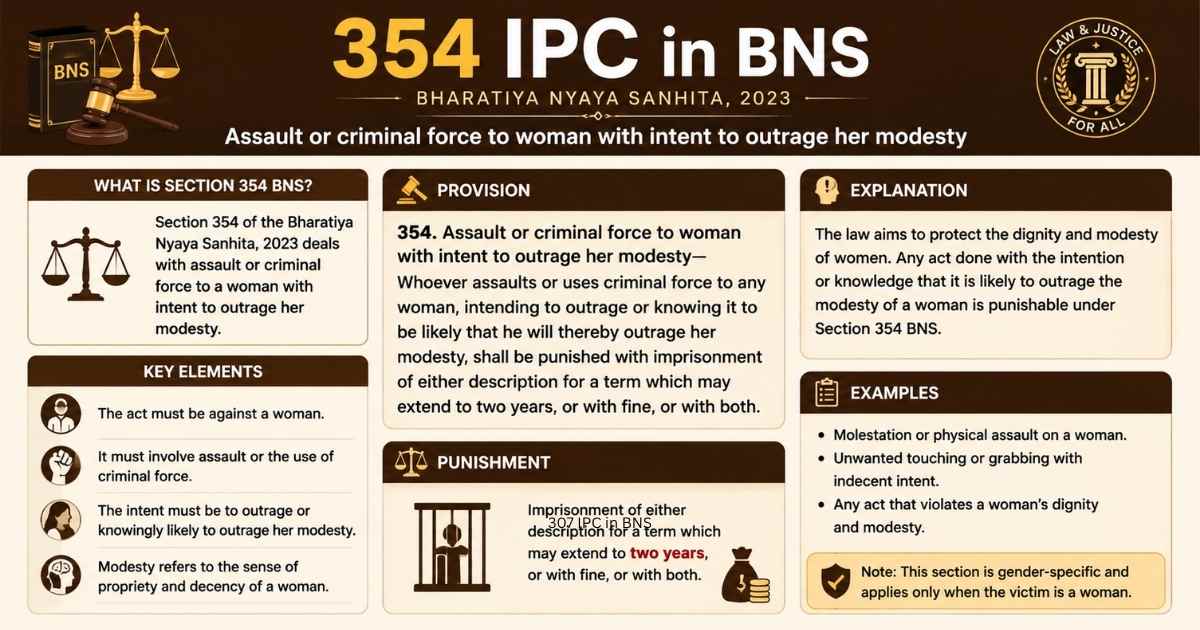
Section 74 of the Bharatiya Nyaya Sanhita now covers what most lawyers know instinctively as the old “modesty” offence. It criminalizes assault or criminal force against a woman when the accused intends to outrage her modesty, or knows that his actions are likely to do so. In plain terms, it’s about protecting women from physical acts touches, grabs, shoves carried out with a degrading intent, not just any accidental brush in a crowded space.
The punishment structure hasn’t softened. You’re looking at a mandatory minimum of one year, extending up to five years, and this offence remains non-bailable. That non-bailable tag is crucial it means your client can be arrested first and argue for bail later, which changes your entire strategy from the moment the FIR is filed. Magistrates handle these trials, and the bar for proving intent stays high, which is exactly where a skilled defense earns its value.
Key Changes from IPC 354
The move from IPC 354 to BNS 74 wasn’t just a renumbering exercise it brought real procedural weight with it. The biggest shift practitioners notice immediately is the mandatory fine. Courts no longer have discretion to skip it; the law now says “and fine,” full stop. In 2026, judges are increasingly treating this fine as direct compensation for the victim’s mental harassment, rather than a token penalty.
Digital evidence has also taken center stage. IPC 354 to BNS 74 cases today lean heavily on dashcam footage, smartphone videos, and CCTV recordings, all treated as primary evidence under Section 61 of the Bharatiya Sakshya Adhiniyam. If your client swears the incident was nothing more than an accidental bump on a packed bus, that footage might be the single strongest thing standing between him and a conviction.
Related post: 303(2) BNS = IPC 379 (Theft): Bailable Below ₹5,000 + Community Service 2026
Three Major Practitioner Shifts:
Beyond the fine and the digital evidence rules, there’s a third change that quietly reshapes how defense counsel operates: victim statement privacy. The BNSS strengthens confidentiality around the victim’s recorded statement, so as defense counsel, you need to be proactive. Make sure you formally request the complete Section 183 BNSS statement what used to be the old Section 164 CrPC statement during document supply under Section 230 BNSS. Missing this step early can leave you scrambling later in trial.
Arrest and Bail Procedure
Because Section 74 remains a non-bailable offence, the procedural roadmap moves fast, and you need to move faster. It starts with the FIR and victim statement, recorded first by police under Section 180 BNSS and then, where relevant, by a Magistrate under Section 183 BNSS. These two statements need to align closely, because any inconsistency between them often becomes the backbone of a defense argument later.
From there, the police typically arrest the accused and must produce him before a Magistrate within 24 hours there’s no wiggle room on that timeline. Counsel then files for bail, and this is where the real advocacy begins. Highlighting false implication due to personal enmity, or pointing to CCTV logs that show an absence of force, can genuinely tip the scales. If digital evidence like videos or messages enters the picture, it goes to the Forensic Science Laboratory, and under the Bharatiya Sakshya Adhiniyam, a Section 63 certificate becomes mandatory for that evidence to hold up. Finally, the case proceeds to trial by Magistrate, following the warrant procedure, where the victim’s deposition during examination-in-chief usually becomes the single most decisive moment in the entire case.
FIR & Victim Statement
The process begins the moment the FIR is registered and statements are taken under Sections 180 and 183 BNSS, setting the factual foundation for everything that follows.
Arrest & Remand
Given the non-bailable status, police move quickly to arrest and must present the accused before a Magistrate within a strict 24-hour window.
Bail Application
Defense counsel files under Section 481 BNSS, and success often depends on proving false implication or an absence of force through solid documentary evidence.
Forensic Analysis
Any digital evidence gets routed to the FSL, and a Section 63 BSA certificate is non-negotiable if the prosecution wants that evidence admitted.
Trial by Magistrate
The matter follows the warrant trial procedure, with the victim’s testimony during examination-in-chief typically carrying the greatest weight in the courtroom.
Challenging ‘Intent to Outrage’
Winning a Section 74 BNS case for the defense almost always comes down to one question: can the prosecution prove intent, or at least knowledge that the act was likely to outrage modesty? Without that culpable mental state, the charge simply doesn’t hold. This is where the “social interaction” or “accidental contact” defense becomes so valuable. Think about it a packed metro, a crowded market, a jostling queue. Physical contact happens constantly in these settings without any intent behind it, and courts recognize that reality.
CCTV footage, preserved under Section 61 of the Bharatiya Sakshya Adhiniyam, often becomes the clearest way to show the innocent nature of a movement. It’s also worth remembering that if the allegation only involves words or gestures, with no actual force, the case may belong under Section 79 BNS insulting a woman’s modesty which is bailable and caps out at three years, a very different playing field than the non-bailable Section 74. Beyond that, a digital alibi built from GPS data or mobile tower logs can prove your client wasn’t even at the scene, and unfortunately, false implication in these cases remains a documented pattern in property disputes and marital conflicts. Even a simple delay in filing the FIR anything beyond three days without solid justification can cast real doubt on how “spontaneous” the complaint actually was.
Critical Pitfalls for Practitioners
Even experienced lawyers slip up during this transition, and small errors carry big consequences. The most common mistake? Still citing 354 IPC in bail applications or pleadings. Courts expect Section 74 BNS now, and old citations create unnecessary procedural friction that can delay your client’s relief.
Another frequent oversight is failing to secure video evidence in time. If CCTV footage exists near the scene and police haven’t seized it, file an application under Section 94 BNSS immediately evidence has a way of disappearing if nobody moves quickly. You should also push back firmly against unnecessary police custody remand requests; modesty offences rarely require “recovery” of any item, so there’s little justification for custody beyond what Section 187 BNSS truly demands. And whenever the prosecution relies on a viral video or forwarded clip, don’t let it slide without a Section 63 BSA certificate from the original uploader without it, that evidence shouldn’t be treated as reliable. Lastly, retire your old templates. Document supply now runs through Section 230 BNSS, and trial commencement follows Section 248 BNSS, so using outdated formats only slows your own case down.
Trial and Evidence Strategy
Cross-examining the victim in these cases demands a careful balance you need to be firm without losing the courtroom’s sympathy. Focus your questions on the sequence of events and whether the account stays consistent between the Section 180 and Section 183 BNSS statements. Any meaningful contradiction or sudden “improvement” in the story can become solid ground for acquittal, but it has to be handled with precision, not aggression.
It also helps enormously to establish context around the relationship between the parties. If there’s a documented history of civil or criminal disputes between the complainant’s family and your client, bring those records into evidence they help paint a picture of motive for false implication. Because Section 74 is non-bailable, don’t wait for an arrest to happen before acting; file for anticipatory bail under Section 482 BNSS the moment you sense an FIR is coming. Courts in 2026 remain genuinely sensitive to real victims, but they’re also increasingly alert to the misuse of modesty laws, so a well-documented anticipatory bail application can make a real difference. And if the facts point toward sexual harassment, disrobing, voyeurism, or stalking instead, check Sections 75 through 78 BNS the older 354A through 354D provisions since the legal requirements and defenses shift considerably across these related offences.
Conclusion
The transition from 354 IPC in BNS 74 is more than a numbering update it reshapes bail strategy, evidence handling, and trial procedure in ways that directly affect outcomes. Lawyers who master this mapping, stay current on BNSS timelines, and understand the growing role of digital evidence under the Bharatiya Sakshya Adhiniyam will consistently build stronger, faster defenses for their clients.
Staying sharp on these changes isn’t optional anymore it’s what separates a competent defense from a great one. The sooner you fold these updates into your everyday practice, the better positioned you’ll be the next time a client walks through your door facing a Section 74 charge.
