
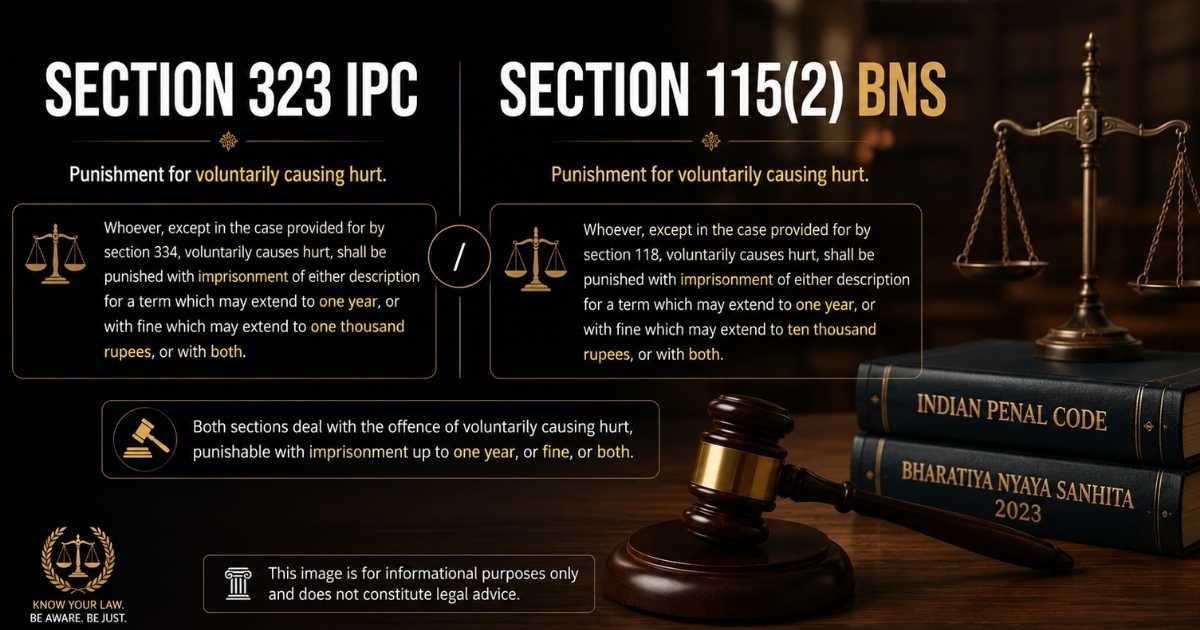

Section 323 IPC / 115(2) BNS deals with voluntarily causing hurt. It covers slaps, scuffles, and minor injuries. Many people search for Section 323 IPC / 115(2) BNS after a police complaint. Others search for it before filing one. This law explains punishment. It explains bail rights. It explains court procedure. Section 323 IPC / 115(2) BNS is common in daily criminal cases. Courts see it often. Lawyers handle it often. The old law was Section 323 IPC. The new law is Section 115(2) BNS. Both cover the same offence.
This guide explains Section 323 IPC / 115(2) BNS in simple words. It explains bail status. It explains punishment. It explains legal rights. Section 323 IPC / 115(2) BNS is bailable. It is non-cognizable. This means police need a warrant to arrest. Read on to understand Section 323 IPC / 115(2) BNS fully.
Legal Excellence
| Parameter | Detail |
| ⚖️ BNS Section | 115(2) |
| ⚖️ Punishment | Up to 1 year imprisonment, or fine up to ₹10,000, or both |
| ⚖️ Bail Status | Bailable |
| ⚖️ Cognizability | Non-Cognizable |
| ⚖️ Triable By | Any Magistrate |
| ⚖️ Compoundable | Yes, with court permission |
Section 115(2) BNS: Voluntarily Causing Hurt
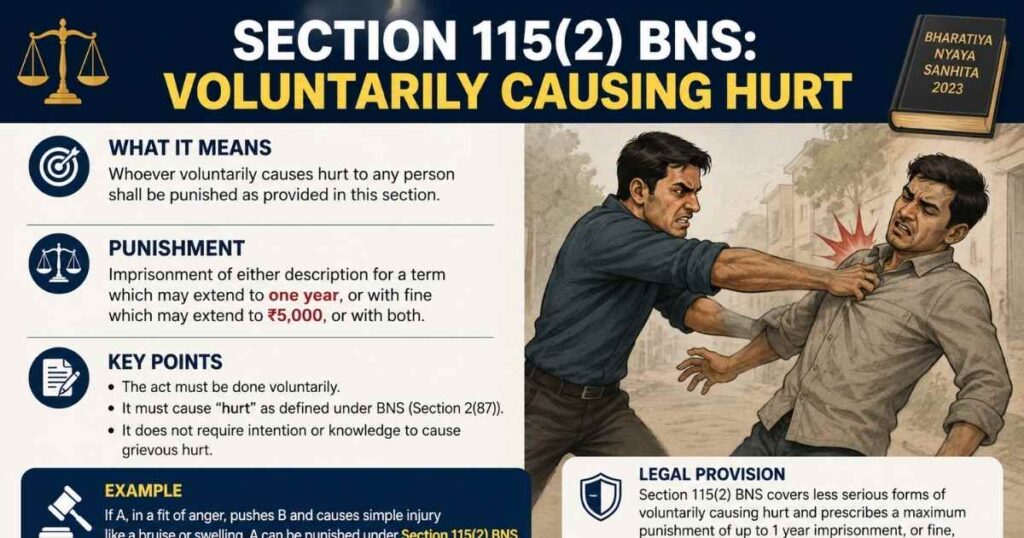
Section 115 of the BNS is split into two parts. Section 115(1) defines what it means to “voluntarily cause hurt” essentially, doing an act with the intention of causing hurt, or with the knowledge that the act is likely to cause hurt, and the act actually does cause hurt. Section 115(2) lays down the punishment for this offence.
In plain terms, “hurt” means bodily pain, disease, or infirmity caused to another person. The offence does not require a weapon or serious injury a slap, a shove, a punch, or a minor scuffle that leaves a bruise can all attract this section, provided there was intent or knowledge behind the act.
The two ingredients a court looks for are:
- Intention or knowledge the accused either meant to cause hurt or knew the act was likely to cause it.
- Actual hurt caused the act must have resulted in real bodily pain, injury, or discomfort, not just mental distress.
Accidental or unintentional harm does not fall within this section. If two people collide by accident and one is injured, that is not voluntarily causing hurt under Section 115.
Related post: BNS Section 191(2) क्या है? झूठी गवाही देना – सजा, जमानत और पूरी जानकारी हिंदी में
Key Changes from IPC 323
The core definition of the offence hasn’t changed much between the IPC and the BNS. What has changed is the financial penalty and the surrounding procedural framework.
| Element | IPC 323 (Old) | BNS 115(2) (New) |
| Hurt definition | Section 319 IPC | Section 115(1) BNS |
| Punishment clause | Section 323 IPC | Section 115(2) BNS |
| Maximum fine | ₹1,000 | ₹10,000 |
| Maximum imprisonment | 1 year | 1 year |
| Cognizability | Non-Cognizable | Non-Cognizable |
| Bail status | Bailable | Bailable |
| Triable by | Any Magistrate | Any Magistrate |
Three Major Practitioner Shifts:
- Higher fine ceiling. The jump from ₹1,000 to ₹10,000 gives Magistrates more room to use the fine as compensation for the victim’s medical expenses, rather than treating it as a token penalty.
- Digital evidence requirements. Where an alleged act of hurt is captured on a phone camera or CCTV, the prosecution must now produce the certificate required under the Bharatiya Sakshya Adhiniyam (BSA) to authenticate that electronic evidence before it can be relied on in court.
- Compounding procedure. The offence remains compoundable, meaning the parties can settle. Courts increasingly permit this settlement to be recorded through remote or video verification when the complainant and accused live in different cities, though this is done at the court’s discretion.
Non-Cognizable Procedure & NBW
Because Section 115(2) BNS is a non-cognizable offence, the police cannot register an FIR or arrest the accused on their own initiative. The procedure instead runs through the Magistrate’s court under the Bharatiya Nagarik Suraksha Sanhita (BNSS).
NCR Recording
When a complaint of simple hurt is brought to a police station, the officer records it as a Non-Cognizable Report (NC/NCR) in the daily diary. No investigation or arrest can follow unless a Magistrate specifically directs it.
Complaint Case
Since the police route is limited, the complainant typically files a private complaint directly before the Magistrate. The Magistrate examines the complainant and any witnesses on oath before deciding whether to proceed.
Summons and NBW
If the Magistrate takes cognizance, the court issues a summons to the accused. Repeated non-appearance can escalate matters the court may issue a bailable warrant first, and a non-bailable warrant (NBW) if the accused continues to avoid court.
Simple Bail
As a bailable offence, the accused has a statutory right to bail. There is no need to argue the merits of the case; furnishing a personal bond and, where required, a surety is generally sufficient for the Magistrate to grant bail.
Summary Trial
Given the minor nature of the offence, courts often try Section 115(2) cases summarily, which is intended to keep the proceedings short and get them resolved within a matter of months rather than years.
Defending Against ‘Simple Hurt’ Allegations
Most Section 115(2) cases turn on two things: what actually happened, and what the medical evidence shows. Common defense angles include:
- Right of private defense. If the hurt was caused while resisting an unlawful assault, the general exceptions relating to private defense may apply, potentially taking the act outside the scope of a punishable offence.
- Absence of medical findings. If the medico-legal certificate (MLC) records no visible injury no swelling, redness, or tenderness it becomes difficult for the prosecution to establish that “bodily pain” or “infirmity” was actually caused. Mental distress alone does not amount to hurt under this section.
- Alibi through digital records. Location history, mobile tower data, or timestamped footage can sometimes establish that the accused was not present at the scene when the alleged incident occurred.
- Testing witness consistency. In many hurt cases, the only witnesses are relatives or close associates of the complainant. Careful cross-examination on the exact sequence of events often reveals inconsistencies that weaken the prosecution’s version.
Critical Pitfalls for Practitioners
A few recurring mistakes can derail an otherwise straightforward Section 115(2) matter:
- Using outdated citations. Referring to “Section 323 IPC” in pleadings filed after the BNS came into force can create unnecessary confusion and invite objections from the bench.
- Overlooking illegal arrests. Because the offence is non-cognizable, any arrest made without a Magistrate’s warrant is legally questionable and can be challenged separately.
- Ignoring the timing of the medical exam. A medical examination conducted several days after the alleged incident weakens the link between the injury and the accused, since an intervening cause cannot be ruled out.
- Unrecorded compromises. A settlement between the parties should always be formally recorded before the court under the compounding provisions; an informal compromise leaves the door open for the complaint to be revived later.
Trial and Evidence Strategy
A few practical habits make a real difference in how these cases play out:
- Consider plea bargaining where the evidence against the accused is strong. This route, available for minor offences, can help reduce the eventual penalty and, in some circumstances, avoid a lasting criminal record.
- Question the age of the injury. If the MLC describes the injury as several days old while the complaint claims it happened recently, that gap is worth probing during cross-examination of the treating doctor.
- Keep an anticipatory bail draft ready. Even in a bailable matter, a missed court date can lead to an NBW being issued in a hurry. Having the paperwork prepared in advance saves time if that happens.
- Track the injury classification closely. If the MLC later upgrades the injury from simple to grievous for example, a fracture or an injury causing severe, prolonged pain the case may move out of Section 115(2) altogether and into a more serious provision.
FAQs
Is Section 115(2) BNS a bailable offence?
Yes. It is bailable, and the accused has a right to bail on furnishing a bond, without needing to argue the case on merits.
Can the police arrest someone directly under Section 115(2) BNS?
No. It is non-cognizable, so police generally need a Magistrate’s warrant before making an arrest.
What is the maximum punishment under Section 115(2) BNS?
Imprisonment of up to one year, a fine of up to ₹10,000, or both.
Is Section 115(2) BNS the same as Section 323 IPC?
They cover the same offence with the same maximum jail term, but the BNS raises the maximum fine from ₹1,000 to ₹10,000.
Can a Section 115(2) BNS case be settled out of court?
Yes, it is compoundable with the permission of the court, and the settlement should be formally recorded.
Conclusion
Section 323 IPC / 115(2) BNS covers minor hurt cases. It replaced the old IPC law with a new BNS law. Section 323 IPC / 115(2) BNS is bailable. It is non-cognizable. Police need a Magistrate’s warrant to arrest. The fine under Section 323 IPC / 115(2) BNS is higher now. It can go up to ₹10,000.
Anyone facing a Section 323 IPC / 115(2) BNS case should know their rights. Bail is easy to get. Compromise is possible with court approval. Lawyers should always cite Section 323 IPC / 115(2) BNS correctly. This keeps the case strong and avoids confusion in court.
